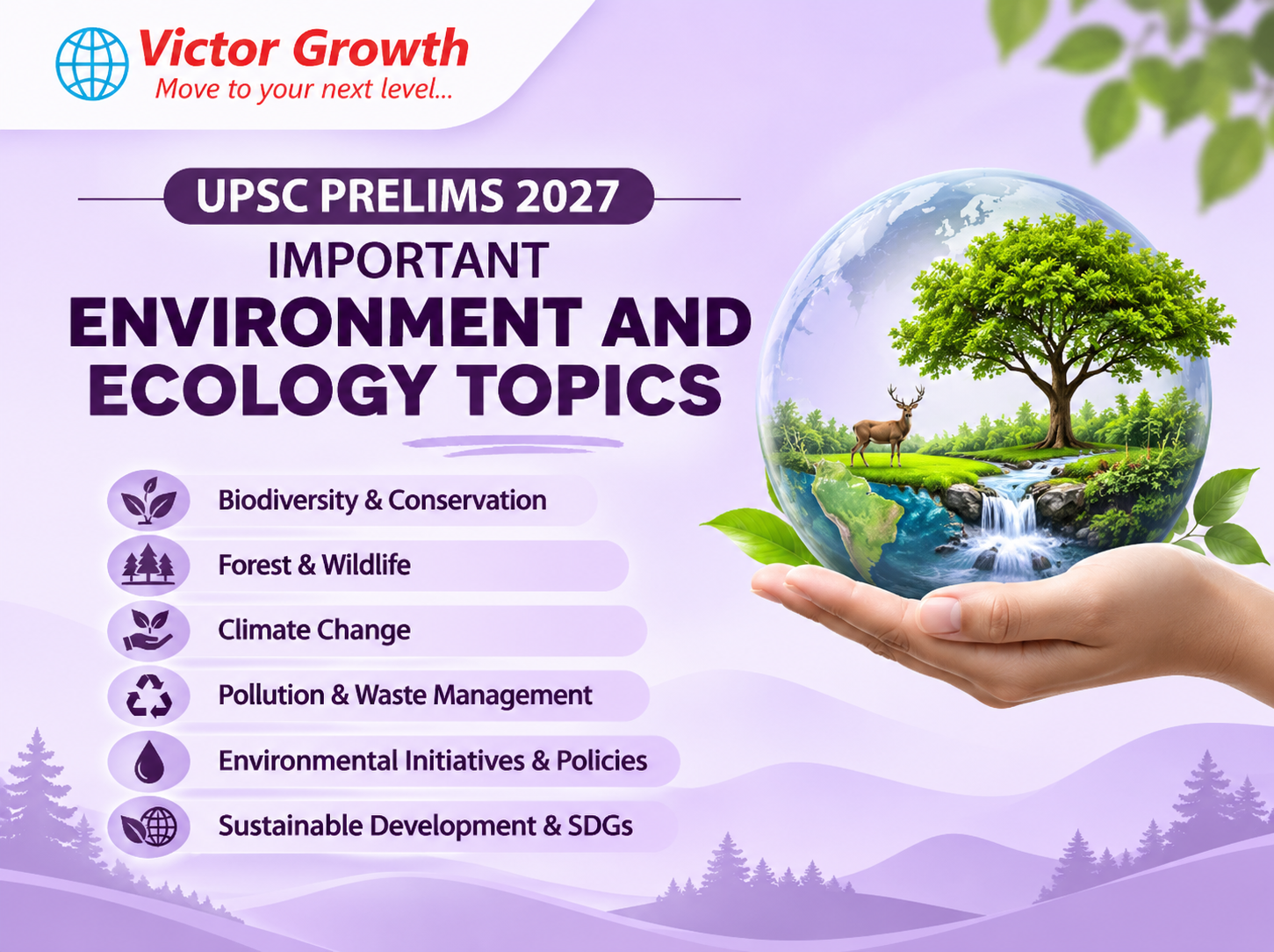
Environment and Ecology is an important area of General Studies Paper I in the UPSC Civil Services Preliminary Examination. It covers biodiversity, ecosystems, climate change, environmental conservation, pollution, and international environmental agreements. Questions often test both basic concepts and their connection with current affairs.
For UPSC Prelims 2027 aspirants, preparing Environment and Ecology requires a combination of conceptual understanding, factual knowledge, and regular revision. This guide highlights the important topics to focus on and provides a practical preparation strategy.
1. Understand the Environment and Ecology Syllabus
Before starting preparation, divide the subject into important sections.
Ecology and ecosystem.
Biodiversity and conservation.
Environmental pollution.
Climate change and global warming.
Natural resources and sustainable development.
Environmental laws and policies.
International environmental conventions.
Protected areas and wildlife conservation.
Understanding these areas helps candidates organise their preparation and identify important topics.
2. Important Ecology and Ecosystem Topics
Ecology deals with the relationship between living organisms and their environment. It is important to understand the basic concepts before studying advanced environmental issues.
Focus on:
Ecosystem structure and functions.
Food chains and food webs.
Ecological pyramids.
Energy flow and nutrient cycles.
Ecological succession.
Biomes and habitats.
Carbon, nitrogen, and water cycles.
Biodiversity and ecological balance.
Preparation Tip: Use diagrams and examples to understand ecological relationships. This makes difficult concepts easier to remember.
3. Biodiversity and Conservation
Biodiversity is an important area of Environment and Ecology preparation. Candidates should understand the different levels of biodiversity and the methods used to protect natural ecosystems.
Important topics include:
Genetic, species, and ecosystem diversity.
Biodiversity hotspots.
Endangered and endemic species.
IUCN Red List categories.
National parks and wildlife sanctuaries.
Biosphere reserves.
Wildlife conservation programmes.
In-situ and ex-situ conservation.
Pay particular attention to important protected areas in India, their locations, and the species associated with them.
4. Climate Change and Global Environmental Issues
Climate-related developments frequently connect with environmental concepts and international agreements.
Important topics include:
Global warming and greenhouse gases.
Climate change causes and impacts.
Carbon emissions and carbon sinks.
Ozone layer depletion.
Ocean acidification.
Desertification.
Sea-level rise.
Climate adaptation and mitigation.
Renewable energy and carbon neutrality.
Preparation Tip: Connect these concepts with current affairs, climate reports, and major international climate conferences.
5. Environmental Pollution and Its Control
Candidates should understand different types of pollution, their causes, consequences, and control measures.
Focus on:
Air pollution and particulate matter.
Water and marine pollution.
Soil pollution.
Noise pollution.
Plastic and electronic waste.
Industrial pollution.
Waste management methods.
Environmental impact assessment.
Study important Indian environmental laws and the institutions responsible for pollution control.
6. Important Environmental Conventions and Organisations
International agreements and environmental organisations are important areas for UPSC preparation.
Convention or Organisation | Main focus |
|---|---|
UNFCCC | International climate change cooperation |
Paris Agreement | Climate action and emission reduction efforts |
Convention on Biological Diversity (CBD) | Biodiversity conservation |
CITES | International trade in endangered species |
Ramsar Convention | Conservation of wetlands |
Montreal Protocol | Protection of the ozone layer |
UN Convention to Combat Desertification (UNCCD) | Combating desertification and land degradation |
Also understand the roles of organisations such as UNEP, IUCN, IPCC, and WWF.
7. Important Indian Environmental Programmes
Prepare major Indian initiatives related to environmental protection and conservation.
Important areas include:
Project Tiger.
Project Elephant.
National Biodiversity Action Plan.
National Action Plan on Climate Change.
Green India Mission.
National Clean Air Programme.
Wetland conservation initiatives.
Wildlife Protection Act and Environment Protection Act.
Focus on the objectives, implementing institutions, and important features of each initiative.
8. How to Prepare Environment and Ecology for UPSC Prelims 2027
A systematic preparation strategy helps candidates cover the subject efficiently.
Recommended resources:
Environment by Shankar IAS Academy.
NCERT Biology textbooks for ecological fundamentals.
Previous-year UPSC question papers.
Reliable newspapers and monthly current affairs materials.
Follow these preparation habits:
Understand basic ecological concepts first.
Prepare short notes on important species and protected areas.
Revise environmental conventions and Indian laws.
Connect current affairs with static concepts.
Practise topic-wise MCQs and previous-year questions.
Attempt mock tests and analyse mistakes.
9. Choosing the Best UPSC Coaching in Kerala
Proper guidance can help aspirants understand environmental concepts and stay updated with important developments.
When searching for the best UPSC coaching in Kerala, consider:
Experienced faculty with subject knowledge.
Complete Environment and Ecology syllabus coverage.
Updated current affairs materials.
Regular MCQ practice and mock tests.
Clear explanations of environmental conventions and laws.
Doubt-clearing and revision sessions.
A good coaching programme should encourage conceptual learning and consistent self-study.
Frequently Asked Questions (FAQs)
1. Is Environment and Ecology important for UPSC Prelims 2027?
Yes. It is an important part of General Studies Paper I and includes ecology, biodiversity, conservation, climate change, pollution, and environmental agreements.
2. Which book is best for Environment and Ecology preparation?
Environment by Shankar IAS Academy is a widely used reference. NCERT Biology textbooks are useful for understanding basic ecological concepts.
3. Which topics should beginners study first?
Start with ecosystems, food chains, biodiversity, conservation, and basic environmental concepts. Then move to climate change, pollution, conventions, and environmental laws.
4. Is current affairs important for Environment preparation?
Yes. Follow news about endangered species, national parks, climate conferences, environmental policies, and conservation initiatives.
5. How can I remember international environmental conventions?
Prepare a comparison table containing each convention’s year, location, objective, and area of focus. Revise it regularly.
6. How can I find the best UPSC coaching in Kerala for Environment preparation?
Compare faculty experience, study materials, current affairs support, mock tests, syllabus coverage, and revision guidance before selecting an institute.
Conclusion
Environment and Ecology preparation for UPSC Prelims 2027 requires a clear understanding of ecological concepts, biodiversity, environmental laws, and international agreements. Start with the basics, use reliable study materials, connect current affairs with static topics, and practise MCQs regularly. With consistent revision and suitable academic guidance, aspirants can strengthen their General Studies preparation and approach the examination with confidence.