
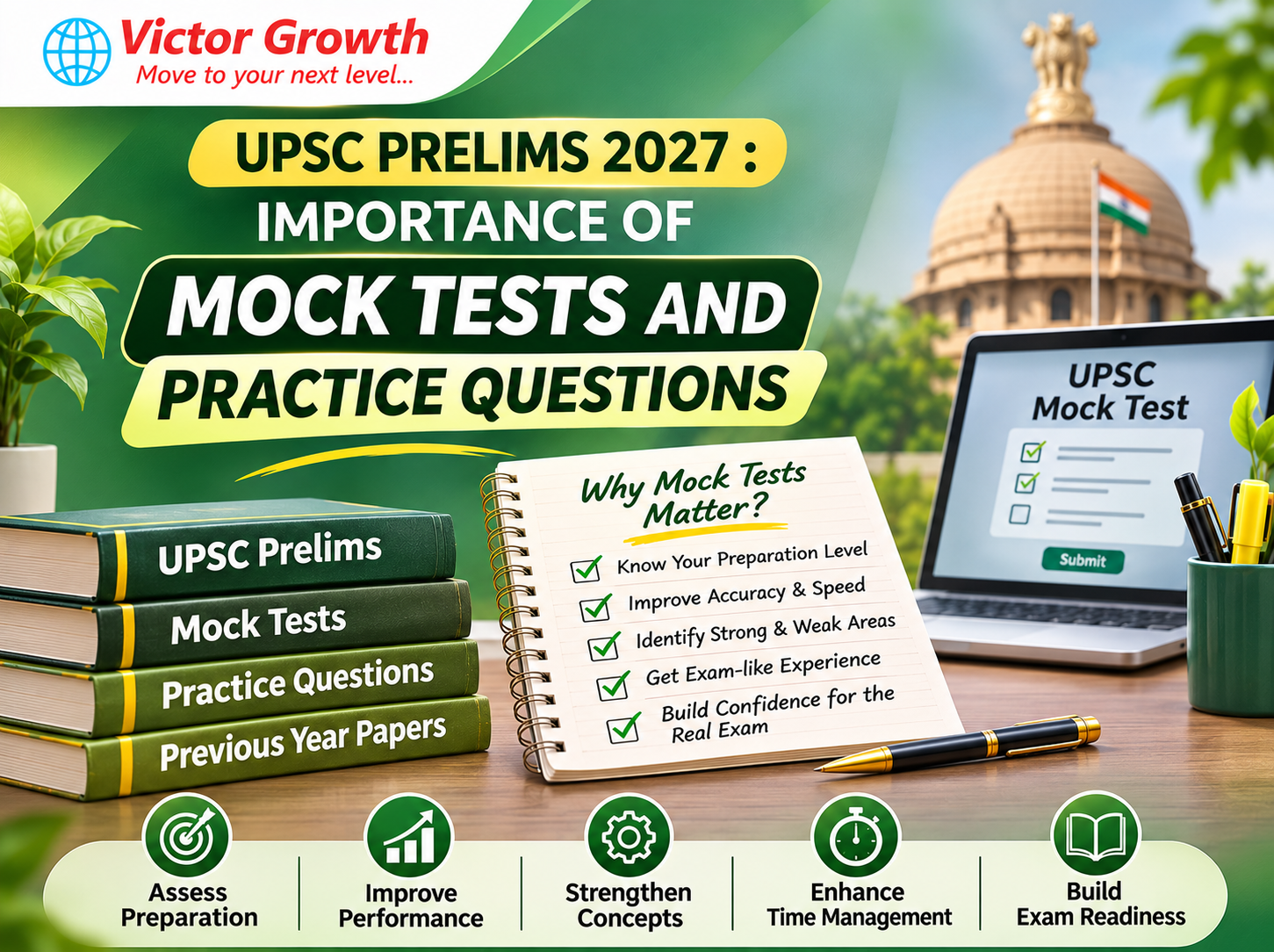
Preparing for UPSC Civil Services Prelims 2027 requires more than reading textbooks and studying current affairs. Aspirants must regularly practise questions and evaluate their preparation through mock tests. Even candidates with good subject knowledge may struggle to clear Prelims if they lack accuracy, time management, and question-solving skills.
Mock tests and practice questions help candidates understand the UPSC examination pattern, identify weak areas, improve accuracy, and build confidence. Including them in your daily preparation routine can make a significant difference in your performance.
1. Why Are Mock Tests Important for UPSC Prelims 2027?
Mock tests are designed to simulate the actual UPSC examination. They help aspirants evaluate their preparation under examination-like conditions.
Important benefits include:
Understand the Exam Pattern: Become familiar with the question format, difficulty level, and examination structure.
Improve Time Management: Learn how to complete the paper within the allotted time.
Identify Weak Areas: Recognise subjects and topics that require additional attention.
Improve Accuracy: Reduce careless mistakes and unnecessary guessing.
Build Confidence: Regular practice helps reduce examination anxiety.
Develop Elimination Skills: Learn to eliminate incorrect options in confusing questions.
2. Types of Practice Questions for UPSC Prelims
Aspirants should practise different types of questions to improve their overall preparation.
Subject-Wise Questions
Practise questions separately for History, Geography, Polity, Economy, Environment, and Science and Technology. This helps strengthen individual subjects.
Previous-Year Questions (PYQs)
Solve at least 10 years of available UPSC Prelims question papers to understand recurring themes, important concepts, and question patterns.
Current Affairs-Based Questions
Practise questions related to government schemes, international developments, economic policies, environmental issues, and scientific advancements.
CSAT Practice Questions
Prepare reading comprehension, logical reasoning, basic mathematics, and data interpretation. Remember that CSAT is a qualifying paper and requires a minimum of 33%.
3. How Often Should You Attempt Mock Tests?
The frequency of mock tests should depend on your preparation stage.
Preparation stage | Recommended practice |
|---|---|
Initial preparation | Topic-wise tests |
After completing subjects | Subject-wise mock tests |
Middle preparation stage | 1–2 full-length tests per week |
Final preparation stage | 2–3 full-length tests per week |
Do not focus only on the number of tests completed. Analysing your performance after every test is equally important.
4. How to Analyse Your Mock Test Performance
Taking a mock test without analysing the results reduces its effectiveness. After every test, spend sufficient time reviewing your answers.
Follow these steps:
Identify the questions you answered incorrectly.
Understand why the correct option is right.
Analyse why the other options are incorrect.
Identify topics where your concepts are weak.
Record important mistakes in a separate notebook.
Revise those topics before attempting the next test.
Classify your mistakes into conceptual errors, factual errors, misreading questions, and incorrect guessing. This will help you improve gradually.
5. Importance of Negative Marking and Accuracy
UPSC Prelims includes negative marking for incorrect answers. Therefore, attempting more questions does not always mean achieving a higher score.
To improve accuracy:
Read questions carefully before selecting an answer.
Pay attention to words such as incorrect, correct, only, and not.
Eliminate options that are clearly incorrect.
Avoid blind guessing.
Attempt questions where you have sufficient knowledge or a reasonable basis for elimination.
Practise maintaining a balance between speed and accuracy.
Remember, the objective is to maximise your score through informed attempts.
6. Importance of CSAT Mock Tests
Many aspirants concentrate heavily on General Studies Paper I and neglect CSAT. This can be risky because CSAT is compulsory and qualifying in nature.
Regularly practise:
Reading comprehension passages.
Logical reasoning.
Analytical ability.
Percentage, ratio, and proportion.
Time and work.
Time, speed, and distance.
Data interpretation.
Attempt full-length CSAT mock tests within the actual two-hour time limit. Candidates who are weak in mathematics should begin practising basic concepts early.
7. Create a Daily Practice Schedule
A simple daily routine can help you include practice questions without affecting your regular syllabus preparation.
Activity | Suggested time |
|---|---|
Revise previously studied topics | 30 minutes |
Practise subject-wise MCQs | 30 minutes |
Current affairs questions | 15 minutes |
CSAT practice | 30 minutes |
Analyse incorrect answers | 15 minutes |
Adjust the schedule according to your preparation level and available study time.
8. Common Mistakes to Avoid While Taking Mock Tests
Many aspirants make mistakes that prevent them from improving their scores.
Attempting mock tests without completing basic concepts.
Taking too many tests without analysing mistakes.
Ignoring CSAT practice.
Repeating the same questions without understanding them.
Focusing only on test scores rather than learning.
Blindly guessing answers.
Frequently changing mock test sources.
Comparing scores with other aspirants instead of tracking personal progress.
Consistency and proper analysis are more important than completing a large number of mock tests.
9. Choose the Right Coaching and Test Series
A good test series should provide syllabus-based questions, detailed explanations, performance analysis, and regular assessments. Proper faculty guidance can also help candidates understand difficult concepts and improve their examination strategy.
Students searching for the best NDA coaching in Kerala should compare faculty experience, study materials, mock test facilities, and teaching methods. However, NDA and UPSC Civil Services are different examinations. UPSC aspirants should choose a programme that specifically covers the Civil Services syllabus, including Prelims mock tests and CSAT practice.
Frequently Asked Questions (FAQs)
1. Are mock tests important for UPSC Prelims 2027?
Yes. Mock tests help aspirants understand the examination pattern, improve time management, identify weak areas, and develop accuracy.
2. How many mock tests should I take before UPSC Prelims 2027?
There is no fixed number. Focus on regular subject-wise tests and full-length mock tests, with detailed analysis after each attempt.
3. When should I start taking UPSC mock tests?
Start with topic-wise tests during your initial preparation. Begin full-length mock tests once you have covered a substantial portion of the syllabus.
4. Are previous-year questions more important than mock tests?
Both are important. Previous-year questions help understand UPSC’s actual question patterns, while mock tests provide additional practice and examination simulation.
5. Should I practise CSAT mock tests regularly?
Yes. CSAT is compulsory, and candidates must score at least 33% to qualify. Regular practice is particularly important for aspirants weak in mathematics and reasoning.
6. What should I do if my mock test scores are low?
Identify your weak subjects, revise the relevant concepts, analyse incorrect answers, and practise similar questions. Do not become discouraged by low scores during the preparation stage.
7. How can I improve accuracy in UPSC Prelims?
Focus on conceptual clarity, careful reading, option elimination, regular revision, and avoiding blind guesses.
Conclusion
Mock tests and practice questions are essential components of UPSC Prelims 2027 preparation. They help aspirants evaluate their knowledge, improve accuracy, develop time-management skills, and become familiar with the actual examination environment. Combine subject-wise practice, previous-year questions, CSAT preparation, and full-length mock tests with regular revision. Most importantly, learn from every mistake and continuously improve your performance. A consistent and well-planned practice strategy can help you approach UPSC Prelims with greater confidence.