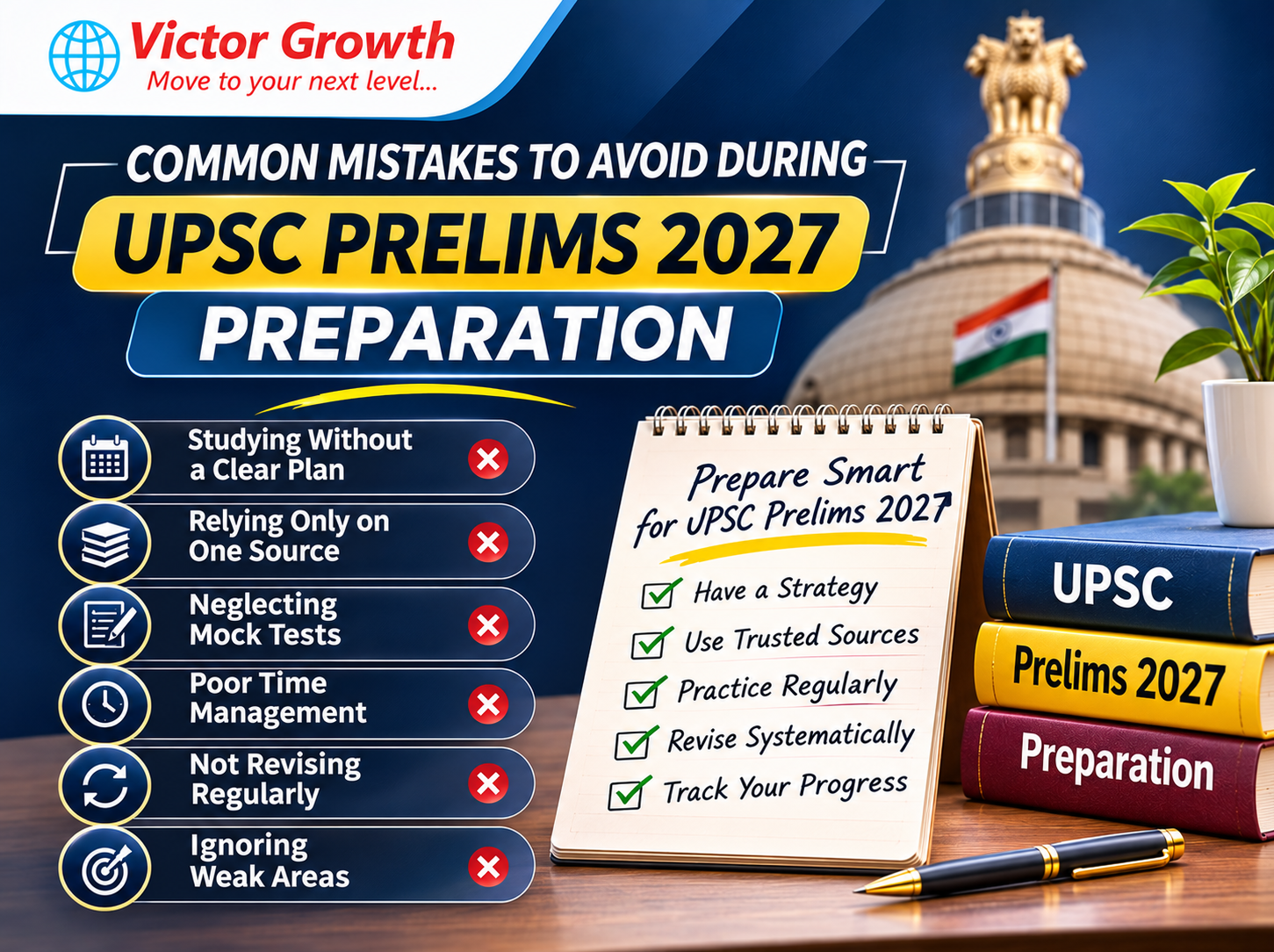
Preparing for UPSC Civil Services Prelims 2027 requires proper planning, consistency, conceptual clarity, and regular practice. Many aspirants work hard but struggle to achieve their desired results because of common preparation mistakes. Studying for long hours alone does not guarantee success. Candidates must also follow the right strategy, use reliable study materials, and revise effectively.
Understanding these common mistakes can help aspirants avoid unnecessary confusion, save valuable time, and improve their chances of clearing UPSC Prelims 2027.
1. Starting Preparation Without Understanding the Syllabus
One of the biggest mistakes is beginning preparation without carefully studying the official UPSC syllabus.
The syllabus acts as a roadmap for the entire preparation process. Without understanding it, aspirants may spend too much time on irrelevant topics.
How to avoid it:
Read the complete UPSC Prelims syllabus.
Divide the syllabus subject-wise.
Identify important topics from previous-year questions.
Connect every topic you study with the syllabus.
2. Using Too Many Study Materials
Collecting multiple books, newspapers, magazines, and online resources can create confusion. Many candidates spend more time searching for study materials than actually studying.
How to avoid it:
Select one or two reliable sources for each subject.
Complete NCERT textbooks before moving to advanced materials.
Follow limited and trustworthy current affairs sources.
Avoid frequently changing books and study materials.
Remember, completing and revising limited resources is more effective than collecting too many books.
3. Ignoring NCERT Books
Some aspirants directly start with advanced reference books without developing a strong understanding of basic concepts. This can make subjects such as Economy, Geography, and Science difficult to understand.
How to avoid it:
Begin with relevant NCERT textbooks and build your fundamentals. Once you understand the basic concepts, move towards standard reference books and current affairs.
4. Neglecting Current Affairs
Current affairs are an important part of UPSC Prelims. Ignoring newspapers, government initiatives, and important national and international developments can affect preparation.
How to avoid it:
Read a reliable newspaper daily.
Follow important government announcements.
Connect current affairs with static subjects.
Prepare short notes for important developments.
Revise monthly current affairs regularly.
Avoid reading every news item. Focus on topics relevant to the UPSC syllabus.
5. Not Solving Previous-Year Question Papers
Reading textbooks without practising previous-year questions is another common mistake. PYQs help aspirants understand how UPSC tests conceptual knowledge and analytical ability.
How to avoid it:
Practise at least 10 years of available Prelims questions.
Solve questions subject-wise after completing each topic.
Analyse both correct and incorrect answers.
Identify frequently tested concepts.
Revise topics based on your mistakes.
6. Ignoring Mock Tests and Practice Questions
Some candidates postpone mock tests until the final months of preparation. This reduces opportunities to improve accuracy and time management.
How to avoid it:
Start with topic-wise tests during the initial preparation stage. Gradually introduce full-length mock tests as you complete the syllabus. Analyse every test and maintain a mistake notebook.
Do not focus only on your score. Understanding why you made mistakes is more important.
7. Neglecting CSAT Preparation
CSAT Paper II is qualifying in nature, but it should never be ignored. Candidates must score at least 33% to qualify for the Mains examination.
How to avoid it:
Practise mathematics regularly.
Improve reading comprehension.
Study logical reasoning and analytical ability.
Solve previous-year CSAT papers.
Attempt full-length CSAT mock tests.
Candidates who are weak in mathematics should start early rather than waiting until the last few weeks.
8. Making Lengthy and Unorganised Notes
Writing everything from textbooks and newspapers can consume valuable preparation time. Lengthy notes also make last-minute revision difficult.
How to avoid it:
Prepare short, syllabus-oriented notes.
Use headings, tables, and bullet points.
Highlight important facts and concepts.
Maintain separate notes for current affairs.
Update notes only when necessary.
Your notes should make revision faster, not create another textbook.
9. Not Revising Regularly
Studying new topics every day without revisiting previously covered subjects can affect memory and understanding.
How to avoid it:
Follow a weekly revision schedule. Revise completed chapters, important facts, current affairs, and short notes. Increase revision frequency as the examination approaches.
10. Following an Unrealistic Study Timetable
Many aspirants prepare timetables that require 12–14 hours of study every day. When they fail to follow these schedules, they become frustrated and lose consistency.
How to avoid it:
Set realistic daily study targets.
Divide subjects across the week.
Include breaks and sufficient sleep.
Allocate time for revision and mock tests.
Track weekly progress instead of comparing study hours with others.
Consistency is more important than studying for extremely long hours.
11. Ignoring Negative Marking and Exam Strategy
Attempting too many questions through blind guessing can reduce the final score because UPSC Prelims includes negative marking.
How to avoid it:
Read questions carefully.
Understand the difference between correct and incorrect statements.
Practise eliminating unsuitable options.
Avoid random guessing.
Develop a balanced attempt strategy through mock tests.
12. Comparing Your Preparation with Other Aspirants
Every candidate has a different educational background, learning speed, and preparation schedule. Constantly comparing your progress with others can create unnecessary pressure.
How to avoid it:
Focus on your own progress. Identify your weak areas, improve your performance gradually, and follow a preparation strategy that suits your learning style.
13. Choose the Right Coaching and Academic Guidance
Proper guidance can help aspirants avoid preparation mistakes, understand difficult concepts, and follow a structured study plan. Before joining a coaching programme, compare faculty experience, teaching methods, study materials, test series, and individual support.
Students searching for the best NDA coaching in Kerala should also consider the quality of academic guidance and regular assessments. However, NDA and UPSC Civil Services are different examinations. UPSC aspirants should select a programme specifically designed for Civil Services preparation.
Frequently Asked Questions (FAQs)
1. What are the most common mistakes in UPSC Prelims preparation?
Ignoring the syllabus, using too many books, neglecting current affairs, avoiding mock tests, and not revising regularly are some of the most common mistakes.
2. Is reading NCERT books necessary for UPSC Prelims 2027?
Yes. NCERT books help build basic concepts in History, Geography, Economy, Science, and other important subjects.
3. How important are previous-year questions for UPSC preparation?
PYQs help aspirants understand the examination pattern, identify important topics, and improve question-solving skills.
4. Can I clear UPSC Prelims without coaching?
Yes. Candidates can prepare through self-study with the right books, current affairs resources, previous-year questions, and mock tests. Proper guidance can also help make preparation more structured.
5. Should I prepare for CSAT from the beginning?
Yes. Regular CSAT practice is especially important for candidates who are weak in mathematics, reasoning, or reading comprehension.
6. How many hours should I study daily for UPSC Prelims 2027?
Study hours depend on individual circumstances. Around 6–8 focused hours can be a useful target for full-time aspirants, while working professionals may need a more flexible schedule.
7. How can I improve my UPSC Prelims preparation strategy?
Understand the syllabus, follow limited resources, practise PYQs, take mock tests, revise regularly, and analyse your mistakes.
Conclusion
Avoiding common preparation mistakes is just as important as following the right UPSC study strategy. For UPSC Prelims 2027, focus on understanding the syllabus, building strong fundamentals, following current affairs, practising previous-year questions, and revising consistently. Avoid unnecessary resources, unrealistic timetables, and last-minute preparation. With proper planning, discipline, and continuous improvement, aspirants can make their preparation more effective and approach the examination with confidence.