
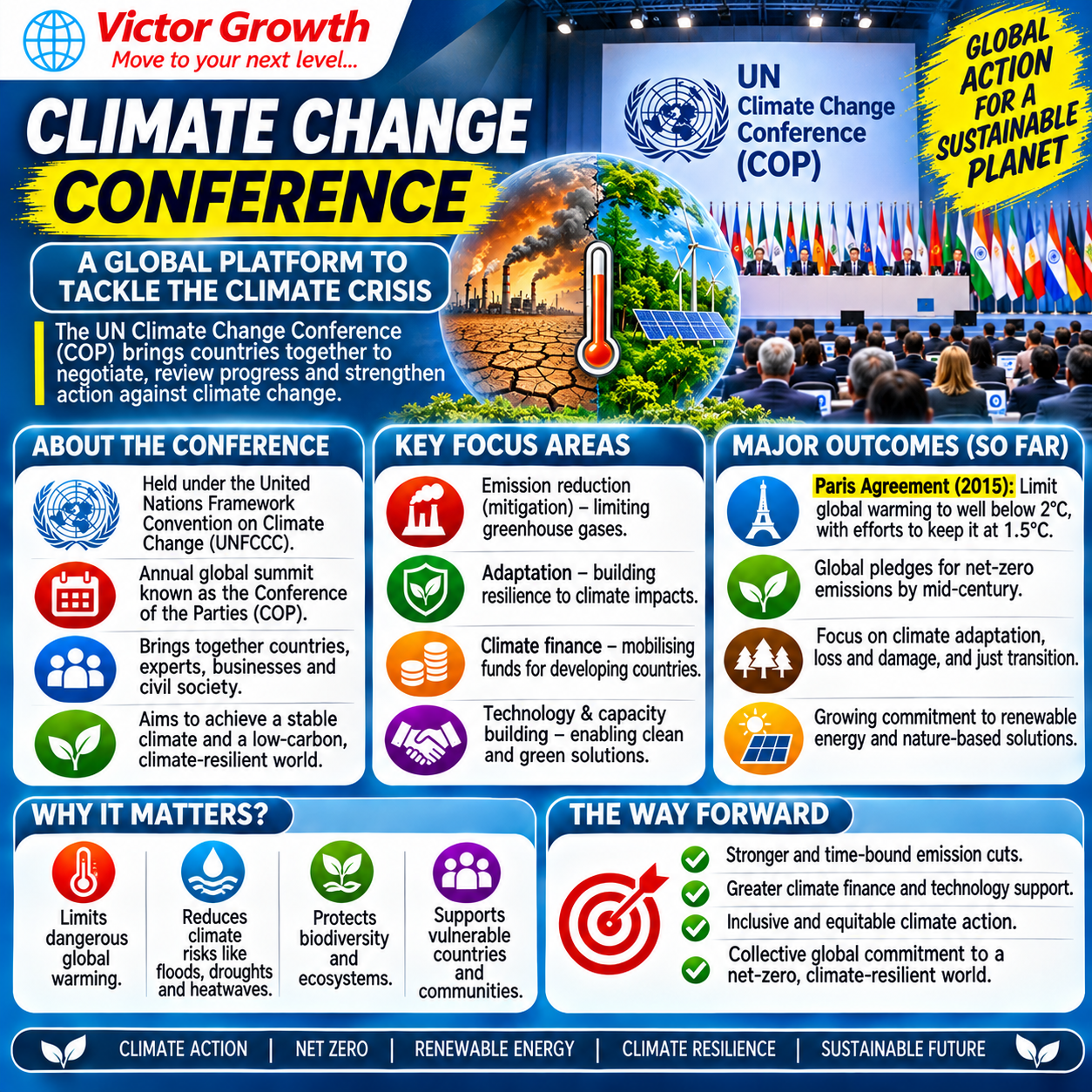
The 31st Conference of the Parties (COP31) to the United Nations Framework Convention on Climate Change (UNFCCC) is being held in Antalya, Türkiye, from 9 to 20 November 2026.
The conference comes at a critical time, with rising global temperatures, extreme weather events and concerns over the world exceeding the Paris Agreement’s 1.5°C warming threshold.
COP31 is focusing on translating climate commitments into practical action, particularly through climate finance, clean energy transition, adaptation and international cooperation. <Cite refs={[“turn919827search0″,”turn919827search1″,”turn919827search3”]}/>
What Is the Conference of the Parties (COP)?
The Conference of the Parties is the supreme decision-making body of the UNFCCC, established in 1992 at the Rio Earth Summit.
Its primary objective is to bring countries together to negotiate and review global climate action.
Important milestones include:
COP3 (1997), Kyoto: Adoption of the Kyoto Protocol.
COP21 (2015), Paris: Adoption of the Paris Agreement.
COP26 (2021), Glasgow: Glasgow Climate Pact and renewed focus on coal and fossil-fuel subsidies.
COP27 (2022), Sharm el-Sheikh: Agreement to establish a Loss and Damage Fund.
COP28 (2023), Dubai: First Global Stocktake and a call to transition away from fossil fuels in energy systems.
COP29 (2024), Baku: New climate finance goal of at least USD 300 billion annually by 2035 from developed countries to developing countries.
COP30 (2025), Belém: Focus on implementation of climate commitments and strengthening global climate action.
Major Issues on the Agenda of COP31
1. Climate Finance
Developing countries require substantial financial support to reduce emissions, adapt to climate impacts and address climate-related losses.
A major concern is the delivery of the new climate finance goal agreed at COP29, including the need for predictable and accessible funding.
2. Clean Energy Transition
COP31 aims to accelerate the transition towards renewable energy, improve electricity infrastructure and promote energy efficiency.
Developing countries emphasise that the transition must also ensure affordable and reliable energy access.
3. Climate Adaptation
Countries increasingly face floods, droughts, heatwaves, cyclones and rising sea levels.
Strengthening climate-resilient agriculture, water management, urban infrastructure and healthcare systems is essential.
4. Just Transition
A just transition ensures that the shift towards a low-carbon economy does not disproportionately affect workers, vulnerable communities and developing economies.
It requires skill development, social protection and alternative livelihood opportunities.
5. Climate Justice
Climate justice recognises that countries have contributed unequally to global greenhouse gas emissions and have different capacities to address climate change.
Developing countries continue to demand equitable access to finance, technology and capacity-building support.
6. Loss and Damage
Climate-vulnerable countries require financial and institutional support to address irreversible climate impacts such as extreme flooding, coastal erosion and destruction of livelihoods.
The effective operationalisation of the Loss and Damage Fund remains an important international priority.
India’s Stand at COP31
India has emphasised the principles of equity, climate justice and Common But Differentiated Responsibilities and Respective Capabilities (CBDR-RC).
In its opening statement at COP31, India called upon developed countries to fulfil their climate finance obligations under the Paris Agreement.
India has highlighted the following priorities:
Climate finance from developed countries must be predictable and accessible.
Adaptation needs of developing countries must receive greater attention.
Climate action should not undermine the development priorities of the Global South.
Technology transfer and capacity-building are essential for an equitable energy transition.
International climate cooperation must respect national circumstances and development needs.
India has also reaffirmed its commitment to multilateral climate cooperation through the UNFCCC framework. <Cite refs={[“turn919827news11″,”turn919827news13”]}/>
Key International Climate Agreements
| Agreement | Major Objective |
|---|---|
| UNFCCC, 1992 | Stabilise greenhouse gas concentrations |
| Kyoto Protocol, 1997 | Emission reduction commitments for developed countries |
| Paris Agreement, 2015 | Limit global warming to well below 2°C and pursue efforts towards 1.5°C |
| Glasgow Climate Pact, 2021 | Strengthen mitigation and adaptation efforts |
| UAE Consensus, COP28 | Transition away from fossil fuels in energy systems |
What Is the Global Stocktake?
The Global Stocktake (GST) is a process under the Paris Agreement that assesses collective global progress towards achieving climate goals.
It takes place every five years.
The first Global Stocktake concluded at COP28 in 2023. It assessed progress in mitigation, adaptation and climate finance and highlighted the need for stronger global action.
COP31 is significant as countries begin the process of the second Global Stocktake, which will assess collective progress towards the Paris Agreement’s objectives.
Challenges in Global Climate Negotiations
North–South divide: Developed and developing countries differ over historical responsibility and financial obligations.
Climate finance gap: Financial commitments do not always translate into timely and accessible funding.
Fossil-fuel dependence: Many economies continue to depend heavily on coal, oil and natural gas.
Technology inequality: Developing countries face barriers in accessing affordable clean technologies.
Implementation gap: National climate commitments are not yet sufficient to achieve global temperature goals.
Way Forward
Global climate negotiations must move beyond declarations towards measurable implementation.
Developed countries should fulfil their climate finance commitments.
Renewable energy and energy efficiency must be expanded.
Climate adaptation should receive greater financial and policy attention.
Technology transfer and capacity-building must be strengthened.
Vulnerable communities should be prioritised in climate planning.
International cooperation must be guided by equity and climate justice.
UPSC Examination Relevance
Prelims
UNFCCC and its establishment in 1992
Conference of the Parties (COP)
Kyoto Protocol and Paris Agreement
CBDR-RC principle
Global Stocktake
Loss and Damage Fund
Nationally Determined Contributions (NDCs)
Mains – GS Paper II
International environmental agreements
India’s role in global climate negotiations
International institutions and multilateral cooperation
Mains – GS Paper III
Climate change and global warming
Renewable energy and sustainable development
Climate finance and adaptation
Environmental conservation
Possible UPSC Mains Question:
“Global climate negotiations are increasingly shifting from target-setting towards implementation. Examine the major challenges in achieving equitable and effective climate action, with reference to COP31.”
Conclusion
COP31 represents an important opportunity to strengthen international climate cooperation at a time of growing environmental risks. Its success will depend not merely on ambitious declarations but on delivering climate finance, accelerating adaptation and ensuring an equitable energy transition. For India and other developing countries, climate justice and the principle of CBDR-RC must remain central to global climate governance.