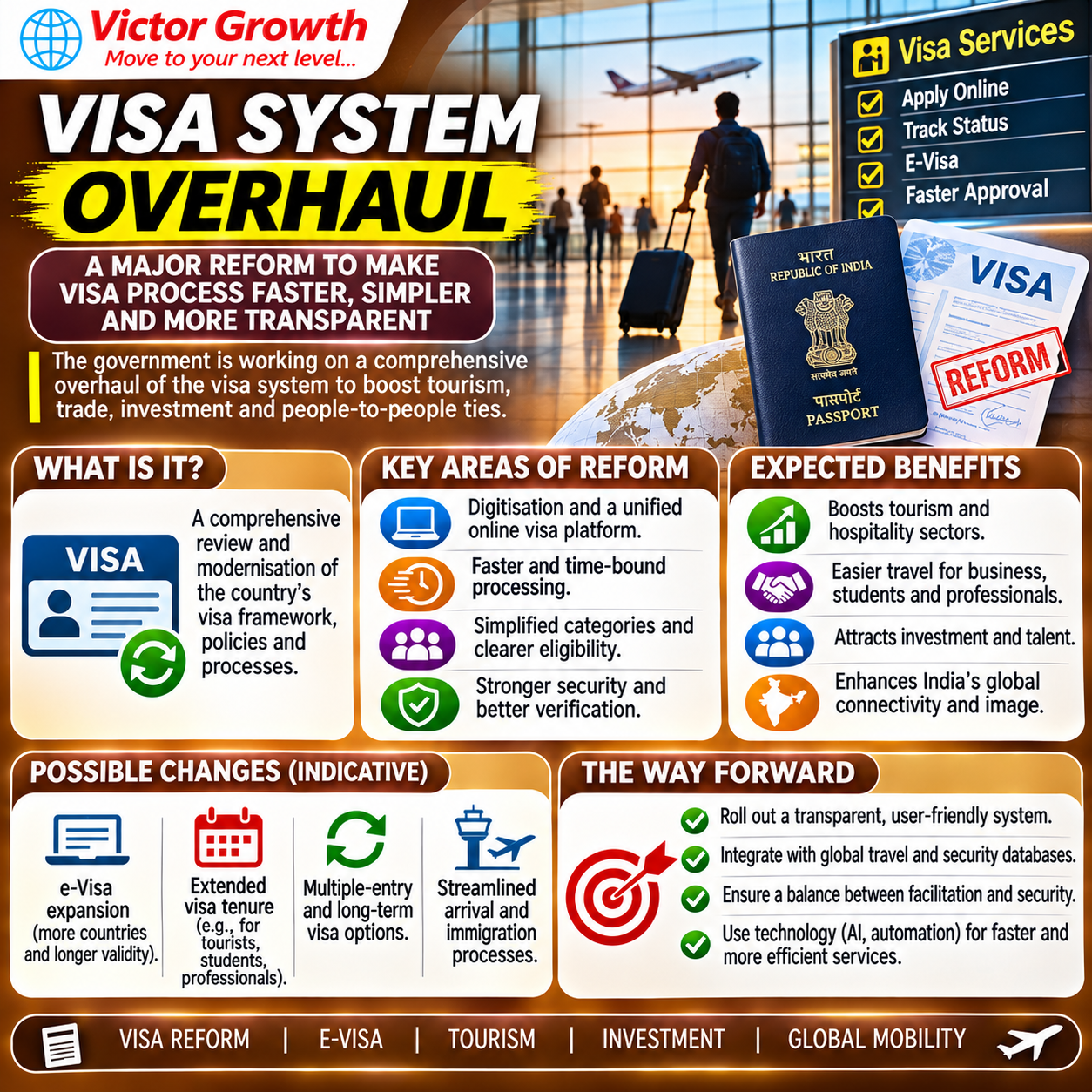
On 11 November 2026, the Ministry of Home Affairs (MHA) announced a major rationalisation of India’s visa system, aimed at simplifying entry procedures for foreign nationals.
The government has reduced the number of main visa categories from 13 to 9 and sub-categories from 49 to 23. It has also reduced the number of fields in visa application forms by approximately 65–70%.
The reform aims to attract more foreign tourists, medical travellers, students, researchers, investors and business professionals while improving administrative efficiency and immigration management. <Cite refs={[“turn718219search0″,”turn718219search1”]}/>
What Is the Visa System Overhaul?
The visa system overhaul is an initiative of the Government of India to consolidate overlapping visa categories and make the application process simpler and more user-friendly.
The rationalisation was undertaken in two stages:
October 2025: Main visa categories reduced from 22 to 13 and sub-categories from 63 to 49.
August 2026: Main categories further reduced from 13 to 9 and sub-categories from 49 to 23.
The revised framework is designed around the purpose of travel, making it easier for foreign nationals to identify the appropriate visa.
Nine Main Visa Categories Under the Revised Framework
The revised Indian visa system comprises the following nine categories:
Business Visa
Diplomatic Visa
Employment Visa
Journalist Visa
Medical Visa
Official Visa
Student Visa
Visitor Visa
Miscellaneous Visa
Major Changes Under the New Visa Framework
1. Tourist Visa Renamed as Visitor Visa
The earlier Tourist Visa has been renamed Visitor Visa, with two sub-categories:
V-1 Visa: For short-term visits, including tourism, business meetings, medical consultations, wellness retreats and short-duration cultural or language courses. It provides 30-day multiple-entry validity.
V-2 Visa: For longer-duration visits, with validity of 1, 5 or 10 years, depending on eligibility. A six-month multiple-entry provision is available for mountaineering.
2. Simplified Medical Visa
The medical visa framework distinguishes between conventional medical treatment and AYUSH treatment.
M-1: Medical treatment other than AYUSH.
M-2: Medical attendant accompanying an M-1 visa holder.
M-3: Treatment under AYUSH systems.
M-4: Medical attendant accompanying an M-3 visa holder.
The medical visas are ordinarily granted for one year with multiple entries. This is expected to support India’s medical value tourism sector and the government’s Heal in India initiative.
3. Student Visa Reforms
The Student Visa category has been consolidated into two sub-categories:
S-1: School, graduate and postgraduate education.
S-2: PhD programmes, research scholars, visiting faculty, internships, exchange programmes and specified academic activities.
Eligible foreign students enrolled through the Study in India portal may receive multiple-entry e-S1 visas for up to five years or the duration of their course, whichever is shorter.
4. Business Visa Reforms
The Business Visa category has been reorganised into:
B-1: Long-term, licence-based business activities, including establishing industrial or commercial ventures.
B-2: Short-term, contract-based activities, including conferences, sports, cultural performances, films and production investment.
A specific provision has also been introduced for foreign technical experts, engineers and specialists working on installation, commissioning, maintenance, training and technology transfer in Indian companies.
5. Simplification of Application Forms
One of the most significant changes is the reduction of application-form fields by 65–70% across the 23 sub-categories.
This is expected to:
Reduce the time required to complete applications.
Improve the user experience for foreign applicants.
Reduce procedural complexity.
Enable more focused scrutiny by immigration authorities.
The government is updating its information technology systems, with visa issuance under the revised framework expected to begin by the end of 2026. <Cite refs={[“turn718219search0″,”turn718219search4”]}/>
Other Important Immigration Reforms in India
The visa overhaul is part of a broader effort to modernise India’s immigration system.
Immigration, Visa, Foreigners Registration & Tracking (IVFRT) Scheme: The Union Cabinet approved its continuation from April 2026 to March 2031, with a budget allocation of ₹1,800 crore. It aims to modernise visa issuance, immigration clearance and foreigner registration through digital infrastructure.
Fast Track Immigration–Trusted Traveller Programme (FTI-TTP): This programme uses automated e-gates to facilitate faster immigration clearance for eligible Indian nationals and OCI cardholders.
Expansion of FRROs: The government has announced plans to establish Foreigners Regional Registration Offices (FRROs) in all state capitals by 2027, improving access to immigration-related services. <Cite refs={[“turn718219search2″,”turn718219search3”]}/>
Significance of the Visa System Overhaul
1. Boost to Tourism
Simpler visa procedures can attract more international tourists and strengthen India’s tourism economy.
2. Promotion of Medical Value Tourism
Improved medical visa provisions can encourage foreign patients to access India’s healthcare and AYUSH services.
3. Strengthening Higher Education
Clearer student and research visa pathways can make India a more attractive destination for international students and scholars.
4. Ease of Doing Business
Simplified business visas can facilitate foreign investment, industrial projects and technology transfer.
5. Digital Governance
Integration with digital immigration systems can improve administrative efficiency and service delivery.
6. National Security
A modernised immigration framework can help authorities monitor foreign nationals, identify irregular migration and strengthen border and internal security management.
Challenges and Concerns
Security risks: Simplification must not weaken background verification and immigration scrutiny.
Data protection: Greater digital integration requires strong cybersecurity and personal data safeguards.
Implementation: Upgrading IT infrastructure and coordinating different immigration authorities may create operational challenges.
Institutional capacity: FRROs and immigration posts need adequate personnel and technology.
Overlapping regulations: Visa simplification must remain consistent with immigration and foreigner-related laws.
Way Forward
India should combine ease of travel with effective immigration management. Strong digital infrastructure, transparent procedures, data protection and coordination between central and state authorities are essential.
Regular evaluation of visa processing times, security outcomes and foreign visitor experience will help ensure that the reforms achieve their objectives.
UPSC Examination Relevance
Prelims
Ministry of Home Affairs and visa administration.
Nine main Indian visa categories.
Visitor Visa: V-1 and V-2.
Medical Visa and AYUSH provisions.
IVFRT Scheme and FTI-TTP.
Foreigners Regional Registration Offices (FRROs).
Mains – GS Paper II
Government policies and interventions.
E-governance and administrative reforms.
India’s international relations and people-to-people contacts.
Internal security and immigration management.
Mains – GS Paper III
Cybersecurity and digital infrastructure.
Internal security and border management.
Tourism and economic development.
Possible UPSC Mains Question:
“The rationalisation of India’s visa system reflects an attempt to balance ease of international mobility with national security. Examine its significance and the challenges involved.”
Conclusion
India’s 2026 visa system overhaul is an important step towards building a simpler, more efficient and technology-driven immigration framework. By reducing visa categories, simplifying application forms and improving digital services, the government aims to encourage tourism, education, healthcare and investment. Its success will depend on balancing administrative convenience with robust security, data protection and effective implementation.