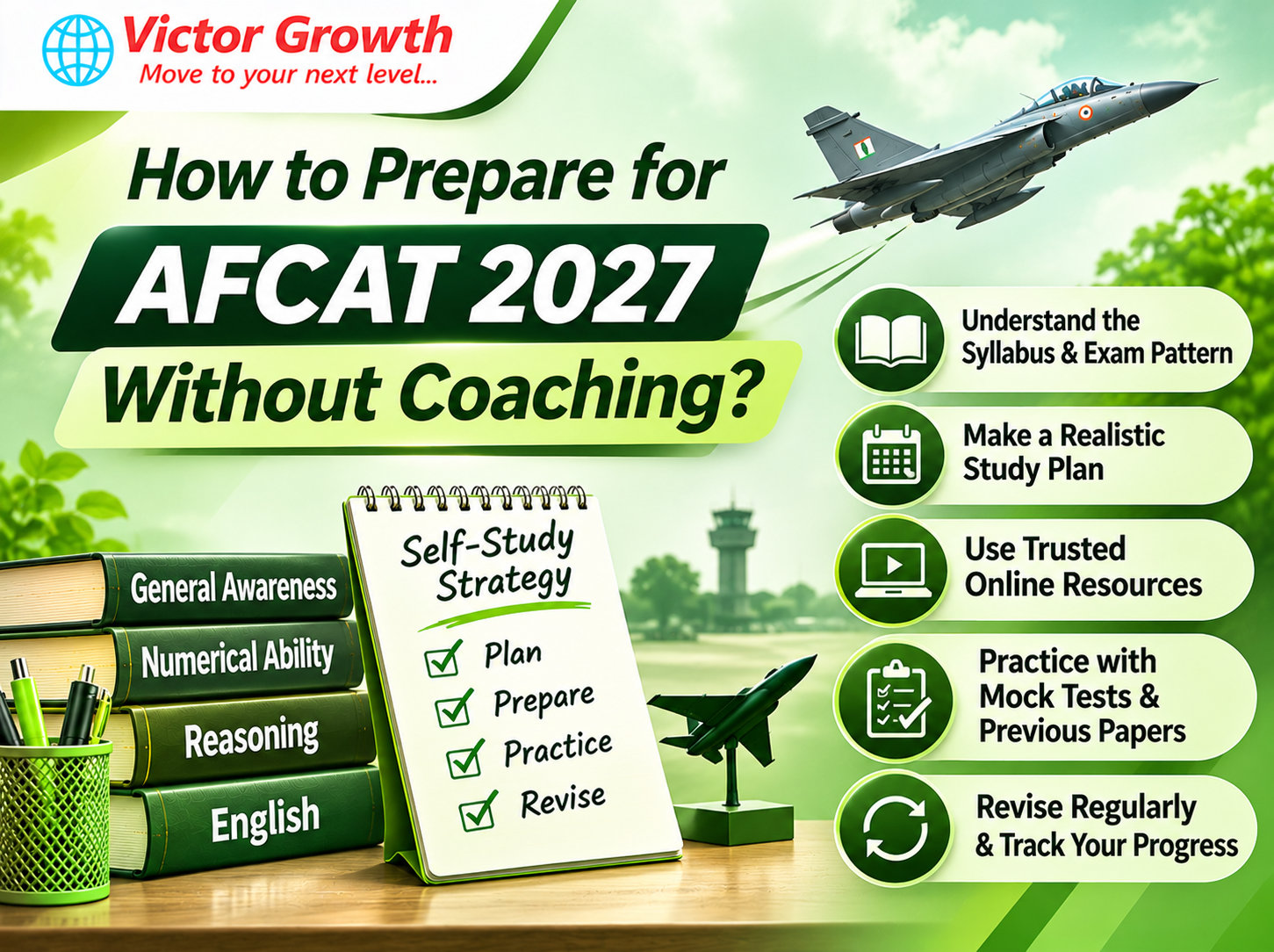
Joining the Indian Air Force as an officer is a dream for many young graduates. The Air Force Common Admission Test (AFCAT) provides an opportunity for eligible candidates to enter the Flying Branch and Ground Duty branches. However, many aspirants wonder whether it is possible to clear AFCAT 2027 without joining a coaching institute.
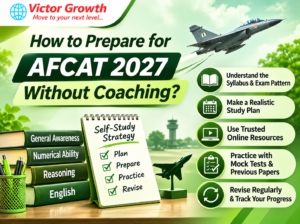
The answer is yes. With a clear understanding of the syllabus, the right study materials, regular practice and a disciplined timetable, candidates can prepare for AFCAT through self-study.
The key is to follow a structured preparation strategy instead of studying randomly. This guide explains how beginners can prepare for AFCAT 2027 without coaching.
1. Understand the AFCAT 2027 Exam Pattern
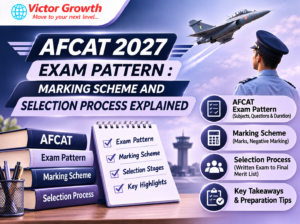
Before starting preparation, understand the examination structure and marking scheme.
Particulars | Details |
|---|---|
Examination mode | Online |
Total questions | 100 |
Maximum marks | 300 |
Duration | 2 hours |
Correct answer | +3 marks |
Incorrect answer | -1 mark |
Unattempted question | 0 marks |
The examination covers four major sections:
English
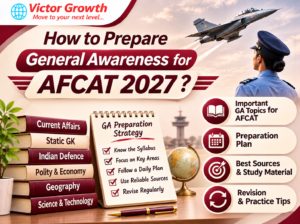
General Awareness
Numerical Ability
Reasoning and Military Aptitude
Understanding the exam pattern helps you divide your preparation time effectively.
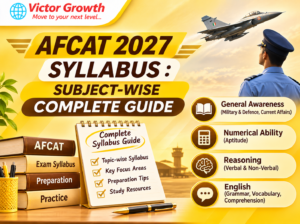
2. Understand the Complete AFCAT Syllabus
Self-study becomes easier when you know exactly what to prepare. Divide the syllabus into four subjects.
A. English
Important topics include:
Reading Comprehension
Synonyms and Antonyms
Error Detection
Idioms and Phrases
One-Word Substitution
Sentence Completion
Cloze Test
Vocabulary and Grammar
How to prepare: Read English newspapers, practise grammar exercises, learn new vocabulary and solve comprehension passages daily.
B. General Awareness
Important topics include:
Indian History and Geography
Indian Polity and Economy
General Science
Environment and Ecology
Art and Culture
Sports and Awards
Important Personalities
Defence-related developments
National and International Current Affairs
How to prepare: Follow reliable news sources, prepare short notes and revise important current affairs regularly.
C. Numerical Ability
Important topics include:
Percentage
Average
Ratio and Proportion
Profit and Loss
Time and Work
Time, Speed and Distance
Simple and Compound Interest
Number System
Probability
Mensuration
How to prepare: Start with basic mathematics, understand formulas and practise questions every day. If mathematics is difficult, spend extra time strengthening fundamental concepts.
D. Reasoning and Military Aptitude
Important topics include:
Analogy
Classification
Coding and Decoding
Number and Alphabet Series
Blood Relations
Direction Sense
Verbal Reasoning
Non-Verbal Reasoning
Pattern Recognition
Spatial Ability
How to prepare: Practise different question types and focus on understanding the logic behind each answer.
3. Follow a Daily Study Timetable
A proper timetable is essential when preparing without coaching. It helps you maintain discipline and cover all subjects systematically.
Here is a suggested daily timetable:
Time | Subject |
|---|---|
6:00 AM – 7:00 AM | English |
7:00 AM – 8:00 AM | Numerical Ability |
10:00 AM – 11:00 AM | General Awareness |
4:00 PM – 5:00 PM | Reasoning and Military Aptitude |
7:00 PM – 7:30 PM | Current Affairs |
7:30 PM – 8:00 PM | Revision and Practice |
You can adjust the timings according to your daily routine. Even three to four hours of focused preparation can be productive when followed consistently.
4. Choose the Right Study Materials
You do not need too many books to prepare for AFCAT. Select a limited number of reliable resources and revise them regularly.
Some useful resources include:
English: Wren & Martin for grammar and a good vocabulary resource.
General Awareness: NCERT textbooks, a standard general knowledge book and reliable newspapers.
Numerical Ability: NCERT mathematics textbooks and quantitative aptitude practice books.
Reasoning: A standard verbal and non-verbal reasoning book.
Current Affairs: Newspaper reading and monthly current affairs compilations.
Practice: Official AFCAT information, previous year question papers and mock tests.
Always check the latest official syllabus and notification before finalising your preparation materials.
5. Practise Previous Year Question Papers
Previous Year Questions (PYQs) are among the most useful resources for self-study.
They help you:
Understand the question pattern.
Identify important topics.
Assess your preparation level.
Improve speed and accuracy.
Understand the difficulty level of different sections.
Try solving questions topic-wise first. Once you become comfortable, attempt complete papers under examination conditions.
6. Take Regular Mock Tests
Mock tests help you understand your strengths and weaknesses. They are especially important for candidates preparing without classroom guidance.
Follow these steps:
Start with subject-wise tests.
Gradually attempt full-length mock tests.
Follow the actual two-hour examination duration.
Analyse every incorrect answer.
Maintain a notebook of mistakes.
Revise weak topics before attempting the next test.
Avoid random guessing because AFCAT has negative marking. Focus on accuracy as well as speed.
7. Prepare for AFSB Alongside the Written Exam
Clearing AFCAT is only the first stage of the selection process. Candidates who qualify are called for Air Force Selection Board (AFSB) testing, subject to eligibility.
The selection process generally includes:
Officer Intelligence Rating Tests.
Picture Perception and Discussion Test.
Psychological tests.
Group Tests.
Personal Interview.
Prescribed medical examination.
Even without coaching, you can start developing communication skills, confidence, general awareness, leadership qualities and decision-making ability.
8. Common Mistakes to Avoid During Self-Study
Many beginners struggle because they do not follow a consistent preparation strategy.
Avoid these mistakes:
Studying without understanding the syllabus.
Collecting too many books and study materials.
Ignoring mathematics and reasoning.
Not revising current affairs.
Avoiding mock tests.
Focusing only on strong subjects.
Neglecting AFSB preparation.
Studying irregularly without a timetable.
Remember that consistency is more important than the number of hours spent studying occasionally.
9. Is Coaching Helpful for AFCAT Preparation?
Self-study is a practical option for disciplined aspirants. However, some candidates may benefit from structured classes, expert explanations, regular tests and doubt-clearing sessions.
When searching for the best NDA coaching in Kerala, remember that NDA and AFCAT are separate examinations with different eligibility requirements and preparation patterns. Aspirants should select a course specifically designed for their target examination.
Victor Growth Coaching Centre in Kochi offers coaching support for defence examination aspirants. Before enrolling, evaluate the faculty, syllabus coverage, study materials, mock tests and academic support to determine whether the programme meets your requirements.
Frequently Asked Questions (FAQs)
1. Can I clear AFCAT 2027 without coaching?
Yes. Candidates can prepare through self-study by following the syllabus, using reliable study materials, practising previous year questions and taking regular mock tests.
2. How many hours should I study daily for AFCAT?
Around three to five focused hours can be a useful starting point. Your study time should depend on your current preparation level and subject knowledge.
3. Which subject should I study first for AFCAT?
Start with the subject you find most challenging while maintaining regular practice in all four sections.
4. Are previous year question papers important for AFCAT?
Yes. They help you understand the examination pattern, question types and important topics.
5. Is mathematics difficult in AFCAT?
Numerical Ability is generally based on matriculation-level mathematics. Regular practice of basic concepts and formulas can improve performance.
6. Is coaching compulsory for AFCAT?
No. Coaching is not compulsory. However, proper guidance and structured practice can make preparation more organised.
7. Should I prepare for AFSB before clearing AFCAT?
Yes. Developing communication skills, confidence, leadership qualities and general awareness alongside written preparation can be beneficial.
Conclusion
Preparing for AFCAT 2027 without coaching is possible with proper planning, discipline and consistent practice. Understand the syllabus, select reliable study materials, follow a realistic timetable and practise mock tests regularly.
Do not compare your preparation with others. Identify your weaknesses, improve your performance and stay focused on your goal of joining the Indian Air Force. A well-planned self-study strategy can help you approach AFCAT 2027 with confidence.