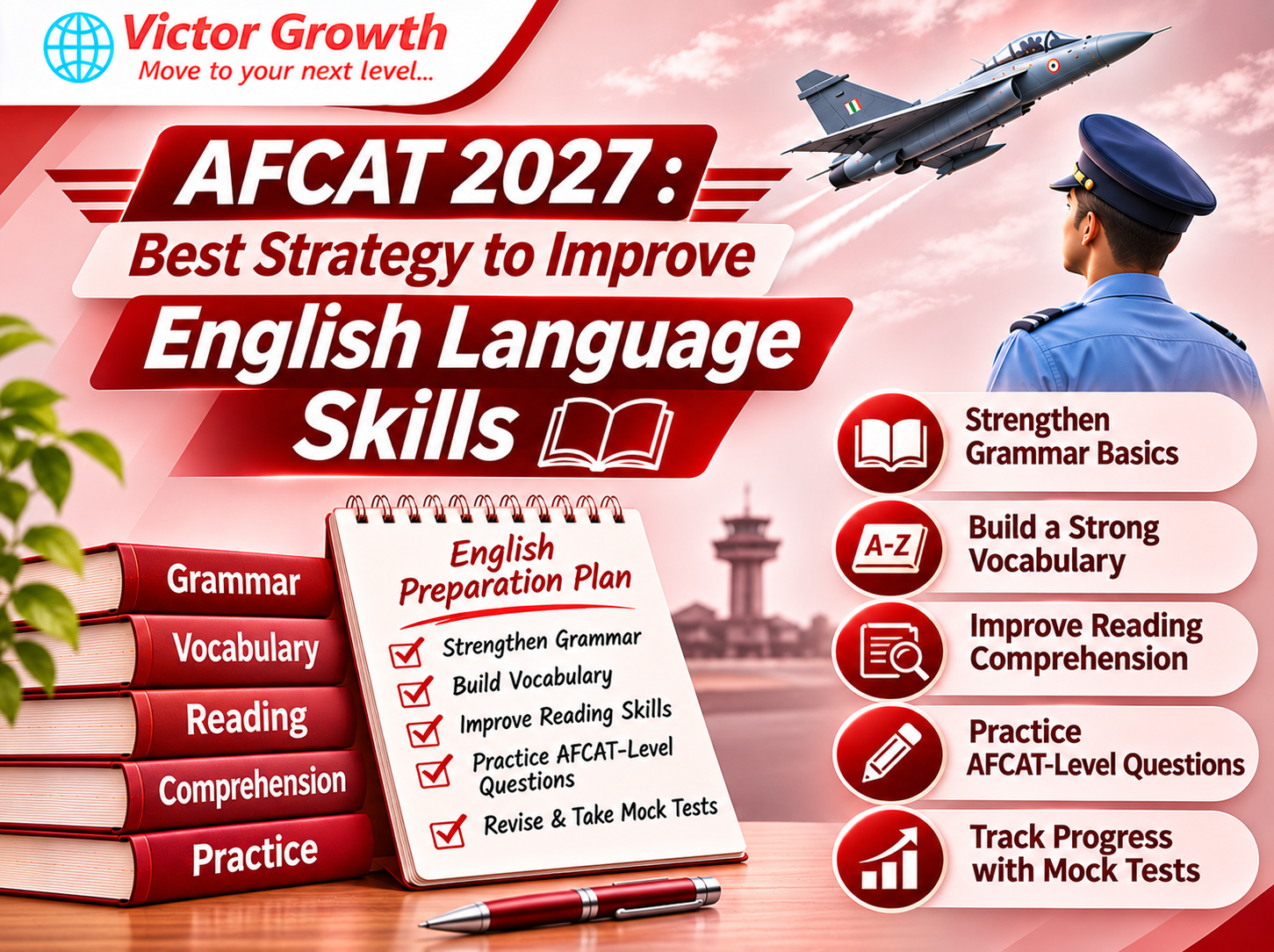
English is an important section of the Air Force Common Admission Test (AFCAT). It tests candidates’ vocabulary, grammar, comprehension and overall language ability. A good score in English can improve your overall performance and help you move closer to your dream of joining the Indian Air Force.
Many AFCAT aspirants struggle with English because of weak grammar, limited vocabulary or a lack of regular reading practice. However, English is a skill that can be improved through consistent practice and the right preparation strategy.
This guide explains the important English topics, recommended books and practical strategies to improve your English language skills for AFCAT 2027.
1. Understand the AFCAT 2027 English Syllabus
Before starting preparation, understand the important topics included in the English section.
Topic | What to Prepare |
|---|---|
Comprehension | Understanding passages and answering questions |
Synonyms and Antonyms | Similar and opposite word meanings |
Error Detection | Identifying grammatical mistakes |
Sentence Completion | Choosing suitable words or phrases |
Idioms and Phrases | Understanding commonly used expressions |
One-Word Substitution | Replacing phrases with single words |
Cloze Test | Completing passages using appropriate words |
Sentence Rearrangement | Arranging sentences in logical order |
Vocabulary | Word meanings, usage and spelling |
Grammar | Tenses, articles, prepositions and sentence structure |
Understanding these topics will help you prepare systematically instead of studying English without a clear direction.
2. Improve Your English Vocabulary
Vocabulary plays an important role in AFCAT English. Questions on synonyms, antonyms, idioms and one-word substitutions require a good understanding of words.
How to improve vocabulary:
Learn 10–15 new words every day.
Understand the meaning and usage of each word.
Learn synonyms and antonyms together.
Maintain a separate vocabulary notebook.
Revise previously learned words regularly.
Practise vocabulary-based MCQs.
Do not simply memorise word meanings. Try using new words in simple sentences to remember them more effectively.
3. Strengthen Your English Grammar
Grammar is essential for solving error detection, sentence completion and other objective questions.
Focus on these important topics:
Parts of Speech
Tenses
Subject-Verb Agreement
Articles
Prepositions
Active and Passive Voice
Direct and Indirect Speech
Conjunctions
Conditional Sentences
Sentence Structure
Preparation strategy:
Start with basic grammar rules and understand each concept through examples. After completing a topic, solve practice questions to check your understanding.
If you are weak in grammar, avoid jumping directly into difficult questions. Build your fundamentals first.
4. Develop a Daily Reading Habit
Reading regularly improves vocabulary, comprehension and sentence formation. It also helps candidates understand how English is used in different contexts.
Recommended reading materials:
The Hindu
The Indian Express
English magazines
Editorial articles
Short English stories
General awareness articles
While reading, identify unfamiliar words, understand their meanings and note useful expressions.
Spend at least 20–30 minutes every day reading English content.
5. Practise Reading Comprehension
Reading comprehension tests your ability to understand passages and identify relevant information.
To improve comprehension skills:
Read the passage carefully.
Identify the main idea.
Understand the context of unfamiliar words.
Pay attention to important details.
Read the questions before selecting answers.
Practise timed comprehension exercises.
Regular practice helps improve reading speed and accuracy.
6. Best Books for AFCAT 2027 English Preparation
Selecting the right study materials can make your preparation more organised.
Recommended books include:
Objective General English – S.P. Bakshi: Useful for grammar, vocabulary and objective-type questions.
Word Power Made Easy – Norman Lewis: Helps improve vocabulary and word usage.
High School English Grammar and Composition – Wren & Martin: Useful for strengthening grammar fundamentals.
AFCAT Previous Year Solved Papers: Helps candidates understand the actual question pattern and practise exam-oriented questions.
You do not need to complete every book. Choose one main grammar resource and one vocabulary resource, and practise previous year questions regularly.
7. Follow a Daily English Preparation Timetable
Consistency is the key to improving English. Follow a simple daily routine.
Time | Activity |
|---|---|
15 minutes | Learn new vocabulary |
20 minutes | Grammar practice |
20 minutes | Newspaper reading |
15 minutes | Reading comprehension |
20 minutes | AFCAT English MCQs |
10 minutes | Revision |
You can adjust the timetable according to your daily schedule. Even one hour of focused practice can make a difference when followed consistently.
8. Practise Previous Year Questions and Mock Tests
Previous Year Questions (PYQs) help you understand the types of English questions asked in AFCAT.
Follow these tips:
Solve topic-wise English questions.
Attempt full-length mock tests.
Practise under a time limit.
Analyse incorrect answers.
Maintain a list of frequently repeated mistakes.
Revise difficult grammar rules and vocabulary.
Since AFCAT has negative marking, focus on accuracy instead of attempting every question without confidence.
9. Common Mistakes to Avoid in AFCAT English Preparation
Many aspirants make mistakes that slow down their progress.
Avoid:
Memorising vocabulary without understanding usage.
Ignoring basic grammar.
Reading without revising new words.
Depending on only one source of practice.
Avoiding comprehension exercises.
Not solving previous year questions.
Attempting questions without understanding them.
A balanced preparation strategy covering vocabulary, grammar and comprehension is essential.
10. Choose the Right Defence Coaching in Kerala
Self-study is important, but proper academic guidance can help aspirants strengthen weak areas, understand difficult grammar concepts and practise examination-level questions.
When searching for the best NDA coaching in Kerala, remember that NDA and AFCAT are separate examinations with different eligibility criteria and preparation requirements. NDA is an entry route after Class 12, whereas AFCAT is designed for eligible graduates and other candidates who meet the prescribed qualifications.
Victor Growth Coaching Centre in Kochi provides coaching support for defence examination aspirants. Before selecting a programme, evaluate faculty experience, subject coverage, study materials, mock tests and individual doubt-clearing support.
Frequently Asked Questions (FAQs)
1. Is English difficult in AFCAT 2027?
The difficulty level depends on your preparation and language skills. Regular practice in grammar, vocabulary and comprehension can improve performance.
2. How can beginners improve English for AFCAT?
Start with basic grammar, learn new vocabulary daily, read English newspapers and practise objective-type questions.
3. Which book is best for AFCAT English preparation?
Objective General English by S.P. Bakshi is a useful resource for grammar and objective questions. Word Power Made Easy by Norman Lewis can help improve vocabulary.
4. How many hours should I study English daily for AFCAT?
Around 45 minutes to one hour of focused daily practice is a useful starting point.
5. Is newspaper reading necessary for AFCAT English?
Newspaper reading is helpful for improving vocabulary, comprehension and reading speed, although it should be combined with grammar and question practice.
6. Can I improve my English without coaching?
Yes. With regular reading, grammar exercises, vocabulary revision and mock tests, candidates can improve their English through self-study.
7. Are previous year questions important for AFCAT English?
Yes. They help you understand question patterns, identify important topics and improve your examination skills.
Conclusion
Improving English language skills for AFCAT 2027 requires regular reading, vocabulary development, grammar practice and consistent revision. Focus on strengthening your basics rather than memorising answers. Practise comprehension passages, solve previous year questions and take regular mock tests.
Remember, English proficiency develops gradually through daily practice. Stay consistent, identify your weak areas and work towards improving your accuracy and confidence. A well-planned English preparation strategy can help you perform better in AFCAT 2027 and move closer to your dream of becoming an Indian Air Force officer.