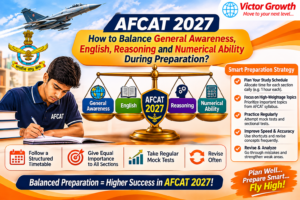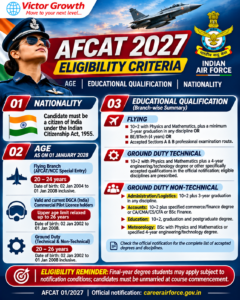
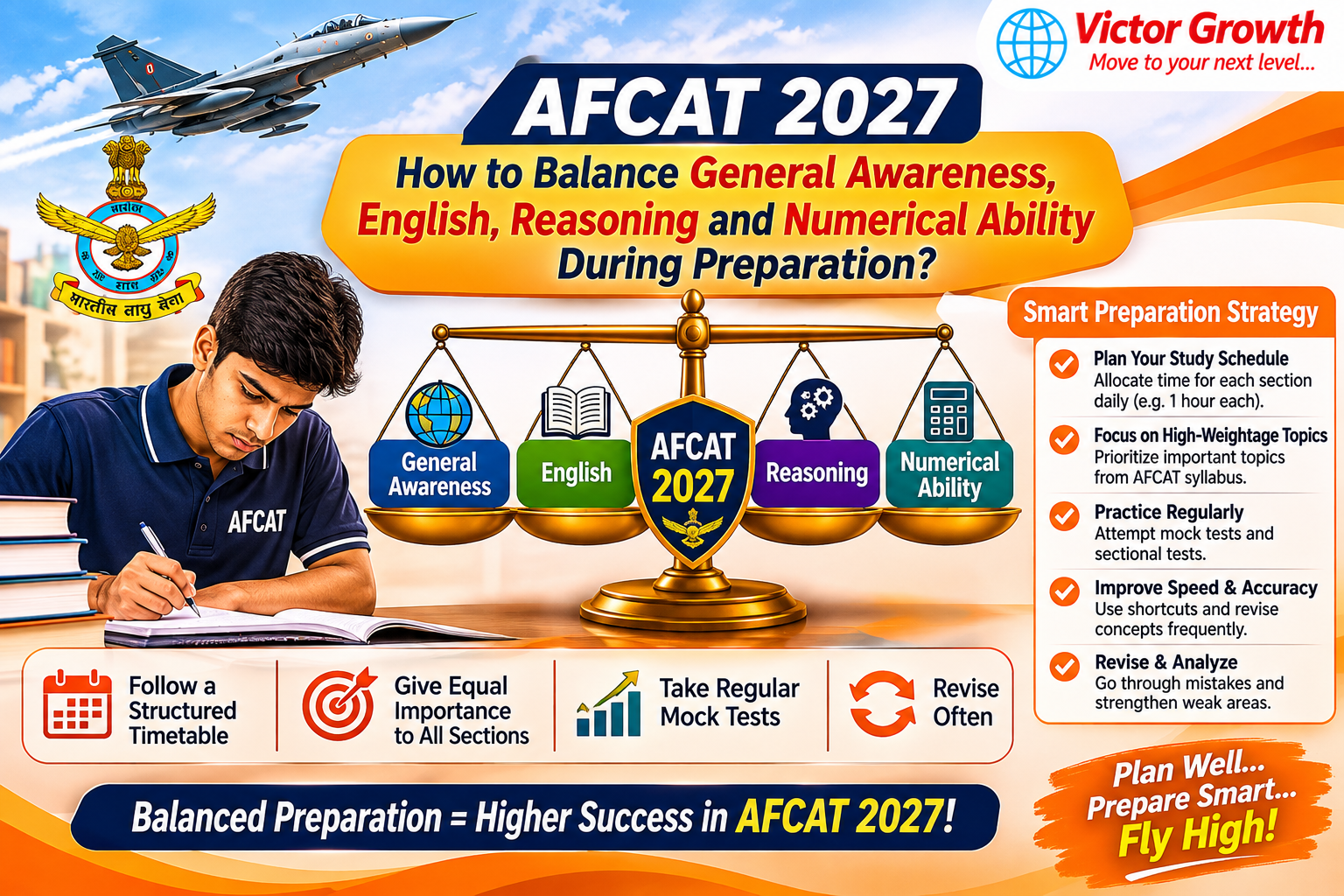
Preparing for AFCAT 2027 requires more than studying hard. Candidates need to manage four important sections: General Awareness, English, Reasoning and Numerical Ability. Each section tests different skills, so spending too much time on one subject while ignoring another can affect overall performance.
A balanced preparation strategy helps candidates improve their strengths, work on weaker areas and use their study time effectively. Whether you are beginning your preparation or revising for the examination, following a proper timetable can make your AFCAT journey more organised.
1. Understand the AFCAT Exam Pattern
Before preparing, understand the subjects included in the AFCAT examination. The four main areas are:
General Awareness: Current affairs, history, geography, science, defence-related updates and other important topics.
English: Vocabulary, grammar, comprehension, sentence completion and verbal ability.
Reasoning and Military Aptitude: Verbal and non-verbal reasoning, patterns, logical thinking and spatial ability.
Numerical Ability: Basic mathematical concepts, arithmetic, percentages, ratios, averages, time and distance, and other numerical topics.
Each section requires a different preparation method. Therefore, candidates should divide their study time according to the difficulty of each subject and their individual performance.
2. Create a Balanced Daily Study Timetable
A well-planned timetable prevents candidates from spending the entire day on only one subject. Try to give regular attention to all four sections.
If you can study for around four hours daily, you can divide your time as follows:
Subject | Daily study time |
|---|---|
General Awareness | 45 minutes |
English | 45 minutes |
Reasoning | 1 hour |
Numerical Ability | 1 hour |
Revision and practice | 30 minutes |
You can adjust this timetable based on your strengths and weaknesses. For example, if Numerical Ability is difficult for you, spend additional time practising calculations and basic concepts.
The most important point is consistency. Studying every subject regularly is more effective than preparing one subject intensively and ignoring the others.
3. How to Prepare General Awareness
General Awareness requires regular reading and revision because it covers a wide range of topics.
Preparation tips:
Read daily current affairs and make short notes.
Focus on important national and international events.
Study Indian history, geography, polity and basic science.
Follow defence-related developments, military exercises and important appointments.
Revise previously studied topics every week.
Practise General Awareness questions to improve recall.
Avoid collecting information from too many sources. Choose reliable study materials and revise them regularly.
4. How to Improve English
English can become a scoring section with consistent practice. Candidates should focus on grammar, vocabulary and reading comprehension.
Preparation tips:
Learn a few new English words every day.
Practise synonyms, antonyms and idioms.
Revise basic grammar rules.
Read short English articles to improve comprehension.
Practise sentence completion and error detection questions.
Attempt English mock tests to improve speed and accuracy.
Instead of memorising large vocabulary lists, learn words with their meanings and use them in simple sentences.
5. How to Prepare Reasoning and Military Aptitude
Reasoning tests your ability to identify patterns, understand relationships and solve problems logically. Regular practice is essential to improve speed.
Preparation tips:
Practise verbal and non-verbal reasoning questions.
Understand topics such as analogy, series, classification and coding-decoding.
Solve figure-based and pattern-based questions.
Learn different approaches to solving questions.
Practise timed exercises.
Review incorrect answers and understand why you made mistakes.
Start with simple questions and gradually move towards more challenging problems.
6. How to Improve Numerical Ability
Many candidates find Numerical Ability challenging, especially if their mathematical basics are weak. The best approach is to understand the concepts before attempting difficult questions.
Preparation tips:
Revise basic arithmetic and calculation methods.
Practise percentages, averages, ratios and proportions.
Learn shortcuts only after understanding the basic method.
Solve questions topic by topic.
Maintain a notebook for important formulas.
Practise calculations daily to improve speed and accuracy.
Do not move to advanced questions without understanding the fundamentals. Even 30–45 minutes of regular numerical practice can help build confidence over time.
7. Take Mock Tests and Analyse Your Performance
Mock tests are important for understanding your preparation level. They help you identify strong and weak areas while improving time management.
After every mock test:
Check your score and accuracy.
Identify the sections where you made more mistakes.
Revise the topics you found difficult.
Understand why incorrect answers occurred.
Practise similar questions before attempting another test.
Do not focus only on your mock test score. The main purpose is to identify mistakes and improve your performance in the next test.
8. Follow a Weekly Revision Strategy
Weekly revision helps you remember what you have studied and prevents topics from being forgotten.
A simple weekly plan can include:
Monday to Friday: Study all four subjects and practise questions.
Saturday: Revise important topics and solve section-wise tests.
Sunday: Attempt a full-length mock test and analyse your performance.
Keep short notes for formulas, grammar rules, vocabulary and important current affairs. These notes will be useful during the final revision period.
9. Choose the Right AFCAT Coaching and Study Guidance
Self-study is important, but proper guidance can make preparation more organised. Candidates should look for coaching that provides experienced faculty, updated study materials, regular mock tests, doubt-clearing sessions and individual performance guidance.
Students searching for the best NDA coaching in Kerala should also understand the importance of choosing a defence coaching institute that offers suitable preparation guidance for their specific examination. NDA and AFCAT are different examinations, so candidates should ensure that the coaching programme matches their eligibility and preparation requirements.
Victor Growth, located in Kadavanthra, Kochi, provides guidance for defence examination aspirants. With a structured study approach and regular practice, candidates can work towards improving their preparation for AFCAT and other defence entrance examinations.
Conclusion
Balancing General Awareness, English, Reasoning and Numerical Ability is essential for effective AFCAT 2027 preparation. Instead of concentrating on only one subject, candidates should follow a realistic timetable, practise questions regularly, revise important topics and analyse mock test performance.
Consistency, proper planning and continuous improvement can help candidates prepare with greater confidence. Start with your basic concepts, identify your weak areas and follow a balanced study routine throughout your preparation.
Important exam detail: The AFCAT 01/2027 notification lists 100 questions for 300 marks in two hours, with four subject areas. It also specifies +3 marks for a correct answer and a deduction of 1 mark for an incorrect answer.
Frequently Asked Questions (FAQs)
1. How should I balance all four subjects during AFCAT 2027 preparation?
Follow a daily timetable that gives regular attention to General Awareness, English, Reasoning and Numerical Ability. Adjust the time according to your strengths and weaknesses.
2. Which subject should I study first for AFCAT?
Start with the subject you find most difficult, while maintaining regular practice in the other three sections. This helps you improve weak areas without neglecting your strengths.
3. How many hours should I study daily for AFCAT 2027?
The required study time depends on your current preparation level. Around 3–4 focused hours daily can be a useful starting point, provided you practise and revise consistently.
4. Is General Awareness important for AFCAT?
Yes. General Awareness includes current affairs, history, geography, science, defence-related topics and other areas. Regular reading and revision can help improve your performance.
5. Are mock tests necessary for AFCAT preparation?
Yes. Mock tests help you understand the exam format, improve time management, identify weak areas and practise answering questions accurately.
6. How can I improve Numerical Ability if my maths basics are weak?
Start with basic arithmetic, understand the formulas and practise simple questions. Gradually move towards timed exercises and more challenging problems.