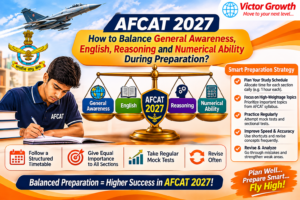

The final 30 days before the AFCAT 2027 examination are extremely important for every defence aspirant. At this stage, candidates should focus on revising important topics, improving accuracy, practising mock tests and strengthening their examination strategy rather than trying to study everything from the beginning.
A well-planned preparation strategy can help candidates make the best use of their remaining time and improve their chances of qualifying for the next stage of selection.
Whether you are appearing for AFCAT for the first time or attempting it again, the last month should be dedicated to smart revision, regular practice and effective time management.
In this article, let’s explore a practical 30-day preparation strategy to help AFCAT 2027 aspirants achieve better results.
1. Understand the AFCAT Exam Pattern
Before starting your final revision, understand the examination pattern. AFCAT is a computer-based examination consisting of four major sections.
Subject | Important Areas |
|---|---|
General Awareness | History, Geography, Polity, Science and Current Affairs |
English | Grammar, Vocabulary and Comprehension |
Numerical Ability | Percentages, Averages, Ratios and Basic Mathematics |
Reasoning and Military Aptitude | Verbal and Non-Verbal Reasoning, Logical Ability |
The examination generally consists of 100 questions for 300 marks, with a duration of two hours.
Correct answer: +3 marks.
Incorrect answer: -1 mark.
Unattempted question: 0 marks.
Understanding the exam pattern helps candidates plan their time and avoid unnecessary negative marking.
2. 30-Day AFCAT Preparation Plan
A proper timetable is essential during the final month. Divide your preparation into three stages to ensure effective revision and practice.
Days 1–10: Revise Important Topics
The first ten days should focus on revising the most important topics from every subject.
General Awareness
Revise important historical events and Indian Geography.
Study Indian Polity and basic Economics.
Revise important scientific developments.
Focus on recent national and international current affairs.
English
Revise important grammar rules.
Practise synonyms and antonyms.
Solve error detection and sentence completion questions.
Improve reading comprehension.
Numerical Ability
Revise percentages, averages and ratios.
Practise profit and loss.
Study time and work, speed and distance.
Revise simple and compound interest.
Reasoning and Military Aptitude
Practise series and analogies.
Revise coding-decoding.
Solve spatial ability questions.
Practise non-verbal reasoning.
Days 11–20: Focus on Mock Tests and Practice
The second stage should focus on improving speed, accuracy and examination performance.
Attempt two or three sectional tests regularly.
Practise full-length mock tests.
Analyse incorrect answers.
Identify topics where you are losing marks.
Revise difficult concepts.
Practise solving questions within the time limit.
Do not simply attempt mock tests to increase the number of tests completed. Spend enough time understanding your mistakes and correcting them.
Days 21–30: Final Revision and Exam Readiness
The final ten days should be dedicated to revision and building confidence.
Revise important formulas and shortcuts.
Go through previously attempted mock tests.
Revise important current affairs.
Practise frequently asked question types.
Avoid starting completely new and difficult topics.
Maintain a proper sleep schedule.
Keep your mind relaxed and focused.
Avoid studying continuously without breaks. A fresh and confident mind is important for good examination performance.
3. Subject-Wise Preparation Tips for the Last 30 Days
A. General Awareness
General Awareness covers a wide range of topics. Focus on important events, static GK and current affairs. Revise important defence exercises, awards, sports events, appointments, government schemes and national developments.
B. English
English can become a scoring section with consistent practice. Focus on grammar, vocabulary, comprehension, idioms and sentence correction. Practise a few questions every day to improve accuracy.
C. Numerical Ability
Do not waste time learning too many new shortcuts during the final month. Concentrate on basic formulas and commonly tested arithmetic topics. Regular calculation practice can improve both speed and accuracy.
D. Reasoning and Military Aptitude
Practise different question patterns regularly. Focus on logical reasoning, number series, analogy, classification, pattern recognition and spatial ability.
4. Importance of Mock Tests in the Final Month
Mock tests play a major role in the final stage of AFCAT preparation. They help candidates understand their actual preparation level and improve their examination strategy.
Some important benefits include:
Improving time management.
Identifying weak subjects.
Increasing speed and accuracy.
Becoming familiar with the online examination format.
Developing confidence under examination pressure.
Try to attempt full-length mock tests under actual examination conditions. After every test, analyse your performance and revise the topics where you made mistakes.
5. Common Mistakes to Avoid During the Last 30 Days
Many candidates lose valuable preparation time by following ineffective strategies during the final month.
Avoid these common mistakes:
Starting Too Many New Topics: Focus on revising what you already know instead of trying to complete everything at the last minute.
Ignoring Weak Subjects: Give additional attention to subjects where your performance is poor.
Avoiding Mock Tests: Regular practice is essential to understand your preparation level.
Ignoring Negative Marking: Avoid random guessing and attempt questions carefully.
Studying Without a Timetable: Divide your available time between all four sections.
Ignoring Health and Sleep: Avoid excessive late-night studying and maintain a healthy routine.
6. Daily Study Timetable for AFCAT 2027
A consistent daily routine can help candidates cover all four sections without unnecessary pressure.
Here is a suggested timetable for the final 30 days:
Time | Subject / Activity |
|---|---|
7:00 AM – 8:00 AM | General Awareness |
8:00 AM – 9:00 AM | English |
10:00 AM – 11:00 AM | Numerical Ability |
11:00 AM – 12:00 PM | Reasoning and Military Aptitude |
2:00 PM – 3:00 PM | Mock Test / Sectional Practice |
4:00 PM – 5:00 PM | Revision and Error Analysis |
Candidates can adjust this timetable according to their availability and preparation level. The important thing is to maintain consistency and give sufficient attention to every subject.
7. How Victor Growth Helps You Prepare for AFCAT 2027
Preparing for AFCAT requires a combination of conceptual understanding, regular practice, effective revision and proper examination guidance.
Victor Growth, located in Kadavanthra, Kochi, provides structured coaching and guidance for aspirants preparing for NDA, AFCAT and CDS examinations.
For candidates searching for the best NDA coaching in Kerala, Victor Growth focuses on helping defence aspirants build a strong foundation, improve examination performance and develop the confidence required for competitive defence examinations.
With proper guidance, regular practice and a disciplined preparation strategy, candidates can make their final 30 days more productive.
8. Frequently Asked Questions (FAQs)
1. Is 30 days enough to prepare for AFCAT 2027?
Yes, 30 days can be useful for candidates who have already covered the basic syllabus. Focused revision, mock tests and regular practice can help improve performance.
2. How many hours should I study daily during the last month?
Ideally, dedicate 5–6 focused hours daily, depending on your preparation level. Consistency and effective revision are more important than simply increasing study hours.
3. How many mock tests should I attempt in the last 30 days?
You can aim for two or three full-length mock tests per week, along with regular sectional tests. Always analyse your performance after each test.
4. Which subject should I focus on more during the final month?
Give attention to all four sections. However, spend additional time on subjects where you consistently score fewer marks.
5. Should I study new topics during the last 30 days?
Focus mainly on revision and practice. You can study small, manageable new topics if necessary, but avoid starting lengthy and difficult chapters during the final few days.
6. How can I improve my AFCAT score quickly?
Practise previous years’ questions, revise important concepts, attempt mock tests and analyse mistakes. Improving accuracy and avoiding unnecessary negative marking can also help.
7. Is current affairs important for AFCAT 2027?
Yes. Current affairs form an important part of General Awareness. Revise important national and international events, defence news, awards, sports and government initiatives.
8. What should I do one day before the AFCAT examination?
Revise important formulas and short notes, check your examination details and required documents, avoid lengthy mock tests and get sufficient sleep.
Conclusion
The last 30 days before AFCAT 2027 can significantly influence your examination performance. Instead of studying randomly, follow a structured timetable, revise important topics, practise mock tests and work on your weak areas.
Remember, success in AFCAT is not just about how many hours you study but how effectively you use your preparation time.
Stay disciplined, remain confident and give your best effort.
Prepare with Victor Growth and take your next step towards becoming an Indian Air Force officer!