The Indian Air Force (IAF) Flying Branch is one of the most prestigious career options for young graduates who dream of becoming fighter, transport or helicopter pilots. Through the Air Force Common Admission Test (AFCAT), eligible candidates can apply for a commission in the Flying Branch and begin an exciting career as an officer in the Indian Air Force.
AFCAT 2027 is an important opportunity for aspirants who want to serve the nation while building a challenging and rewarding career. Understanding the eligibility criteria, selection process, training programme and career opportunities is essential before starting preparation.
For candidates preparing through the best NDA coaching in Kerala, understanding the AFCAT examination structure and requirements can also help build a strong foundation for a career in the defence forces.
1. What Is the AFCAT Flying Branch?
The Flying Branch is responsible for operating and managing different aircraft of the Indian Air Force. Officers selected through this branch receive specialised flying training and are assigned to different aircraft based on their performance, aptitude and service requirements.
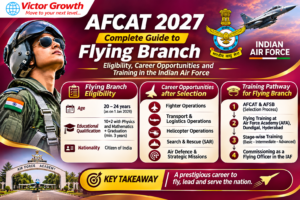
The Flying Branch generally offers three major types of flying roles:
Fighter Pilots: Operate fighter aircraft for combat, air defence and tactical missions.
Transport Pilots: Fly transport aircraft to carry personnel, equipment and essential supplies.
Helicopter Pilots: Operate helicopters for rescue operations, transportation, surveillance and other missions.
A career in the Flying Branch requires discipline, physical fitness, mental strength and excellent decision-making abilities.
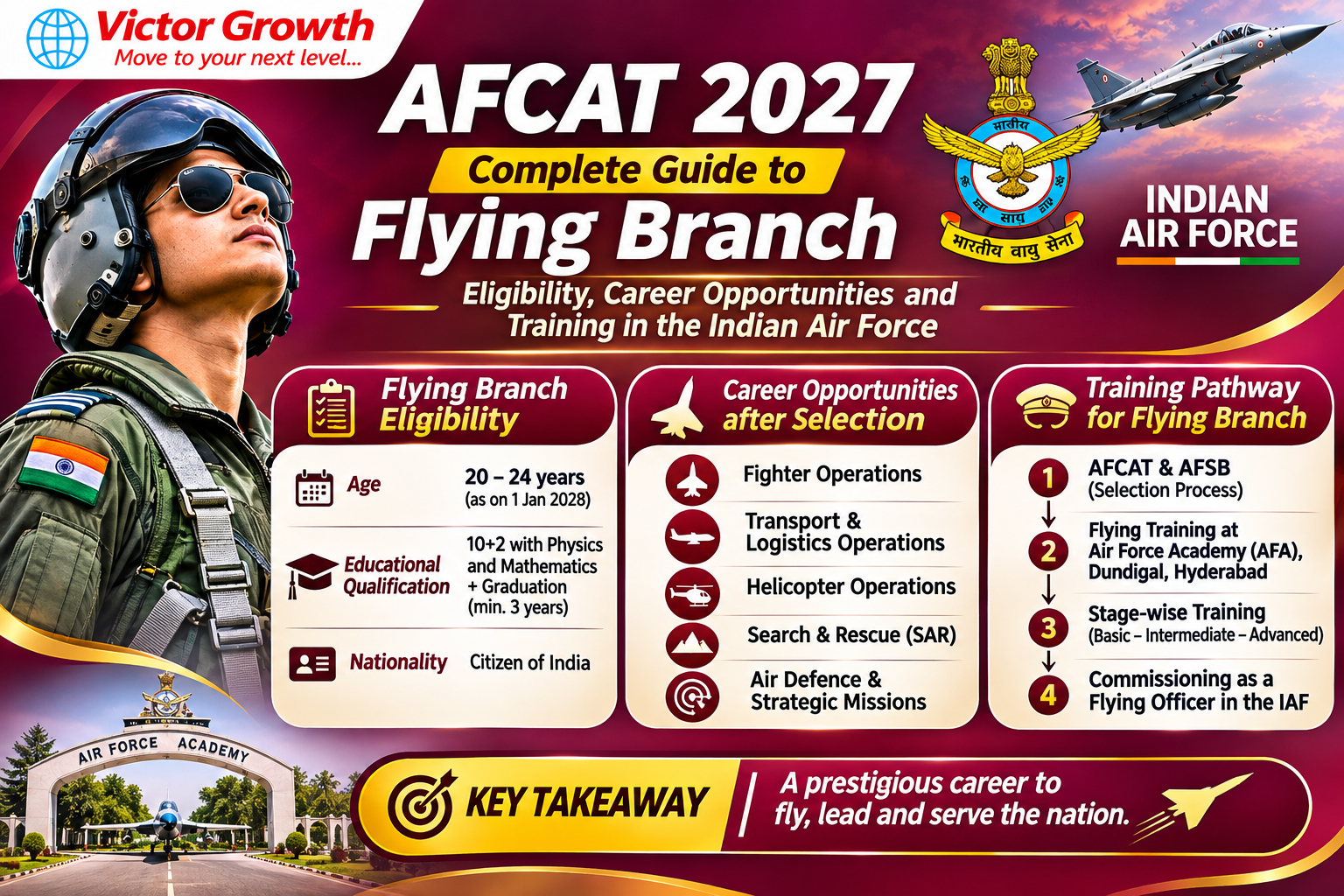
2. AFCAT 2027 Flying Branch Eligibility Criteria
Candidates must satisfy the prescribed educational, age and physical requirements to apply for the Flying Branch.
Age Limit
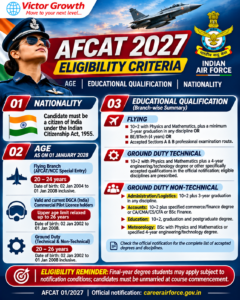
Flying Branch: 20 to 24 years.
Candidates holding a valid and current Commercial Pilot Licence (CPL) issued by DGCA may receive age relaxation up to 26 years, subject to official notification conditions.
Educational Qualification
Candidates must have:
Passed Class 12 with Mathematics and Physics, securing at least 50% marks in each subject.
A minimum of 60% marks in graduation (three-year degree course) or BE/BTech (four-year degree course) from a recognised university.
Candidates with equivalent qualifications recognised by the relevant authorities may also be eligible, subject to the official notification.
Nationality: Candidates must be Indian citizens.
Marital Status: Candidates must satisfy the marital status conditions specified in the AFCAT notification.
3. AFCAT 2027 Flying Branch Selection Process
The selection process involves multiple stages to evaluate candidates’ knowledge, personality, intelligence and suitability for a flying career.
AFCAT Written Examination: Candidates must qualify in the online examination covering General Awareness, Verbal Ability in English, Numerical Ability, Reasoning and Military Aptitude.
AFSB Interview: Shortlisted candidates attend the Air Force Selection Board (AFSB), where their officer-like qualities, communication skills and leadership abilities are assessed.
Computerised Pilot Selection System (CPSS): Flying Branch candidates must qualify in the pilot aptitude assessment. It is generally a once-in-a-lifetime test.
Medical Examination: Candidates undergo detailed medical and physical examinations according to Indian Air Force standards.
Final Merit List: Selection depends on performance, medical fitness, vacancies and merit.
Passing the written examination alone does not guarantee selection. Candidates must successfully complete all the required stages.
4. AFCAT Flying Branch Exam Pattern
The AFCAT written examination is conducted online and consists of objective-type questions.
Subject | Topics covered |
|---|---|
General Awareness | History, Geography, Polity, Science, Defence and Current Affairs |
English | Grammar, Vocabulary, Comprehension and Verbal Ability |
Numerical Ability | Mathematics, Arithmetic and Basic Calculations |
Reasoning and Military Aptitude | Verbal and Non-Verbal Reasoning |
Total questions: 100
Total marks: 300
Duration: 2 hours
Correct answer: +3 marks
Incorrect answer: -1 mark
Unattempted question: 0 marks
Candidates should focus on accuracy, time management and regular mock tests to improve their performance.
5. Training Programme at the Air Force Academy
Candidates selected for the Flying Branch undergo training at the Air Force Academy (AFA), Dundigal, Hyderabad.
For AFCAT 01/2027, training is scheduled to commence in January 2028. The notification specifies a 74-week training duration for Flying Branch candidates.
The training programme includes:
1. Military Training
Cadets receive military education, discipline training, physical conditioning and leadership development.
2. Ground Training
Candidates learn aviation fundamentals, aircraft systems, navigation, meteorology, flight rules and safety procedures.
3. Flying Training
Cadets undergo practical flying training using training aircraft. They gradually develop essential flying skills under the supervision of qualified instructors.
4. Specialised Aircraft Training
After completing the required stages, candidates progress towards specialised training and aircraft allocation according to their performance and service requirements.
The training is demanding and requires dedication, physical fitness and the ability to perform under pressure.
6. Career Opportunities in the AFCAT Flying Branch
Joining the Flying Branch offers several exciting career opportunities.
Fighter Pilot: Operates advanced fighter aircraft and participates in combat and air defence operations.
Transport Pilot: Operates transport aircraft for personnel movement, logistics and strategic missions.
Helicopter Pilot: Supports rescue missions, disaster relief, transportation and operational requirements.
Apart from flying aircraft, officers develop leadership, teamwork, operational planning and decision-making skills. These experiences also provide valuable professional development.
7. Salary and Benefits of an AFCAT Flying Officer
Candidates commissioned into the Indian Air Force receive an attractive salary package and several service benefits.
Basic pay: ₹56,100 per month (Flying Officer, Level 10).
Military Service Pay (MSP): ₹15,500 per month.
Flight Cadet stipend during training: ₹56,100 per month.
Flying Allowance and other applicable allowances.
Medical facilities for officers and eligible dependants.
Accommodation and other service-related facilities.
Additional allowances depend on the nature of duties, posting and applicable service rules.
Important: AFCAT Flying Branch officers are granted a Short Service Commission (SSC) for 14 years from the date of commissioning. Candidates should understand the service conditions before applying.
8. How to Prepare for AFCAT 2027 Flying Branch
A well-planned preparation strategy can help candidates improve their chances of clearing the examination and succeeding in the selection process.
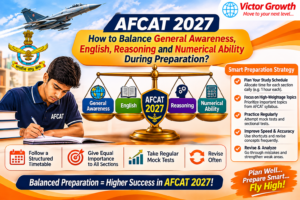
Understand the syllabus: Study the complete AFCAT syllabus and identify important topics.
Improve English: Practise grammar, vocabulary, comprehension and sentence correction.
Practise Mathematics: Focus on arithmetic, percentages, ratios, averages and time-based problems.
Read Current Affairs: Follow national news, international developments, defence updates and important events.
Develop Reasoning Skills: Practise verbal and non-verbal reasoning questions regularly.
Take Mock Tests: Attempt previous-year questions and full-length mock examinations to improve speed and accuracy.
Prepare for AFSB: Develop communication skills, confidence, leadership qualities and decision-making abilities.
Maintain Fitness: Follow a regular exercise routine and maintain a healthy lifestyle.
Candidates should prepare for the written examination and AFSB interview simultaneously rather than waiting until the written results are announced.
9. Why Choose the Best NDA Coaching in Kerala for Defence Exam Preparation?
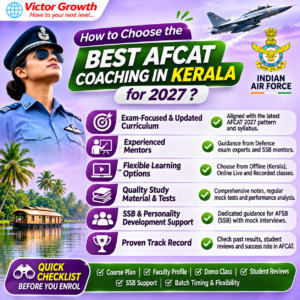
Choosing the right defence coaching institute can make a difference in a candidate’s preparation journey. Students looking for the best NDA coaching in Kerala should consider institutes that provide structured guidance, experienced faculty, regular mock tests and individual attention.
A good defence coaching programme can help aspirants strengthen their English, Mathematics, General Awareness and Reasoning skills. It can also support personality development, communication skills and interview preparation.
At Victor Growth, Kochi, aspirants can seek guidance for defence competitive examinations and build the knowledge and confidence required to pursue their goals in the Indian Armed Forces.
Candidates should choose a preparation programme based on their examination requirements, learning needs and long-term defence career ambitions.
10. Frequently Asked Questions (FAQs)
1. Can both male and female candidates apply for the AFCAT Flying Branch?
Yes. Both male and female candidates can apply for the Flying Branch through AFCAT, subject to eligibility requirements and available vacancies.
2. What is the age limit for AFCAT 2027 Flying Branch?
The age limit is 20–24 years. Candidates with a valid and current DGCA Commercial Pilot Licence can receive relaxation up to 26 years, subject to applicable conditions.
3. Is Mathematics compulsory for the AFCAT Flying Branch?
Yes. Candidates must have studied Mathematics and Physics in Class 12 and secured at least 50% marks in each subject.
4. Can candidates from Arts or Commerce backgrounds apply?
Yes. Candidates from any graduation stream can apply if they meet the prescribed Class 12 Physics and Mathematics requirements and the required graduation marks.
5. Where does Flying Branch training take place?
Flying Branch training takes place at the Air Force Academy, Dundigal, Hyderabad.
6. How long is the AFCAT Flying Branch training?
For AFCAT 01/2027, the notified training duration is 74 weeks.
7. Is AFCAT enough to become a fighter pilot?
No. Clearing AFCAT is only the first stage. Candidates must qualify in the AFSB selection process, CPSS, medical examination and final merit selection. Fighter aircraft allocation depends on performance and service requirements.
8. What is the salary of an AFCAT Flying Officer?
The basic pay is ₹56,100 per month, along with Military Service Pay of ₹15,500 and applicable allowances.
9. What is the commission period for AFCAT Flying Branch officers?
The Flying Branch offers a 14-year Short Service Commission from the date of commissioning.
10. When can candidates apply for AFCAT 01/2027?
As per the AFCAT 01/2027 notification, applications are open from 12 November to 11 December 2026 for courses commencing in January 2028.
Conclusion
The AFCAT 2027 Flying Branch offers an excellent opportunity for graduates who dream of becoming pilots in the Indian Air Force. From operating advanced aircraft to participating in important national missions, the career provides professional growth, responsibility and the honour of serving the country.
Candidates should start their preparation early, understand the eligibility requirements and develop the academic, physical and personality skills needed for selection.
With consistent preparation and the right guidance from the best NDA coaching in Kerala, defence aspirants can take confident steps towards achieving their dream of joining the Indian Air Force.