1. Background and Context
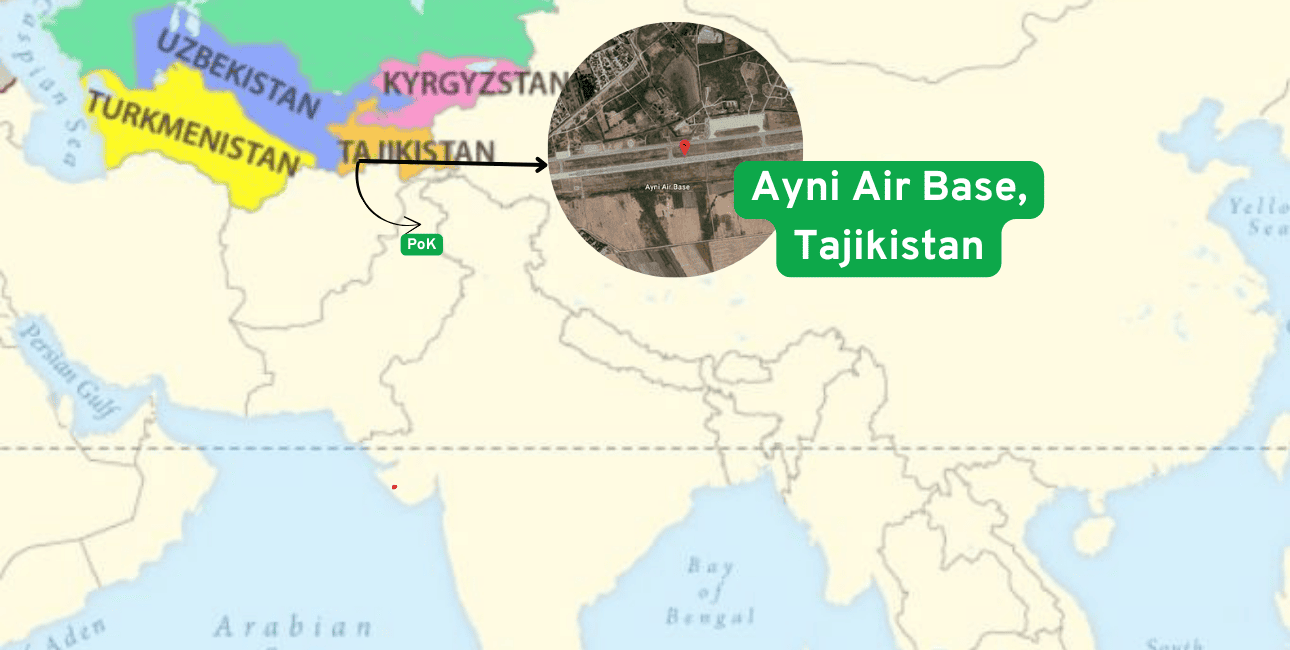
Location: Ayni Airbase is located near Dushanbe, the capital of Tajikistan (about 15–20 km west).
Significance: It was India’s only overseas military facility, representing a unique experiment in projecting Indian military and strategic power beyond South Asia.
Current status: Two decades after its establishment, India’s operational presence at Ayni has reportedly come to an end — marking the closure of India’s first and only foreign military base initiative.
2. Geopolitical Setting and Origins
(a) Post-9/11 Geopolitical Context
After the 9/11 attacks (2001) and the subsequent U.S.-led invasion of Afghanistan, global geopolitics opened new alignments in Central Asia.
India sought to play a more active role in the region to secure its long-term strategic interests, especially amid growing U.S., Russian, and Chinese activity there.
(b) Kargil War Lessons (1999)
The Kargil Review Committee (1999) highlighted deficiencies in India’s:
Intelligence gathering,
Early warning systems, and
Strategic reach beyond its immediate neighbourhood.
Strengthening India’s presence in Central Asia was viewed as a way to enhance strategic depth and surveillance capacity against threats from Pakistan and Afghanistan.
(c) Strategic Vision under Vajpayee Government
The government of Atal Bihari Vajpayee (2002) acted on advice from strategic thinkers who advocated power projection beyond the subcontinent.
Tajikistan, geographically central to Eurasia and close to Afghanistan, was seen as a natural partner.
3. Development of the Ayni Airbase
(a) Infrastructure Investment
India, through its Air Force and Border Roads Organisation (BRO), invested around $70 million to upgrade and reconstruct the base.
Upgrades included:
A 3,200-meter runway capable of handling most military aircraft.
New hangars, fuel depots, and maintenance facilities.
These developments turned Ayni into a fully operational dual-use airbase.
(b) Strategic Capabilities
The base’s location provided:
Proximity to Pakistan-occupied Kashmir (PoK) — about 20 km via the Wakhan Corridor.
Easy access to Afghanistan’s northern border, enabling monitoring and rapid deployment potential.
Symbolically, it marked India’s ability to operate west of the Himalayas without depending on Pakistan for transit routes.
4. Strategic Rationale and Objectives
Regional Power Projection: Establish India as a stakeholder in Central Asian security.
Counterterrorism: Support operations and intelligence in Afghanistan post-9/11.
Balancing Influence: Serve as a counterbalance to Chinese and Pakistani strategic presence.
Energy and Connectivity: Deepen engagement in Central Asia’s energy-rich landscape.
Diplomatic Symbolism: Showcase India as a capable and confident regional power.
5. Decline of Indian Presence
(a) Russian Reluctance
Tajikistan remains within Russia’s strategic sphere of influence.
Moscow was reluctant to support a permanent Indian presence at Ayni, preferring to maintain control through its 201st Motor Rifle Division stationed there.
Russia’s dominance in Tajikistan’s defense policy limited India’s operational autonomy.
(b) China’s Expanding Role
The rise of China’s Belt and Road Initiative (BRI) and its growing security footprint (including a presence near the Tajik-Afghan border) reshaped regional geopolitics.
Tajikistan’s “multi-vector” diplomacy—balancing between powers—tilted toward Russia and China, reducing space for India.
(c) Changing Security Context
The U.S. withdrawal from Afghanistan (2021) and Taliban’s return changed the regional strategic environment.
With diminishing prospects for direct security engagement in Afghanistan, Ayni’s operational relevance for India reduced.
6. Lessons and Strategic Implications
Limits of Indian Power Projection
Demonstrates India’s challenges in sustaining overseas bases due to geopolitical constraints, logistics, and competing great-power interests.
Dependence on Regional Powers
Highlights India’s reliance on Russia’s goodwill for regional access—limiting true strategic autonomy in Eurasia.
Fragility of “Multi-Vector” Diplomacy
Central Asian states balance between multiple powers; their alignment can shift quickly under pressure from Russia or China.
Need for Hybrid Strategic Models
Future Indian strategy may need to rely more on dual-use infrastructure, defense partnerships, and logistical agreements (like with Oman, Singapore, or France) rather than full-scale bases.
Importance of Connectivity and Partnerships
Strengthening projects like Chabahar Port, International North–South Transport Corridor (INSTC), and engagement with SCO becomes crucial for maintaining strategic access.
7. Conclusion
The Ayni Airbase episode stands as a case study in India’s evolving approach to external military presence.
It reflects both India’s ambitions to project power beyond its borders and the structural constraints that limit such ambitions in contested geopolitical spaces.
Going forward, India’s focus is likely to shift toward flexible partnerships, logistical support agreements, and regional cooperation mechanisms instead of permanent overseas bases.
UPSC Relevance
Mains GS Paper II & III Themes:
International Relations – India and its neighborhood, Central Asia policy
Security – Strategic depth, power projection, military diplomacy
India’s foreign policy evolution post-Kargil and post-9/11
Great power competition in Eurasia
Possible UPSC Question:
“The story of India’s Ayni airbase in Tajikistan reflects both the ambition and constraints of India’s power projection in Eurasia.” Discuss.