
Introduction
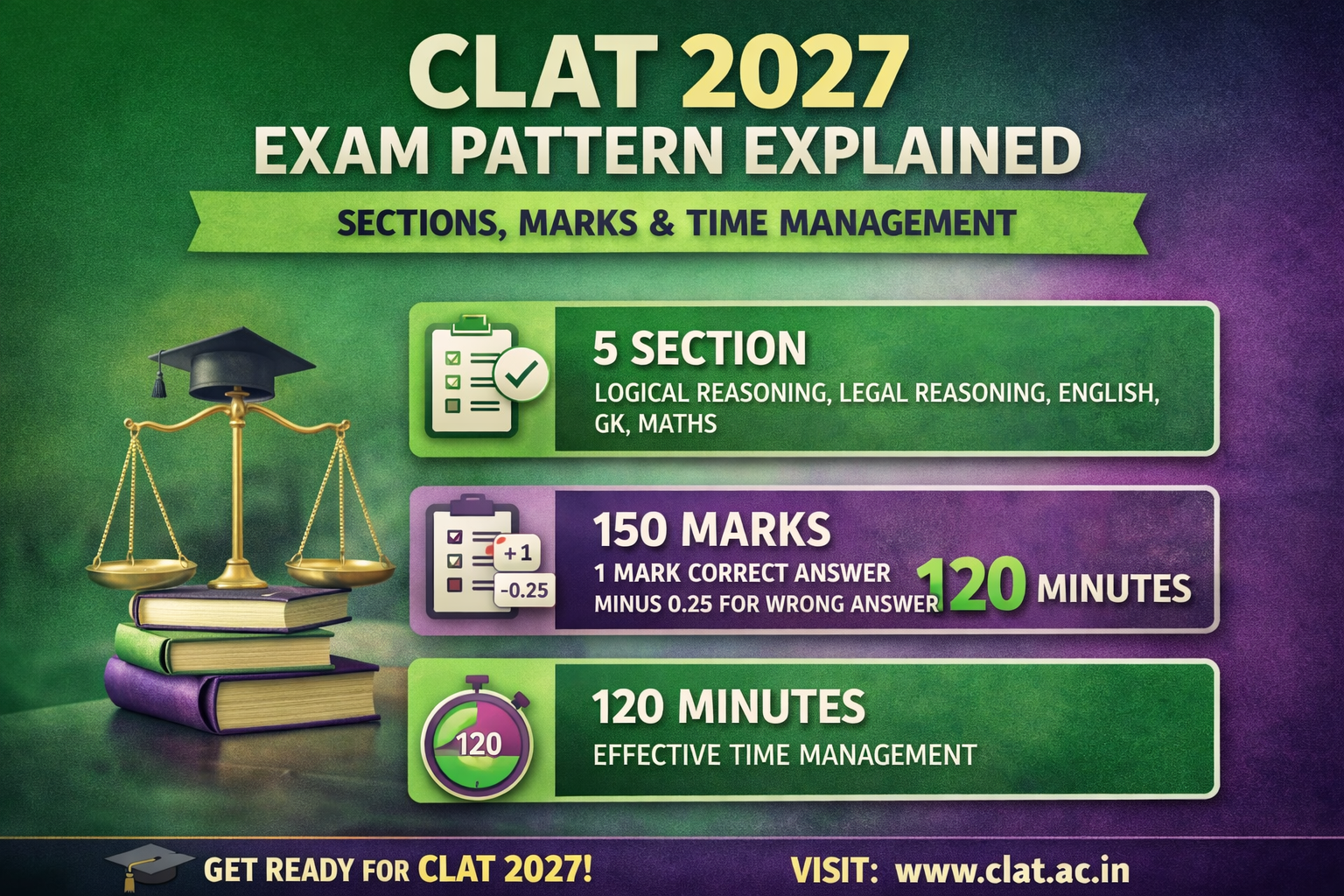
Understanding the CLAT 2027 exam pattern is the first and most crucial step for aspirants aiming to secure admission into National Law Universities (NLUs). A clear grasp of the sections, marking scheme, and time management strategy helps candidates prepare smartly and improve their chances of success in this highly competitive law entrance examination.
In this article, we provide a complete breakdown of the CLAT 2027 exam pattern, including section-wise marks distribution, question format, negative marking, and effective time management tips.
📌 CLAT 2027 Exam Overview
Exam Name: Common Law Admission Test (CLAT) 2027
Conducting Authority: Consortium of National Law Universities
Mode of Exam: Offline (Pen & Paper)
Duration: 2 Hours (120 Minutes)
Type of Questions: Multiple Choice Questions (MCQs)
Total Questions: 120 (Approximate)
📝 CLAT 2027 Exam Pattern – Key Highlights
Passage-based comprehension questions
Focus on reading, reasoning, and application of concepts
No descriptive or subjective questions
Negative marking applicable
📚 CLAT 2027 Section-Wise Exam Pattern (UG)
The CLAT UG exam consists of five sections, each designed to test a specific skill set.
🧠 1. English Language
What This Section Tests
Reading comprehension
Vocabulary and grammar usage
Inference and tone recognition
Question Format
450–500 word passages
MCQs based on comprehension
Expected Weightage
22–26 questions
22–26 marks
Key Skills Required
Fast reading
Contextual vocabulary understanding
Logical interpretation
🌍 2. Current Affairs & General Knowledge
What This Section Tests
Awareness of current national and international events
Static GK linked with current affairs
Question Format
Passage-based questions
Questions derived from news events
Expected Weightage
28–32 questions
28–32 marks
Key Focus Areas
Polity & governance
International relations
Sports, awards, and appointments
⚖️ 3. Legal Reasoning
What This Section Tests
Legal aptitude
Application of legal principles to factual situations
Question Format
Legal passages followed by MCQs
No prior legal knowledge required
Expected Weightage
28–32 questions
28–32 marks
Important Topics
Constitutional principles
Law of Torts
Contract law (basic concepts)
🔍 4. Logical Reasoning
What This Section Tests
Analytical thinking
Logical relationships and arguments
Question Format
Short passages
Argument-based MCQs
Expected Weightage
22–26 questions
22–26 marks
Skills Required
Identifying assumptions
Drawing conclusions
Evaluating arguments
🔢 5. Quantitative Techniques
What This Section Tests
Basic numerical ability
Data interpretation skills
Question Format
Graphs, tables, and charts
Short mathematical problems
Expected Weightage
10–14 questions
10–14 marks
Level of Difficulty
Class 10 standard mathematics
📊 CLAT 2027 Marks Distribution & Marking Scheme
| Particulars | Details |
|---|---|
| Total Questions | 120 |
| Total Marks | 120 |
| Correct Answer | +1 mark |
| Wrong Answer | −0.25 mark |
| Unattempted Question | 0 mark |
📌 Accuracy is crucial due to negative marking.
⏱️ CLAT 2027 Time Management Strategy
With 120 minutes for 120 questions, efficient time management is key.
🕒 Ideal Time Allocation (Suggested)
| Section | Time (Minutes) |
|---|---|
| English Language | 20–25 |
| Current Affairs & GK | 25–30 |
| Legal Reasoning | 30–35 |
| Logical Reasoning | 20–25 |
| Quantitative Techniques | 10–15 |
| Revision / Buffer | 5–10 |
✅ Smart Time Management Tips
Start with strong sections to build confidence
Avoid spending too much time on a single passage
Skip lengthy calculations initially
Keep last 5–10 minutes for review
🎯 How to Approach the CLAT 2027 Paper
Read passages quickly but carefully
Identify keywords and legal principles
Eliminate incorrect options logically
Attempt questions with high accuracy first
🚫 Common Mistakes to Avoid
Blind guessing due to negative marking
Ignoring Quantitative Techniques
Spending too much time on Current Affairs passages
Not practicing mock tests under timed conditions
📈 Importance of Understanding CLAT 2027 Exam Pattern
Helps in creating an effective study plan
Improves speed and accuracy
Reduces exam-day anxiety
Enables strategic mock test practice
❓ Frequently Asked Questions (FAQs)
Q1. How many questions are there in CLAT 2027?
CLAT 2027 is expected to have 120 multiple-choice questions.
Q2. Is there negative marking in CLAT 2027?
Yes, 0.25 marks are deducted for every incorrect answer.
Q3. Which section carries the highest weightage in CLAT?
Legal Reasoning and Current Affairs & GK usually carry the highest weightage.
Q4. Is Quantitative Techniques difficult in CLAT?
No, it is based on Class 10-level mathematics and focuses on data interpretation.
Q5. Can I change the order of sections while attempting CLAT?
Yes, candidates can attempt sections in any order.
Q6. How important is time management in CLAT 2027?
Time management is extremely important as the paper is passage-heavy and time-bound.
Conclusion
A thorough understanding of the CLAT 2027 exam pattern—including sections, marks distribution, and time strategy—can significantly enhance your performance. By aligning your preparation with the exam structure and practicing under real-time conditions, you can maximize your score and secure a seat in a top National Law University.