
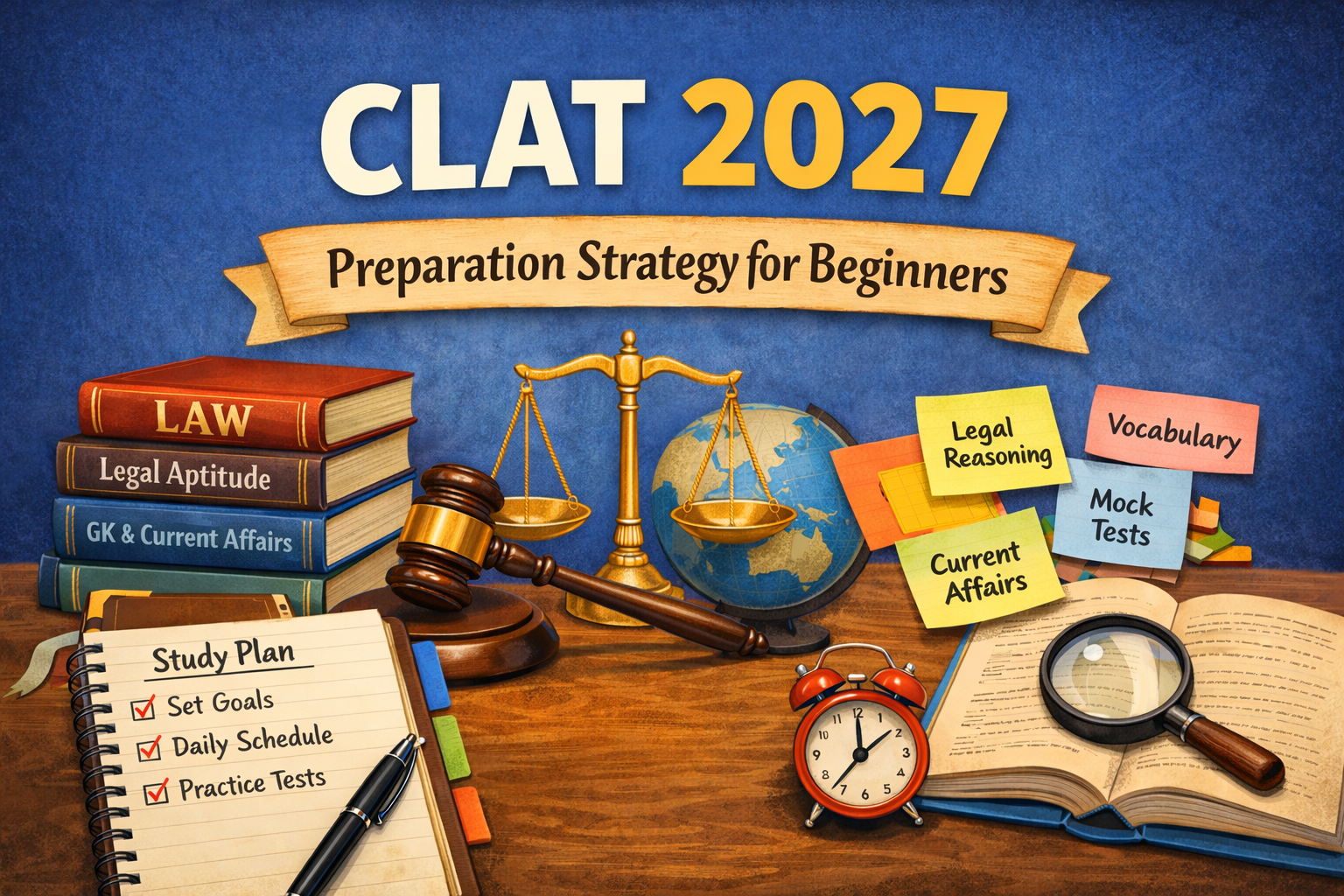
Preparing for CLAT 2027 as a beginner can feel overwhelming at first, especially if you are unfamiliar with law entrance exams. The good news is that CLAT does not test rote learning—it tests comprehension, reasoning, and application skills. With the right strategy, even absolute beginners can crack CLAT and secure admission to top National Law Universities (NLUs).
This article provides a complete CLAT 2027 preparation strategy for beginners, covering exam overview, section-wise preparation, study plans, reading habits, mock test strategy, and common mistakes to avoid.
What Is CLAT & Why Beginners Can Crack It
The Common Law Admission Test (CLAT) is a national-level entrance exam for undergraduate and postgraduate law programs offered by NLUs.
CLAT is beginner-friendly because:
No prior legal knowledge is required
Questions are passage-based
Focus is on logic, comprehension, and current affairs
School-level math and English are sufficient
CLAT 2027 Exam Overview (For Beginners)
Mode of Exam: Offline (Pen & Paper)
Duration: 2 Hours
Total Questions: Around 120
Question Type: Passage-based MCQs
Marking Scheme:
+1 mark for correct answer
−0.25 mark for wrong answer
Understanding the pattern early helps beginners plan effectively.
Step 1: Understand the CLAT 2027 Syllabus
CLAT 2027 consists of five sections:
English Language
Current Affairs & General Knowledge
Legal Reasoning
Logical Reasoning
Quantitative Techniques
All sections are passage-based, meaning reading and comprehension skills are crucial.
Step 2: Build a Strong Reading Habit (Most Important)
For beginners, reading is the foundation of CLAT preparation.
What to Read Daily:
Newspapers (editorials & opinion columns)
General articles on social, legal, and political issues
Editorial summaries and legal news
Benefits of Reading:
Improves reading speed
Enhances comprehension
Builds vocabulary
Strengthens reasoning ability
Aim for 60–90 minutes of reading daily.
Step 3: Section-Wise CLAT 2027 Preparation Strategy
1. English Language (For Beginners)
Focus Areas:
Reading comprehension
Vocabulary in context
Tone and inference
How to Prepare:
Read English articles daily
Practice RC passages regularly
Avoid memorising vocabulary—learn through usage
2. Current Affairs & General Knowledge
This section often decides rank.
Focus Areas:
National & international current affairs
Legal current affairs
Polity, economy, and static GK linked with news
Beginner Tips:
Read daily news summaries
Make short monthly notes
Revise regularly instead of cramming
3. Legal Reasoning (Beginner-Friendly Section)
No legal background needed.
Focus Areas:
Legal principles
Application of rules to facts
Legal maxims through examples
How to Prepare:
Understand principles first
Practice application-based questions
Read legal current affairs
4. Logical Reasoning
This section tests thinking skills.
Focus Areas:
Arguments and conclusions
Assumptions and inferences
Cause-effect reasoning
Beginner Tips:
Read the passage carefully
Practice regularly
Focus on accuracy over speed
5. Quantitative Techniques
Math is basic but passage-based.
Topics Covered:
Percentages
Ratios
Averages
Profit & Loss
Graphs and tables
Beginner Strategy:
Revise Class 6–10 concepts
Practice calculation speed
Attempt only doable questions
Step 4: Ideal Study Plan for Beginners
Daily Study Time (Beginners)
2–3 hours (Class 11)
3–4 hours (Class 12 or droppers)
Sample Daily Routine
Reading & English: 1 hour
GK & Current Affairs: 45 minutes
Legal/Logical Reasoning: 1 hour
Quantitative Practice: 30 minutes
Consistency matters more than long study hours.
Step 5: When & How to Start Mock Tests
For Beginners
Start with sectional tests
Move to full-length mocks after basics
Attempt mocks in exam-like conditions
Mock Analysis Is Crucial
Analyse mistakes carefully
Identify weak sections
Improve time management
Step 6: Common Mistakes Beginners Must Avoid
Ignoring reading practice
Memorising GK without understanding
Avoiding legal reasoning
Skipping mock test analysis
Starting preparation too late
Step 7: Final 6-Month Strategy for Beginners
Regular reading and revision
Weekly mock tests
Focus on strong sections
Improve accuracy
Avoid negative marking
Conclusion
CLAT 2027 is highly achievable for beginners if preparation is started early and done smartly. By building strong reading habits, understanding concepts clearly, practicing regularly, and analysing mock tests, beginners can confidently crack CLAT and secure a seat in a top National Law University.
Frequently Asked Questions (FAQs)
Q1. Is CLAT 2027 difficult for beginners?
No. CLAT is designed to test comprehension and reasoning, not prior legal knowledge.
Q2. How many hours should a beginner study for CLAT?
2–4 focused hours daily are sufficient if used consistently.
Q3. Can beginners crack CLAT without coaching?
Yes. Self-study with proper resources and mock tests is enough.
Q4. Is math compulsory in CLAT?
Yes, but it is basic and passage-based.
Q5. When should beginners start mock tests?
After basic understanding of sections, preferably within 2–3 months of preparation.