
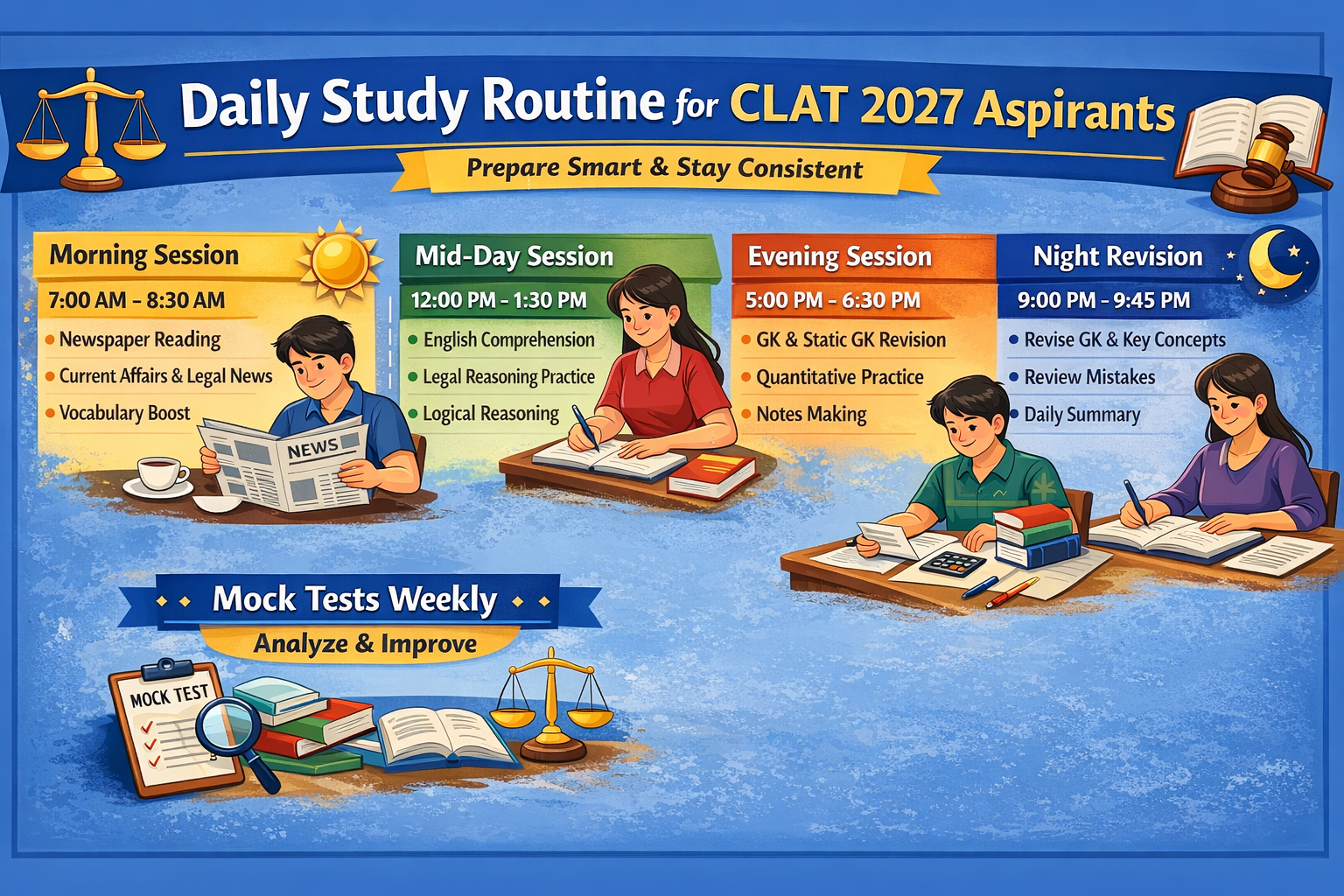
A well-structured daily study routine for CLAT 2027 aspirants is the key to building strong reading skills, improving reasoning ability, and mastering current affairs without stress. Since CLAT is a passage-based and time-bound exam, success depends more on daily consistency than on studying for long hours occasionally.
This article provides a complete daily study routine for CLAT 2027, including time allocation, section-wise focus, tips for school students and droppers, and expert advice to stay productive.
Why a Daily Study Routine Is Important for CLAT 2027
CLAT tests comprehension, reasoning, and application—not memorisation. A fixed daily routine helps you:
Build strong reading habits
Stay updated with current affairs
Improve accuracy and speed
Balance all five sections
Avoid last-minute panic
CLAT 2027 Exam Structure (Quick Recap)
Mode: Offline (Pen & Paper)
Duration: 2 Hours
Questions: Around 120 (Passage-based MCQs)
Sections:
English Language
Current Affairs & General Knowledge
Legal Reasoning
Logical Reasoning
Quantitative Techniques
Ideal Daily Study Hours for CLAT 2027 Aspirants
Class 11 students: 2–3 hours
Class 12 students: 3–4 hours
Droppers: 4–6 hours
Quality and consistency matter more than total hours.
Daily Study Routine for CLAT 2027 Aspirants (Ideal Schedule)
Morning Routine (1–1.5 Hours)
Focus: Reading & Awareness Building
Newspaper reading (editorials + opinion pages)
Legal and constitutional news
Important national & international events
Why Morning Reading Matters:
Improves reading speed and comprehension
Strengthens English and Legal Reasoning
Builds strong GK foundation
Mid-Day Study Session (1–1.5 Hours)
Focus: Core Sections
English comprehension practice
Legal Reasoning passages
Logical Reasoning exercises
Key Tip:
Focus on accuracy and understanding, not speed.
Evening Study Session (1–1.5 Hours)
Focus: GK + Quantitative Techniques
Current affairs note-making
Static GK revision linked with news
Quantitative Techniques practice (tables, graphs, calculations)
Night Revision Session (30–45 Minutes)
Focus: Consolidation & Revision
Revise GK notes
Review mistakes made during practice
Short revision of important concepts
Section-Wise Daily Time Allocation
| Section | Daily Time |
|---|---|
| Reading & English | 60–90 minutes |
| GK & Current Affairs | 45–60 minutes |
| Legal Reasoning | 45–60 minutes |
| Logical Reasoning | 30–45 minutes |
| Quantitative Techniques | 30 minutes |
| Revision | 30 minutes |
Daily Study Routine for School-Going CLAT Aspirants
Recommended Hours: 2–3 hours
Reading & GK: 1 hour
Legal/Logical Reasoning: 1 hour
Light revision: 30 minutes
Balance school studies and CLAT prep smartly.
Daily Study Routine for Droppers
Recommended Hours: 4–6 hours
Reading & GK: 2 hours
Legal + Logical Reasoning: 2 hours
Quantitative Techniques: 1 hour
Mock analysis & revision: 1 hour
When to Include Mock Tests in Daily Routine
Sectional tests: 2–3 times a week
Full-length mocks: Once a week (increase later)
Mock Analysis Is Mandatory:
Identify weak sections
Improve time management
Reduce negative marking
Common Mistakes to Avoid in Daily Routine
Skipping newspaper reading
Ignoring GK revision
Studying one section excessively
Avoiding mock test analysis
Studying without breaks
Tips to Stay Consistent Every Day
Fix a realistic timetable
Track daily progress
Take short breaks to avoid burnout
Avoid social media distractions
Focus on improvement, not perfection
Conclusion
A disciplined daily study routine for CLAT 2027 aspirants builds the skills required to crack the exam confidently. Regular reading, balanced section-wise practice, and consistent revision are the keys to success. Stick to a routine, stay patient, and trust the process—a top NLU seat is within reach.
Frequently Asked Questions (FAQs)
Q1. How many hours should I study daily for CLAT 2027?
2–3 hours for beginners, 4–6 hours for serious aspirants.
Q2. Is daily newspaper reading compulsory for CLAT?
Yes, it is essential for English, GK, and Legal Reasoning.
Q3. Can I skip Quantitative Techniques daily?
No. Even 20–30 minutes daily improves accuracy significantly.
Q4. Should I study all sections every day?
Yes, but you can rotate focus while ensuring revision.
Q5. When should I start daily mock tests?
After basic preparation, gradually include them in your routine.