How the Best IAS Coaching in Kerala Builds Future Leaders Through Better Decision-Making
Decision-making is one of the most valuable life skills a student can develop. Every successful IAS officer is expected to make informed, ethical, and timely decisions that impact thousands—even millions—of people. However, these skills are not developed overnight during UPSC preparation. They begin much earlier through structured learning, critical thinking, and consistent practice.
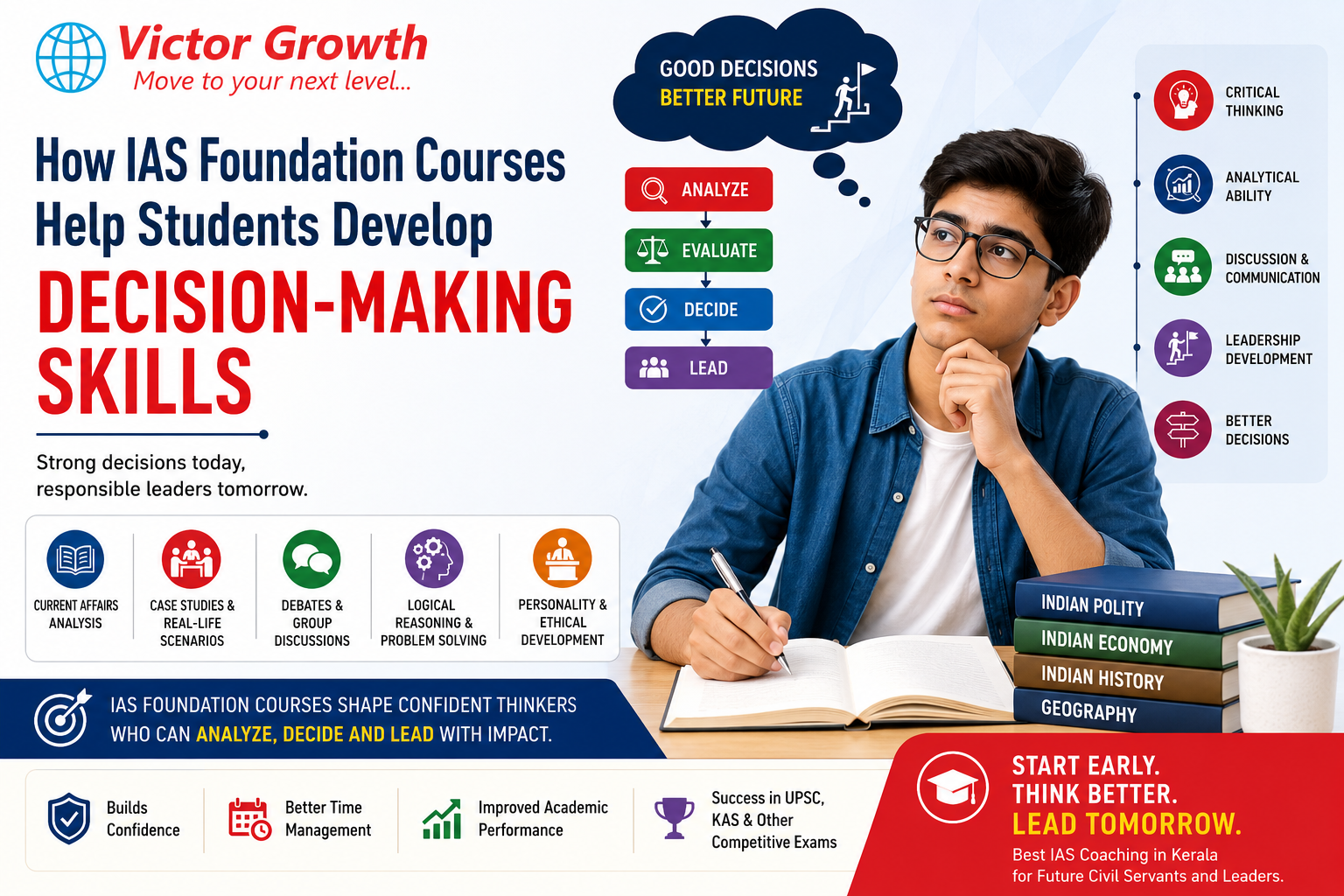
This is where IAS Foundation Courses play a transformative role. Designed for school and higher secondary students, these programs go beyond academic excellence by nurturing analytical thinking, leadership qualities, and problem-solving abilities. Students who join the best IAS coaching in Kerala gain a strong foundation that prepares them not only for the UPSC Civil Services Examination but also for life, higher education, and various competitive exams.
In this article, we explore how IAS Foundation Courses help students develop exceptional decision-making skills and why starting early provides a significant advantage.
Why Decision-Making Skills Matter
Decision-making is the ability to evaluate situations, analyze available information, consider alternatives, and choose the most effective course of action.
Students use decision-making skills every day while:
- Managing study schedules
- Choosing academic streams
- Solving examination questions
- Participating in competitions
- Handling peer pressure
- Prioritizing goals
- Managing time effectively
For future civil servants, these skills become even more critical because administrative decisions influence governance, development, public welfare, and crisis management.
The best IAS coaching in Kerala ensures students begin cultivating these qualities during their school years.
What is an IAS Foundation Course?
An IAS Foundation Course is a structured program created for students studying in Classes 8 to 12. Instead of focusing only on UPSC preparation, it develops the intellectual and personality traits required to become successful leaders.
The curriculum generally includes:
- General Knowledge
- Current Affairs
- Indian Constitution
- History
- Geography
- Economics
- Science
- Logical Reasoning
- Mental Ability
- Communication Skills
- Personality Development
- Leadership Training
- Ethics and Values
Every subject contributes to improving logical and balanced decision-making.
How IAS Foundation Courses Develop Decision-Making Skills
1. Encouraging Critical Thinking
Students are encouraged to think beyond textbook answers.
Instead of memorizing facts, they learn to ask:
- Why did this happen?
- What caused this issue?
- What could be the solution?
- What are the consequences?
Critical thinking helps students evaluate multiple perspectives before making decisions.
For example:
Rather than simply learning about climate change, students analyze:
- Environmental impact
- Economic consequences
- Government policies
- International cooperation
- Public responsibility
This develops a habit of informed decision-making.
2. Improving Analytical Skills
IAS officers constantly analyze reports, statistics, and field situations before making administrative decisions.
Foundation courses introduce analytical thinking through:
- Data interpretation
- Graph analysis
- Maps
- Case studies
- News discussions
- Problem-solving exercises
Students gradually become comfortable interpreting information rather than relying on assumptions.
3. Exposure to Real-Life Case Studies
Many IAS Foundation programs include discussions on:
- Flood management
- Disaster response
- Environmental conservation
- Public health
- Education reforms
- Poverty alleviation
- Urban planning
Students are presented with real situations and asked to recommend practical solutions.
This activity enhances:
- Logical thinking
- Risk assessment
- Leadership
- Decision-making under constraints
4. Developing Problem-Solving Ability
Decision-making is impossible without problem-solving skills.
Foundation courses present students with situations requiring them to:
- Identify the problem
- Gather information
- Compare alternatives
- Select the best solution
- Justify their choice
This systematic approach becomes a lifelong skill useful in academics and professional life.
5. Learning Time Management
Good decisions often depend on proper time management.
Students participating in foundation programs learn to:
- Prioritize tasks
- Allocate study hours
- Meet deadlines
- Balance academics and extracurricular activities
These habits help students avoid rushed decisions and improve productivity.
6. Building Confidence Through Group Discussions
Many students hesitate to express their opinions.
IAS Foundation Courses regularly conduct:
- Group discussions
- Debates
- Panel discussions
- Public speaking sessions
Students learn:
- Listening skills
- Respecting different viewpoints
- Supporting opinions with evidence
- Making balanced conclusions
Confidence grows naturally through regular participation.
7. Improving Logical Reasoning
Logical reasoning is one of the strongest tools for effective decision-making.
Students practice:
- Pattern recognition
- Verbal reasoning
- Non-verbal reasoning
- Analytical puzzles
- Decision-making questions
- Situation analysis
These exercises train the brain to think systematically.
8. Enhancing Ethical Decision-Making
An IAS officer must make decisions that are:
- Fair
- Transparent
- Legal
- Ethical
- Citizen-centric
Foundation programs introduce students to ethical dilemmas through classroom discussions.
Examples include:
- Honesty versus personal gain
- Public interest versus political pressure
- Environmental protection versus industrial development
Students understand that the best decision is not always the easiest one.
9. Current Affairs Discussions Improve Judgment
Daily current affairs sessions expose students to:
- National issues
- International relations
- Government policies
- Social reforms
- Economic developments
Teachers encourage students to analyze events from multiple perspectives.
This broadens thinking and improves mature decision-making.
10. Personality Development Sessions
Decision-making is closely linked with personality.
Foundation courses improve:
- Self-confidence
- Emotional intelligence
- Communication
- Leadership
- Teamwork
- Stress management
Students become more composed while making important decisions.
11. Leadership Activities
Leadership cannot exist without sound decision-making.
Students participate in:
- Team projects
- Leadership games
- Role plays
- Social awareness campaigns
- Community service
These activities teach responsibility, accountability, and practical decision-making.
12. Mock Interviews and Situational Questions
Many advanced IAS Foundation Courses introduce interview-style questions such as:
“What would you do if two villages fight over water?”
“How would you solve traffic congestion near a school?”
Students learn to:
- Think quickly
- Stay calm
- Balance competing interests
- Provide practical solutions
These exercises significantly strengthen decision-making skills.
13. Exposure to Competitive Exams
Foundation courses prepare students for exams like:
- UPSC
- KAS
- NDA
- CDS
- SSC
- Banking
- CLAT
- CUET
- Other government recruitment examinations
Objective questions often require quick yet accurate decisions.
Continuous practice develops speed and accuracy.
14. Better Academic Performance
Decision-making also improves academic success.
Students become better at:
- Choosing study methods
- Planning revision
- Attempting examinations strategically
- Managing time during exams
- Selecting the correct answers confidently
This leads to consistently improved performance.
15. Encouraging Independent Thinking
Students gradually stop depending entirely on parents or teachers for every decision.
Instead, they learn to:
- Evaluate facts
- Compare alternatives
- Accept responsibility
- Learn from mistakes
This independence prepares them for higher education and professional life.
Activities Used by the Best IAS Coaching in Kerala to Build Decision-Making Skills
Leading IAS Foundation institutes conduct practical learning activities such as:
- Current Affairs Analysis
- Debate Competitions
- Mock Parliament Sessions
- Group Discussions
- Leadership Camps
- Public Speaking
- Quiz Competitions
- Situation Analysis Exercises
- Problem-Solving Workshops
- Personality Development Sessions
- Case Study Discussions
- Mock Interviews
These activities transform theoretical knowledge into practical decision-making experience.
Long-Term Benefits of Decision-Making Skills
Students who develop strong decision-making abilities gain advantages throughout life.
Benefits include:
- Better academic performance
- Improved confidence
- Strong leadership qualities
- Effective communication
- Higher emotional intelligence
- Better career planning
- Faster problem-solving
- Improved interview performance
- Success in competitive examinations
- Responsible citizenship
These skills remain valuable regardless of career choice.
Why Parents Should Consider an IAS Foundation Course Early
Parents often focus only on examination marks.
However, future success depends equally on:
- Leadership
- Confidence
- Communication
- Ethics
- Decision-making
- Analytical ability
- Critical thinking
Early exposure helps students develop these qualities naturally over several years instead of rushing during UPSC preparation.
Joining the best IAS coaching in Kerala at the school level gives students sufficient time to strengthen these essential life skills.
Why Choose the Best IAS Coaching in Kerala?
The best IAS coaching in Kerala offers much more than classroom teaching. Students receive comprehensive guidance that focuses on academic excellence, personality development, leadership, and decision-making.
Key features include:
- Experienced faculty
- Structured IAS Foundation curriculum
- Daily current affairs discussions
- Regular assessments
- Logical reasoning practice
- Personality development classes
- Public speaking and leadership training
- Mock interviews
- Individual mentoring
- Career guidance
- Competitive exam preparation
- Ethical and value-based education
Such holistic training prepares students for success in both competitive examinations and future leadership roles.
Conclusion
Decision-making is one of the defining qualities of successful civil servants and effective leaders. It cannot be mastered through memorization alone—it develops through critical thinking, analysis, ethical reasoning, practical exposure, and consistent practice.
IAS Foundation Courses provide students with an environment where they learn to think independently, evaluate situations logically, communicate confidently, and make responsible decisions. These skills benefit students not only in the UPSC journey but throughout their academic, professional, and personal lives.
If you want your child to build leadership qualities from an early age while preparing for future competitive examinations, enrolling in the best IAS coaching in Kerala is a wise investment. A strong foundation today can shape a confident, capable, and responsible leader for tomorrow.
Frequently Asked Questions (FAQs)
1. How do IAS Foundation Courses improve decision-making skills?
They use case studies, current affairs discussions, debates, logical reasoning exercises, leadership activities, and problem-solving sessions that encourage students to analyze situations and make informed decisions.
2. At what age should students join an IAS Foundation Course?
Students from Classes 8 to 12 can benefit the most, as this is the ideal stage to develop critical thinking, leadership, and decision-making skills.
3. Does decision-making training help in UPSC preparation?
Yes. UPSC evaluates analytical thinking, ethics, judgment, and problem-solving abilities in both the written examination and the personality test. Early training gives students a significant advantage.
4. Are IAS Foundation Courses useful for exams other than UPSC?
Yes. These courses also help students prepare for KAS, NDA, CDS, CLAT, CUET, SSC, banking exams, and other competitive examinations by strengthening reasoning, communication, and analytical skills.
5. Why should I choose the best IAS coaching in Kerala for my child?
The best IAS coaching in Kerala provides experienced faculty, structured guidance, personality development, leadership training, current affairs analysis, and comprehensive mentoring that helps students grow academically and personally.
6. Can decision-making skills improve academic performance?
Absolutely. Students learn to manage time effectively, prioritize tasks, solve problems logically, and approach examinations with confidence, leading to better academic outcomes.
7. Do IAS Foundation Courses focus only on UPSC preparation?
No. They aim to develop well-rounded individuals by improving leadership, communication, ethics, confidence, analytical thinking, and decision-making while laying the groundwork for future competitive exams.