The UPSC Civil Services Examination is one of India’s most challenging competitive examinations. Although dedicated UPSC preparation usually begins after graduation, school students can start building the right foundation much earlier.
Starting UPSC preparation from school does not mean studying the entire UPSC syllabus or spending several hours every day on competitive-exam coaching. The objective should be to develop strong academic fundamentals, reading habits, general awareness, analytical thinking and communication skills.
For students and parents exploring the Best IAS Coaching in Kerala, a structured foundation approach can help make this early preparation productive without creating unnecessary academic pressure.
Can You Start UPSC Preparation While in School?
Yes. However, school-level UPSC preparation should be different from conventional UPSC coaching.
At this stage, students should focus on:
Understanding school subjects thoroughly
Developing a regular reading habit
Following age-appropriate current affairs
Improving vocabulary and communication
Building general knowledge
Developing logical and analytical thinking
Learning to write clearly
Participating in quizzes, debates and discussions
The goal is to build capabilities that will become valuable when serious UPSC preparation begins later.
A Practical Roadmap for UPSC Preparation from School
Step 1: Build Strong School-Level Fundamentals
School textbooks should be the first priority.
Students should focus on understanding subjects such as:
History
Geography
Civics
Economics
Science
Mathematics
English
Rather than studying only for examinations, students should try to understand concepts and their practical applications.
Strong fundamentals can make advanced learning considerably easier later.
Step 2: Develop a Daily Reading Habit
Reading is one of the most important habits for a future UPSC aspirant.
School students can gradually develop a habit of reading:
Newspapers
Children’s magazines
Good-quality books
Editorials suitable for their age
General knowledge resources
Reliable educational websites
Initially, even 20–30 minutes of reading every day can be useful.
The objective is not to memorise every news event but to understand what is happening around us.
Step 3: Start Learning Current Affairs
Current affairs should be introduced gradually.
Students can begin with major national and international developments, such as:
Government initiatives
Important scientific discoveries
Environmental issues
International events
Major economic developments
Important constitutional and political events
Sports and cultural achievements
Parents can also discuss important news with children at home. This turns current affairs into a conversation rather than another subject to memorise.
Step 4: Develop General Knowledge
General knowledge provides a broad foundation for future competitive examinations.
Students can explore:
India: States, geography, history, Constitution, culture and important institutions.
World: Countries, continents, international organisations and major global developments.
Science: Space, technology, environment, health and scientific discoveries.
Society: Important social issues and developments affecting communities.
Quizzes and interactive activities can make this learning more interesting.
Step 5: Improve English and Communication Skills
Good communication is extremely important for future Civil Services aspirants.
Students should practise:
Reading aloud
Writing short paragraphs
Summarising what they read
Speaking on simple topics
Learning new vocabulary
Participating in debates and discussions
The focus should be on expressing ideas clearly rather than using complicated language.
Step 6: Develop Analytical Thinking
UPSC requires understanding and analysis rather than simple memorisation.
Students can develop analytical thinking by asking questions such as:
What happened?
Why did it happen?
What are its effects?
What could be the possible solutions?
For example, while learning about climate change, students can explore its causes, effects on India, impact on agriculture and possible solutions.
This habit of thinking can become extremely valuable during future UPSC preparation.
Step 7: Learn to Make Simple Notes
Students do not need to prepare extensive UPSC-style notes during school.
Instead, they can learn to write:
Short summaries
Key points
Important facts
Mind maps
Simple diagrams
Question-and-answer notes
This gradually develops the ability to organise information effectively.
Step 8: Participate in Competitions and Activities
UPSC preparation is not limited to books.
School students can participate in:
Quiz competitions
Debates
Essay competitions
Model United Nations
Public speaking
Science exhibitions
Social-service activities
Leadership programmes
Such activities can improve confidence, communication, teamwork and general awareness.
Step 9: Use an IAS Foundation Course When Appropriate
Self-study can provide a good beginning, but structured guidance can make foundation learning more systematic.
An IAS Foundation Course for school students can introduce concepts through age-appropriate classes, current affairs discussions, quizzes, study materials, assessments and mentorship.
Parents searching for the Best IAS Coaching in Kerala should look for programmes that complement school education instead of placing excessive pressure on students.
Step 10: Create a Long-Term Roadmap
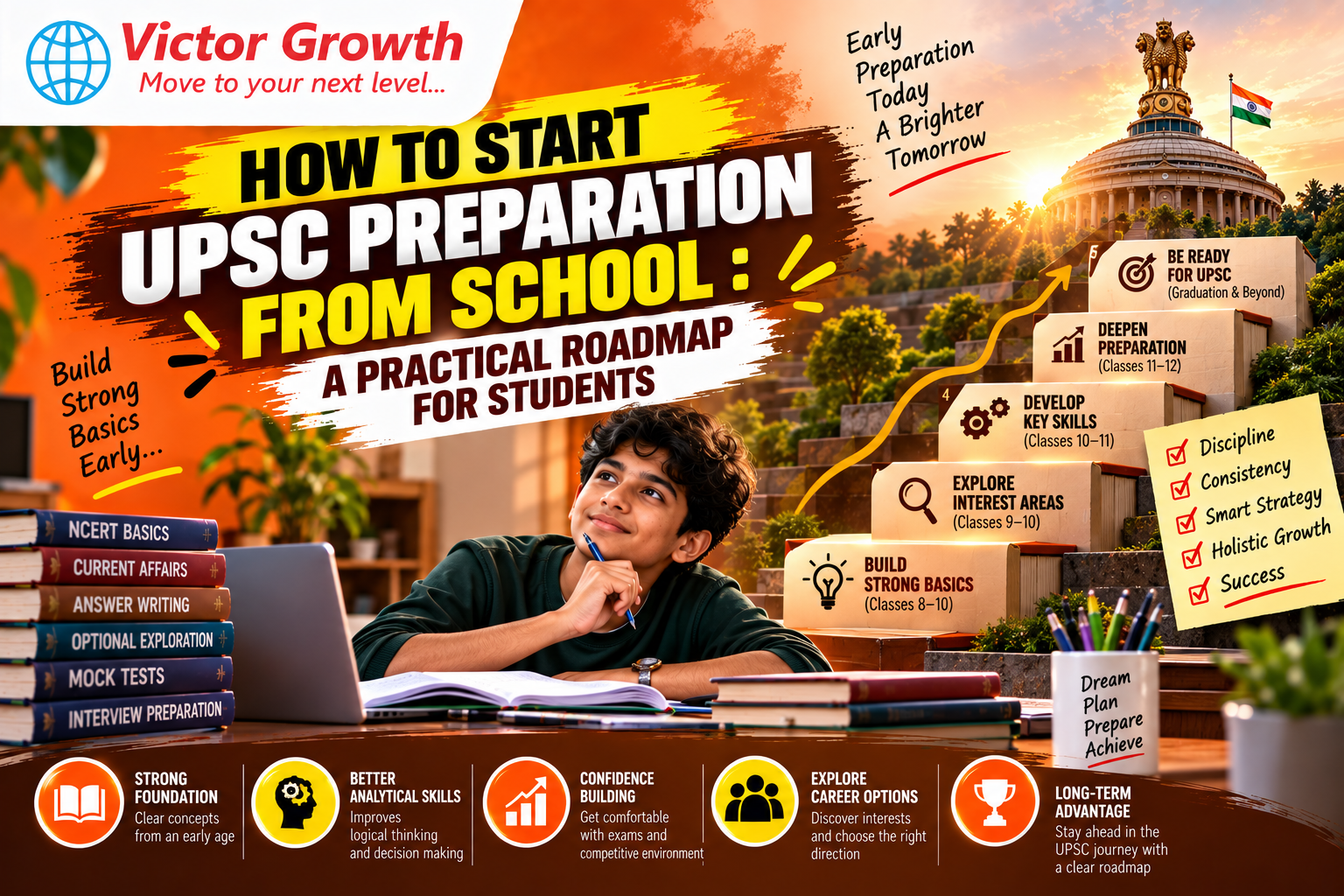
A simple roadmap could look like this:
Classes 6–8:
Focus on reading, curiosity, general knowledge and strong school fundamentals.
Classes 9–10:
Develop better awareness of history, geography, polity, science and current affairs while maintaining academic performance.
Classes 11–12:
Strengthen conceptual understanding, reading, writing, communication and analytical abilities.
College:
Begin structured UPSC preparation, understand the syllabus, study standard resources, practise answer writing and take mock tests.
After Graduation:
Undertake focused Civil Services Examination preparation according to individual goals and strategy.
This gradual approach is more sustainable than attempting intensive UPSC preparation during school.
How Many Hours Should a School Student Study for UPSC?
There is no need for school students to spend several hours every day on UPSC preparation.
A practical approach is to dedicate limited time to:
Reading
Current affairs
General knowledge
Writing
Quizzes
Conceptual learning
School academics, sleep, physical activity, hobbies and family time should remain priorities.
The quality and consistency of learning are more important than the number of hours.
Common Mistakes Students and Parents Should Avoid
Starting Intensive Preparation Too Early
School students do not need to complete the UPSC syllabus.
Ignoring School Academics
Strong school-level fundamentals are an important part of long-term preparation.
Excessive Memorisation
Understanding concepts is more valuable than memorising large amounts of information.
Too Much Coaching
Multiple classes and excessive study materials can create unnecessary pressure.
Comparing Children
Every student develops at a different pace. Foundation learning should encourage curiosity rather than competition.
Choosing the Best IAS Coaching in Kerala for School Students
When searching for the Best IAS Coaching in Kerala, parents should evaluate more than just the institute’s name or results.
Consider:
Age-appropriate curriculum
Experienced mentors
Interactive teaching
Quality study materials
Current affairs exposure
Regular assessments
Personal attention
Flexible schedules
Communication and personality development
Balance with school academics
A good foundation programme should make students more curious and confident—not overwhelmed.
UPSC Foundation Programmes at Victor Growth
Victor Growth, Kadavanthra, Kochi, offers foundation-oriented learning for school students who want early exposure to Civil Services and competitive-examination concepts.
The approach can include current affairs, general awareness, conceptual learning, quizzes, reading activities, communication development, analytical thinking, study materials and mentorship.
For parents looking for the Best IAS Coaching in Kerala, the emphasis should be on building a strong long-term foundation while allowing students to enjoy their school years.
Frequently Asked Questions
1. Can I start UPSC preparation from school?
Yes. Students can begin by developing reading habits, general awareness, strong academic fundamentals, communication skills and analytical thinking.
2. Which class is best to start UPSC foundation preparation?
There is no fixed class. Foundation learning can begin during middle or secondary school, provided it remains age-appropriate and does not interfere with regular academics.
3. Should school students study the complete UPSC syllabus?
No. School students should focus on fundamentals rather than attempting the complete UPSC syllabus.
4. How much time should a school student spend on UPSC preparation?
A small, consistent amount of time is sufficient for foundation learning. School academics, health, hobbies and recreation should remain priorities.
5. Is reading newspapers necessary from school?
It can be useful, but students should begin with age-appropriate news and gradually develop the ability to understand current affairs.
6. Can an IAS Foundation Course help school students?
Yes. A well-designed programme can help develop general awareness, reading habits, analytical thinking, communication and conceptual understanding.
7. How do I choose the Best IAS Coaching in Kerala for foundation preparation?
Look for experienced mentors, an age-appropriate curriculum, interactive learning, quality study materials, current affairs exposure and a balanced approach that complements school education.
Conclusion
Starting UPSC preparation from school should be viewed as building a foundation, not starting an intensive examination campaign.
Strong academics, regular reading, current affairs awareness, communication skills, analytical thinking and curiosity can gradually prepare students for the challenges of higher education and future Civil Services preparation.
For parents exploring the Best IAS Coaching in Kerala, the right foundation programme should help students learn better, think independently and develop confidence while allowing them to enjoy and succeed in their school years.