
Every parent wants their child to excel in academics and build a successful future. As competition for higher education and prestigious careers continues to increase, many parents in Kerala are exploring options beyond traditional tuition classes. One common question they ask is:
“Should my child join regular tuition or an IAS Foundation Course?”
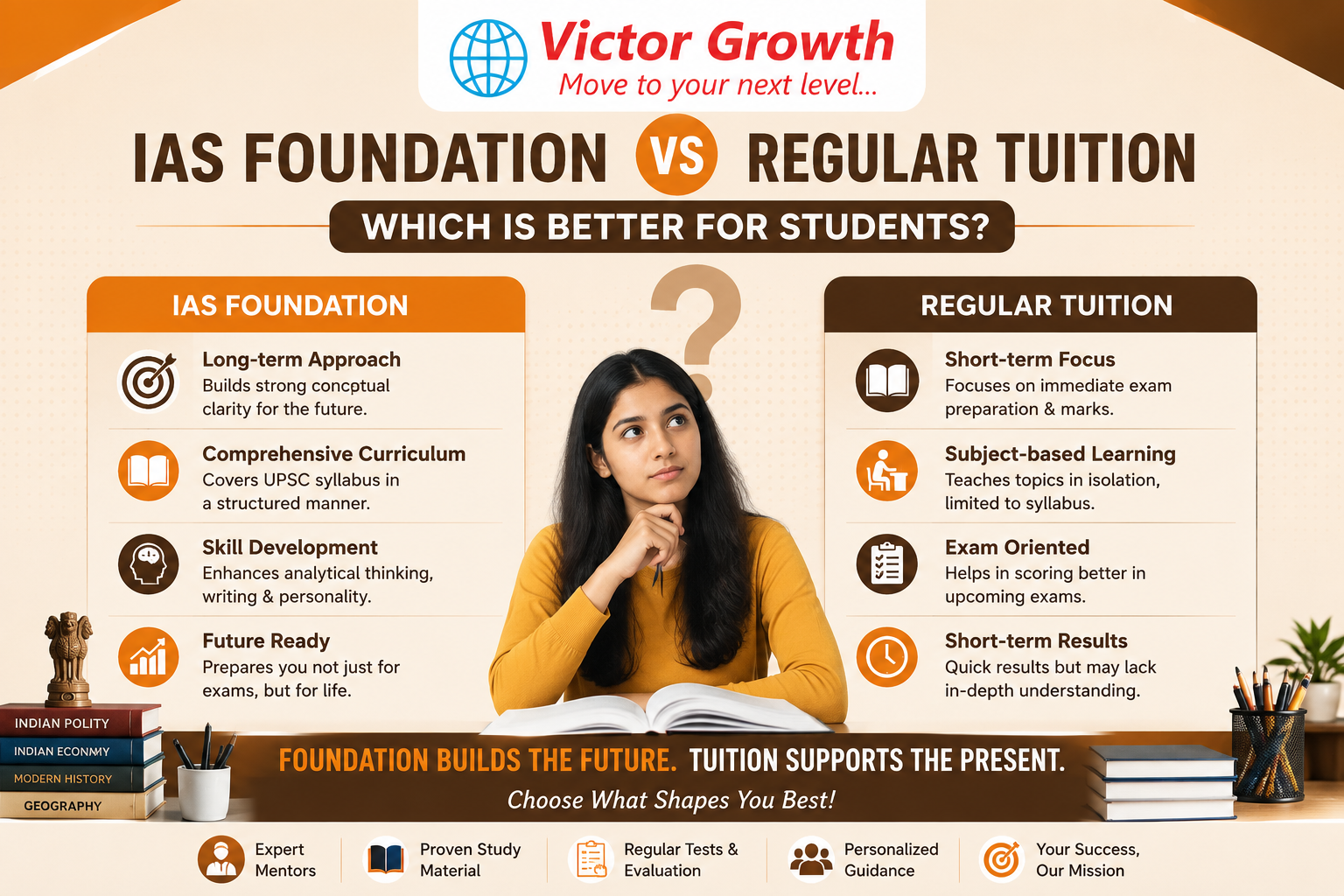
While both support a student’s learning, they are designed with very different objectives. Regular tuition focuses primarily on helping students improve school examination performance, whereas an IAS Foundation Programme aims to develop a student’s overall intellectual, analytical, communication, and leadership abilities while also strengthening academic concepts.
The right choice depends on your child’s goals, interests, and learning needs. In many cases, these two approaches can complement each other rather than compete. Understanding their differences will help parents make informed decisions.
For families looking for the best IAS coaching in Kerala, an IAS Foundation Programme offers long-term benefits that extend well beyond school examinations.
Understanding Regular Tuition
Regular tuition is primarily designed to help students perform better in school examinations.
Most tuition centres focus on:
- Completing the school syllabus
- Solving textbook exercises
- Preparing students for school tests
- Improving examination scores
- Revising classroom lessons
- Practising previous question papers
The teaching is generally aligned with the school curriculum and examination pattern.
Main Objective
The primary objective is academic improvement and higher marks in school examinations.
Understanding an IAS Foundation Programme
An IAS Foundation Programme is much broader in scope.
Rather than focusing only on school examinations, it develops the knowledge, habits, and skills required for long-term academic success and future competitive examinations.
Students learn:
- Indian History
- Geography
- Indian Constitution
- Economics
- Science and Technology
- Environment
- Current Affairs
- Leadership
- Communication Skills
- Personality Development
- Critical Thinking
The programme encourages students to understand concepts deeply instead of memorizing facts.
Major Differences Between IAS Foundation and Regular Tuition
| Feature | IAS Foundation Programme | Regular Tuition |
|---|---|---|
| Primary Goal | Holistic development and long-term preparation | Better school examination performance |
| Teaching Style | Concept-based, interactive, analytical | Syllabus-oriented and exam-focused |
| Focus | Knowledge, skills, personality, leadership | School subjects and marks |
| Current Affairs | Extensive coverage | Usually limited |
| Communication Skills | Strong emphasis | Minimal emphasis |
| Public Speaking | Included | Rarely included |
| Leadership Development | Integral part of the programme | Usually absent |
| Critical Thinking | Strong focus | Limited focus |
| Ethics and Values | Included | Rarely covered |
| Long-Term Benefits | Useful for UPSC and many careers | Primarily school examinations |
1. Learning Approach
Regular Tuition
Students generally:
- Revise classroom lessons
- Memorize important points
- Solve textbook questions
- Prepare for examinations
The emphasis is on achieving good marks.
IAS Foundation Programme
Students:
- Understand concepts
- Ask questions
- Participate in discussions
- Analyze real-life issues
- Solve practical problems
Learning becomes meaningful rather than mechanical.
2. Academic Performance
Many parents assume an IAS Foundation Course distracts students from school studies.
In reality, a quality foundation programme often strengthens academic performance because students develop:
- Better understanding of concepts
- Strong reading habits
- Improved concentration
- Effective note-making
- Better writing skills
Subjects such as Social Science, English, and General Science often become easier.
3. Development of Critical Thinking
One of the biggest advantages of an IAS Foundation Programme is the emphasis on analytical thinking.
Students learn to ask:
- Why did this happen?
- What caused this problem?
- What are the possible solutions?
- How will society be affected?
Regular tuition generally focuses on finding the correct answer, while foundation learning encourages students to understand the reasoning behind it.
4. Communication Skills
Communication is an essential skill for academic success and future careers.
An IAS Foundation Programme includes:
- Public speaking
- Debates
- Group discussions
- Presentations
- Essay writing
- Creative writing
These activities improve confidence and help students express their ideas effectively.
Regular tuition generally gives limited attention to communication beyond classroom explanations.
5. Personality Development
Future leaders require more than academic knowledge.
Foundation programmes help students develop:
- Confidence
- Leadership
- Discipline
- Teamwork
- Responsibility
- Emotional intelligence
- Ethical values
These aspects are rarely included in conventional tuition classes.
6. Reading Habits
Students in IAS Foundation Programmes are encouraged to read:
- Newspapers
- Biographies
- Science magazines
- General knowledge books
- Government initiatives
- Current affairs articles
Reading develops vocabulary, comprehension, and awareness.
Regular tuition usually focuses only on prescribed textbooks.
7. Current Affairs Awareness
Current affairs form an essential part of an IAS Foundation Programme.
Students gradually understand:
- National developments
- International relations
- Economy
- Science
- Technology
- Environment
- Government policies
This broader understanding helps students become informed citizens.
Traditional tuition centres rarely provide structured current affairs education.
8. Leadership Development
Leadership is cultivated through participation.
Foundation programmes include:
- Team activities
- Leadership projects
- Group discussions
- Student presentations
- Decision-making exercises
Students become more confident and responsible.
9. Long-Term Career Benefits
The skills learned in an IAS Foundation Programme are valuable for numerous careers, including:
- Civil Services
- Engineering
- Medicine
- Law
- Management
- Entrepreneurship
- Journalism
- Research
- Defence Services
- Public Policy
Even students who never appear for the UPSC examination benefit from improved communication, leadership, and analytical thinking.
10. Examination Preparation
Regular Tuition
Best suited for:
- School examinations
- Unit tests
- Annual examinations
- Board examinations
IAS Foundation Programme
Helps prepare students over time for:
- UPSC Civil Services
- Kerala Administrative Service (KAS)
- NDA
- CDS
- CLAT
- CUET
- Scholarship examinations
- Olympiads
- Other competitive examinations
Can Students Join Both?
Yes.
In many situations, students benefit from both approaches.
For example:
- Regular tuition can strengthen Mathematics, Science, or other school subjects where additional support is needed.
- An IAS Foundation Programme can develop broader academic skills, leadership, communication, and analytical thinking.
Together, they provide a balanced educational experience.
However, parents should ensure that the overall schedule remains manageable and that students have adequate time for rest, recreation, and extracurricular activities.
Which Students Benefit Most from an IAS Foundation Programme?
An IAS Foundation Programme is particularly suitable for students who:
- Enjoy reading
- Ask questions frequently
- Are curious about current affairs
- Like history and geography
- Participate in debates and quizzes
- Aspire to leadership roles
- Wish to build strong communication skills
- Plan to prepare for competitive examinations in the future
How Parents Should Decide
Before choosing between tuition and a foundation programme, parents should consider:
Academic Performance
Does the child need help understanding school subjects?
Interest Level
Is the child naturally curious about society, history, science, or governance?
Learning Style
Does the child enjoy discussions and concept-based learning?
Long-Term Goals
Would broader skill development benefit the child’s future aspirations?
A thoughtful decision should align with the child’s interests, strengths, and overall development rather than focusing only on examination scores.
Why Choose the Best IAS Coaching in Kerala?
The best IAS coaching in Kerala offers much more than classroom instruction. A high-quality foundation programme provides:
- Experienced faculty with UPSC expertise
- Structured and age-appropriate curriculum
- Interactive teaching methods
- Current affairs sessions
- Leadership development
- Personality development workshops
- Communication skills training
- Individual mentorship
- Regular assessments
- Guidance that complements school education
These programmes are designed to nurture informed, confident, and responsible young learners while strengthening their academic foundations.
Conclusion
Choosing between an IAS Foundation Programme and regular tuition is not always about selecting one over the other. They serve different educational purposes.
Regular tuition is valuable for improving school examination performance and reinforcing classroom learning. An IAS Foundation Programme goes beyond academics by developing critical thinking, leadership, communication, ethical values, and awareness of the world.
For parents seeking the best IAS coaching in Kerala, a well-designed IAS Foundation Programme offers an excellent opportunity to prepare children not only for future competitive examinations but also for lifelong success. When balanced appropriately with school studies, it helps students become confident learners, responsible citizens, and capable future leaders.
Frequently Asked Questions (FAQs)
1. What is the main difference between an IAS Foundation Programme and regular tuition?
Regular tuition focuses on improving school examination performance, while an IAS Foundation Programme develops academic concepts, leadership, communication skills, critical thinking, personality, and long-term preparation for competitive examinations.
2. Will an IAS Foundation Programme improve school marks?
Yes. Because students gain stronger conceptual understanding, better reading habits, and improved writing and analytical skills, many also perform better in school subjects such as Social Science, English, and General Science.
3. Can students attend both regular tuition and an IAS Foundation Programme?
Yes. Many students successfully combine both. Regular tuition supports school-specific learning, while an IAS Foundation Programme develops broader skills. The schedule should remain balanced to avoid excessive workload.
4. Is an IAS Foundation Programme only for students who want to become IAS officers?
No. The programme builds transferable skills such as leadership, communication, critical thinking, discipline, and problem-solving that are valuable in engineering, medicine, law, management, entrepreneurship, research, and many other careers.
5. Which is better for personality development?
An IAS Foundation Programme generally provides greater opportunities for personality development through debates, public speaking, leadership activities, group discussions, and communication training.
6. At what age should students join an IAS Foundation Programme?
Many educators recommend introducing foundation learning from Classes 6 to 8, with Classes 8 to 10 being an ideal stage for structured programmes, depending on the student’s maturity and interest.
7. How do parents choose the best IAS coaching in Kerala?
Parents should evaluate:
- Experienced faculty
- Age-appropriate curriculum
- Interactive teaching methods
- Leadership and personality development
- Current affairs integration
- Individual mentorship
- Regular assessments
- A balanced approach that complements school education
8. Does an IAS Foundation Programme increase academic pressure?
A well-designed programme should not. It is intended to complement school learning through engaging, concept-based teaching. Parents should ensure that students have sufficient time for academics, recreation, physical activity, and rest.