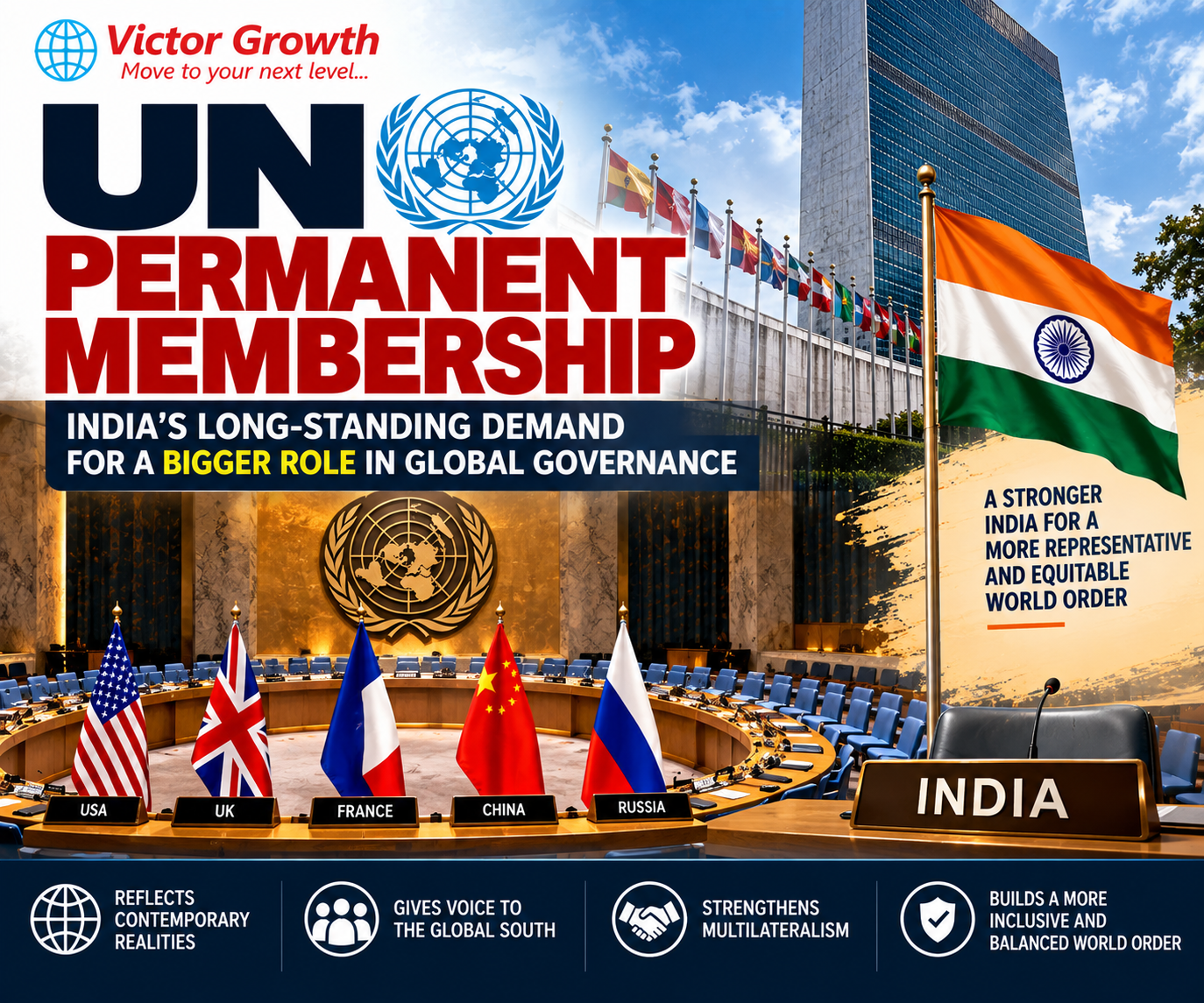
Reform of the United Nations Security Council (UNSC) remains one of the most important issues in contemporary international relations. India has consistently advocated expansion of the Council to make it more representative, legitimate and reflective of present-day global realities.
For UPSC aspirants, the issue connects India’s foreign policy, Global South, multilateralism, UN reforms and strategic autonomy.
What is the UN Security Council?
The UNSC is the principal UN organ responsible for maintaining international peace and security.
It currently has 15 members:
- 5 Permanent Members (P5): China, France, Russia, United Kingdom and United States
- 10 Non-Permanent Members: Elected by the UN General Assembly for two-year terms
The five permanent members possess the veto power, allowing any one of them to block the adoption of a substantive resolution.
Why Does India Seek Permanent Membership?
India argues that the present structure reflects the geopolitical realities of 1945, rather than those of the 21st century.
1. Representation of the Global South
India is one of the world’s major developing economies and has positioned itself as an important voice of the Global South.
Greater representation of developing countries could address concerns about the existing distribution of decision-making power.
2. India’s Contribution to the UN
India has been a significant contributor to UN peacekeeping operations and has served multiple terms as a non-permanent member of the Security Council. India has been elected to the Council eight times, most recently for 2021–22.
3. Population and Economic Weight
India’s large population and growing economic and diplomatic significance are frequently cited in discussions on greater representation in global institutions.
4. Changing Global Order
The international system has changed considerably since the UN was established. Asia, Africa and Latin America have acquired greater economic and political significance, strengthening demands for a more representative Security Council.
India’s Position on UNSC Reform
India is part of the G4 grouping, along with Brazil, Germany and Japan, which advocates expansion of both permanent and non-permanent categories.
The G4 model proposed six additional permanent seats, distributed across Africa, Asia-Pacific, Latin America and the Caribbean, and Western European and Other States.
India has continued to push for text-based negotiations and meaningful expansion of the permanent category in the ongoing Intergovernmental Negotiations (IGN). In May 2026, India delivered a G4 statement calling for substantive progress on Security Council reform.
What Prevents UNSC Reform?
UNSC reform requires changes to the UN Charter, making the process politically and legally complex.
Major areas of disagreement include:
- Whether to expand permanent membership
- Whether new permanent members should receive veto power
- Number and distribution of additional seats
- Regional representation
- Relationship between permanent and non-permanent membership
The UN’s 2026 reform discussions show that while there is broad recognition of the need to consider an enlarged Council, significant differences remain regarding the categories of membership and regional representation.
Why is Veto Power Important?
The veto is one of the most controversial aspects of UNSC reform.
India has supported expansion of permanent membership, but the question of whether new permanent members should immediately receive veto rights remains part of the broader reform debate.
The issue reflects a fundamental tension:
Effectiveness of the Security Council ↔ Democratic and equitable representation
India’s Broader Diplomatic Strategy
India’s campaign for UNSC reform is part of its wider effort to strengthen multilateralism and strategic autonomy.
India simultaneously participates in platforms such as:
- G20
- BRICS
- QUAD
- SCO
- G4
- Commonwealth
- ASEAN-related mechanisms
This allows India to engage with countries having different political and strategic interests while pursuing its own foreign-policy objectives.
UPSC Relevance
Prelims
Remember:
UNSC → 15 members
Permanent members → China, France, Russia, UK, USA
Veto → P5
Non-permanent members → 10, elected for 2 years
G4 → India, Brazil, Germany, Japan
GS Paper II – International Relations
Important themes:
- UN Security Council reform
- Global governance
- India’s role in multilateral institutions
- Global South
- Strategic autonomy
- India–China relations
- G4
Possible UPSC Mains Question
“Reform of the United Nations Security Council is essential to make global governance more representative of contemporary geopolitical realities. Discuss India’s case for permanent membership.”
A good answer should cover India’s contributions, representation, Global South, G4, veto issue, Charter amendment and challenges to reform.
Conclusion
India’s demand for permanent membership of the UNSC is closely linked to the larger debate over reforming global governance institutions.
The ongoing UN reform process demonstrates that there is discussion on expanding the Council, but important differences remain among member states.
For UPSC preparation, the topic should therefore be studied not simply as “India wants a permanent seat”, but as a broader question of representation, legitimacy, effectiveness and the future of multilateralism.