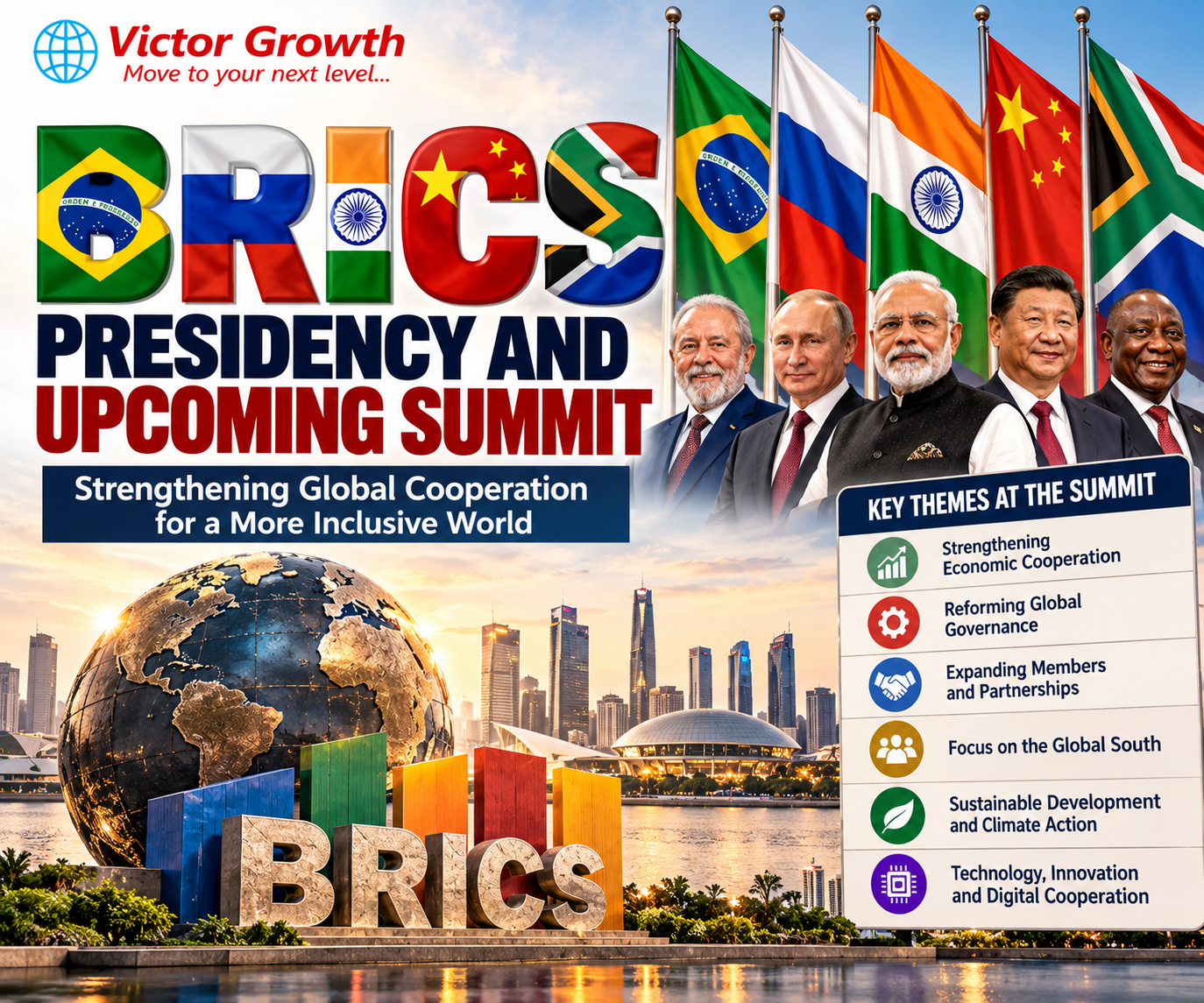
BRICS has emerged as an important platform for cooperation among major emerging economies and the wider Global South. India assumed the BRICS Chairship for 2026, culminating in the 18th BRICS Summit in New Delhi on 12–13 September 2026.
For UPSC aspirants, India’s BRICS Presidency is important for understanding India’s foreign policy, Global South diplomacy, multilateralism, global governance and international economic institutions.
What is BRICS?
BRICS began as a grouping of Brazil, Russia, India and China (BRIC). South Africa joined in 2011, turning BRIC into BRICS.
The grouping has subsequently expanded significantly. The current BRICS membership includes:
- Brazil
- Russia
- India
- China
- South Africa
- Egypt
- Ethiopia
- Iran
- United Arab Emirates
- Indonesia
- Saudi Arabia
The expansion has increased BRICS’ economic and geopolitical significance while also making coordination among members more complex.
India’s BRICS Presidency 2026
India assumed the BRICS Chairship on 1 January 2026.
India’s theme for its presidency is:
“Building for Resilience, Innovation, Cooperation and Sustainability”
The four themes highlight India’s emphasis on:
Resilience – strengthening economies and societies against global shocks.
Innovation – promoting technology, research and digital cooperation.
Cooperation – strengthening coordination among BRICS countries.
Sustainability – addressing climate change and sustainable development.
India’s presidency also placed emphasis on cooperation across the three traditional BRICS pillars: political and security cooperation, economic and financial cooperation, and people-to-people exchanges.
18th BRICS Summit – New Delhi
The 18th BRICS Summit was held in New Delhi on 12–13 September 2026 under India’s chairship. Leaders from BRICS member countries, along with partner and invited countries, participated in the summit.
The summit addressed issues including:
- Global economic governance
- Sustainable development
- Health cooperation
- Technology and innovation
- Climate and energy
- Global South priorities
- International peace and security
- Multilateral cooperation
The summit adopted the New Delhi Declaration, although differences among members on several geopolitical issues demonstrated the challenges of building consensus within an expanded BRICS.
Why is BRICS Important for India?
1. Voice of the Global South
BRICS provides India with an additional platform to raise concerns of developing and emerging economies regarding global governance, development finance, climate finance and international institutions.
2. Reform of Global Institutions
India has consistently advocated reform of institutions such as the:
- UN Security Council
- IMF
- World Bank
- WTO
BRICS provides a platform for discussions on making global governance structures more representative.
3. Economic Cooperation
BRICS can facilitate cooperation in:
- Trade
- Investment
- Finance
- Infrastructure
- Energy
- Technology
4. New Development Bank
The New Development Bank (NDB) is one of the important institutional outcomes of BRICS.
It was established to mobilise resources for infrastructure and sustainable-development projects in member and other developing countries.
BRICS and De-dollarisation
One recurring issue in BRICS discussions is reducing excessive dependence on a single international currency for cross-border transactions.
However, de-dollarisation should not be interpreted as an immediate replacement of the US dollar by a BRICS currency.
Discussions have instead included:
- Local-currency trade
- Cross-border payment mechanisms
- Greater financial cooperation
- Strengthening alternative payment infrastructure
For India, the issue has to be balanced against its extensive integration with the existing global financial system.
BRICS and India’s Strategic Autonomy
BRICS is particularly relevant to India’s foreign-policy principle of strategic autonomy.
India simultaneously engages with multiple platforms such as:
BRICS + QUAD + G20 + SCO + ASEAN + I2U2
This reflects India’s effort to maintain relationships with countries having different strategic interests while pursuing its own national priorities.
Challenges Before BRICS
The expansion of BRICS has increased its representation but also created challenges.
Divergent Interests
Members have different political systems, economic structures and foreign-policy priorities.
India–China Differences
Strategic competition between India and China can affect consensus within the grouping.
Russia–West Tensions
Russia’s relations with Western countries create additional geopolitical complications.
Expansion vs Cohesion
A larger membership increases BRICS’ geographical reach but can make consensus-building more difficult. Analysts have identified this tension between expansion and institutional coherence as a major challenge for the grouping.
BRICS: UPSC Relevance
GS Paper II – International Relations
Important themes:
- Global South
- Multilateralism
- Strategic autonomy
- Reform of global institutions
- India–Russia–China relations
- India’s emerging role in global governance
GS Paper III – Economy
Revise:
- New Development Bank
- International financial architecture
- Local-currency trade
- Development finance
- Global economic governance
Prelims Focus
Remember:
BRICS → Brazil, Russia, India, China, South Africa + expanded members
NDB → Shanghai, China; established by BRICS
2026 Chair → India
2026 Summit → New Delhi
India’s 2026 theme → Building for Resilience, Innovation, Cooperation and Sustainability
Possible UPSC Mains Question
“The expansion of BRICS has increased its global significance but has also made consensus-building more challenging. Discuss the opportunities and challenges for India.”
Conclusion
India’s 2026 BRICS Presidency provided an opportunity to project its priorities on Global South cooperation, sustainable development, technology, economic resilience and reform of multilateral institutions.
For India, BRICS is not simply an economic grouping. It is an important platform through which New Delhi can pursue strategic autonomy, strengthen Global South partnerships and contribute to the evolution of a more representative multilateral order.
For UPSC aspirants, BRICS should therefore be studied through the combined lens of International Relations + Global Governance + Indian Foreign Policy + International Economy.