
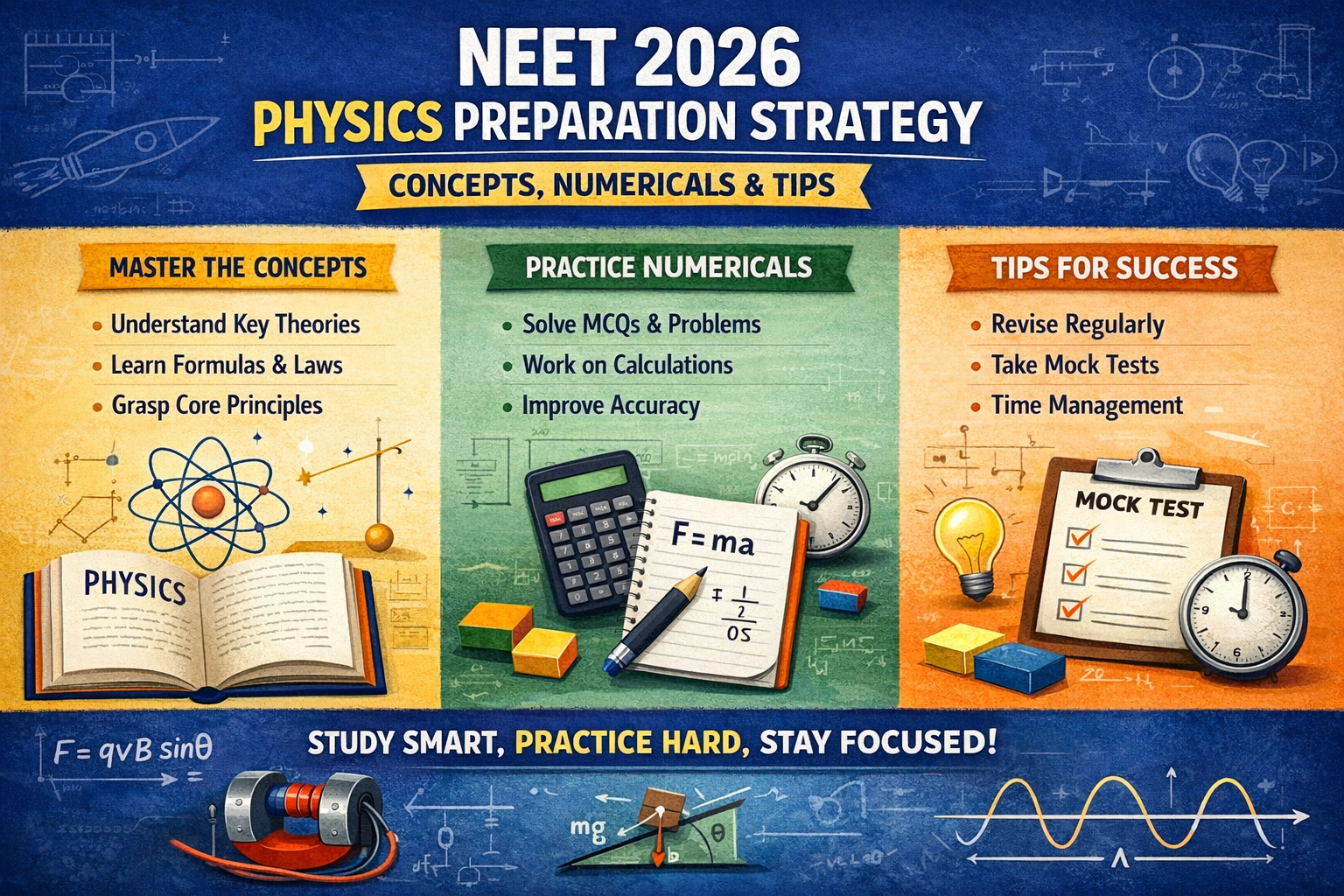
Physics is often considered the most challenging subject in NEET due to its heavy dependence on concepts, formulas, and numerical problem-solving. Scoring well in Physics can give you a strong edge in NEET 2026, provided you follow a structured and smart preparation strategy.
This complete guide explains how to prepare Physics for NEET 2026, covering concept clarity, numerical practice, chapter-wise approach, study plan, and proven tips followed by toppers.
Why Physics Is Important for NEET 2026
Physics carries 180 marks (45 questions) in NEET.
Questions test conceptual understanding + application.
Physics often becomes the deciding factor in top ranks.
A strong Physics score compensates for slight mistakes in Biology or Chemistry.
👉 With the right strategy, Physics can become scoring and predictable.
NEET 2026 Physics Syllabus Overview
NEET Physics syllabus is based on Class 11 and Class 12 NCERT, divided into:
Class 11 Physics Topics
Physical World & Measurement
Kinematics
Laws of Motion
Work, Energy & Power
Centre of Mass & Rotational Motion
Gravitation
Properties of Solids & Liquids
Thermodynamics
Kinetic Theory of Gases
Oscillations & Waves
Class 12 Physics Topics
Electrostatics
Current Electricity
Magnetic Effects of Current
Electromagnetic Induction
Alternating Current
Electromagnetic Waves
Ray Optics & Wave Optics
Dual Nature of Radiation
Atoms & Nuclei
Semiconductor Electronics
Step-by-Step NEET 2026 Physics Preparation Strategy
1. Build Strong Conceptual Clarity (Most Important)
Physics questions in NEET are concept-based, not theory-heavy.
✔ Understand why a formula works
✔ Visualise concepts using diagrams
✔ Focus on derivations for clarity (not rote learning)
Best approach
Read NCERT line by line
Study theory from a standard reference book
Watch concept-based lectures if needed
👉 If concepts are weak, numerical solving becomes impossible.
2. Master Numerical Problem Solving
Around 80–85% of NEET Physics questions are numerical-based.
How to Practice Numericals Effectively
Start with basic formula-based problems
Move to application-level numericals
Practice previous year NEET questions
Focus on units, dimensions, and sign conventions
Golden Rules for Numericals
Write the given data clearly
Convert units before solving
Don’t skip steps while learning
Analyse wrong answers carefully
3. Chapter-Wise Physics Preparation Strategy
High-Weightage Chapters (Must-Do)
Mechanics (Class 11)
Current Electricity
Magnetism & EMI
Ray Optics
Modern Physics (Very Scoring)
Semiconductor Electronics
👉 These chapters together contribute 60–65% questions.
Scoring & Easy Chapters
Units & Dimensions
Kinematics
Thermodynamics
Waves
Atoms & Nuclei
Start preparation with easy + scoring chapters to build confidence.
4. NCERT Is Non-Negotiable
Many direct questions in NEET Physics are:
Based on NCERT diagrams
Taken from examples or statements
Conceptually aligned with NCERT explanations
✔ Read NCERT at least 2–3 times
✔ Highlight definitions and diagrams
✔ Revise NCERT before every mock test
5. Best Books for NEET 2026 Physics Preparation
Primary Resources
NCERT Physics (Class 11 & 12)
Reference Books
Concepts of Physics – H.C. Verma (Vol 1 & 2)
DC Pandey Series (Arihant) – Chapter-wise practice
Errorless Physics (for MCQs)
Previous Year NEET Questions Book
👉 Avoid too many books. Quality > Quantity.
6. Time Management for Physics Preparation
Daily Physics Study Time
Class 11 students: 2–2.5 hours/day
Droppers: 3–4 hours/day
Ideal Daily Split
45 min – Theory
60 min – Numerical practice
30 min – Revision / formula review
7. Revision Strategy for NEET Physics 2026
Without revision, Physics is quickly forgotten.
Smart Revision Plan
Weekly revision of completed chapters
Maintain a formula notebook
Revise wrong questions from mock tests
Monthly full-syllabus revision (last phase)
👉 Revise formulas daily for 10–15 minutes.
8. Mock Tests & Previous Year Questions
Solve NEET PYQs (last 15 years) chapter-wise
Start full-length mocks at least 6 months before exam
Analyse:
Conceptual mistakes
Calculation errors
Time management issues
Physics improvement = Mock Test Analysis
Common Mistakes to Avoid in NEET Physics
❌ Memorising formulas without understanding
❌ Ignoring NCERT
❌ Skipping numericals
❌ Studying theory without practice
❌ Not analysing mock tests
Final Tips to Score High in NEET 2026 Physics
✔ Focus on concepts first
✔ Practice numericals daily
✔ Revise formulas regularly
✔ Strengthen Modern Physics & Electronics
✔ Stay consistent and patient
Remember: Physics is logical, not difficult.
Frequently Asked Questions (FAQs)
Q1. Is Physics difficult for NEET 2026?
Physics is challenging but becomes manageable with concept clarity and regular numerical practice.
Q2. How many hours should I study Physics daily for NEET?
2–4 hours daily depending on your preparation stage and confidence level.
Q3. Is NCERT enough for NEET Physics?
NCERT is essential but should be supported with numerical practice books.
Q4. Which chapters are most important for NEET Physics?
Mechanics, Current Electricity, Magnetism, Optics, Modern Physics, and Semiconductors.
Q5. How many numerical questions come in NEET Physics?
Around 35–40 out of 45 questions involve numerical calculations.
Q6. Can I score 150+ in NEET Physics?
Yes, with strong concepts, consistent practice, and smart revision, scoring 150+ is achievable.