
Introduction
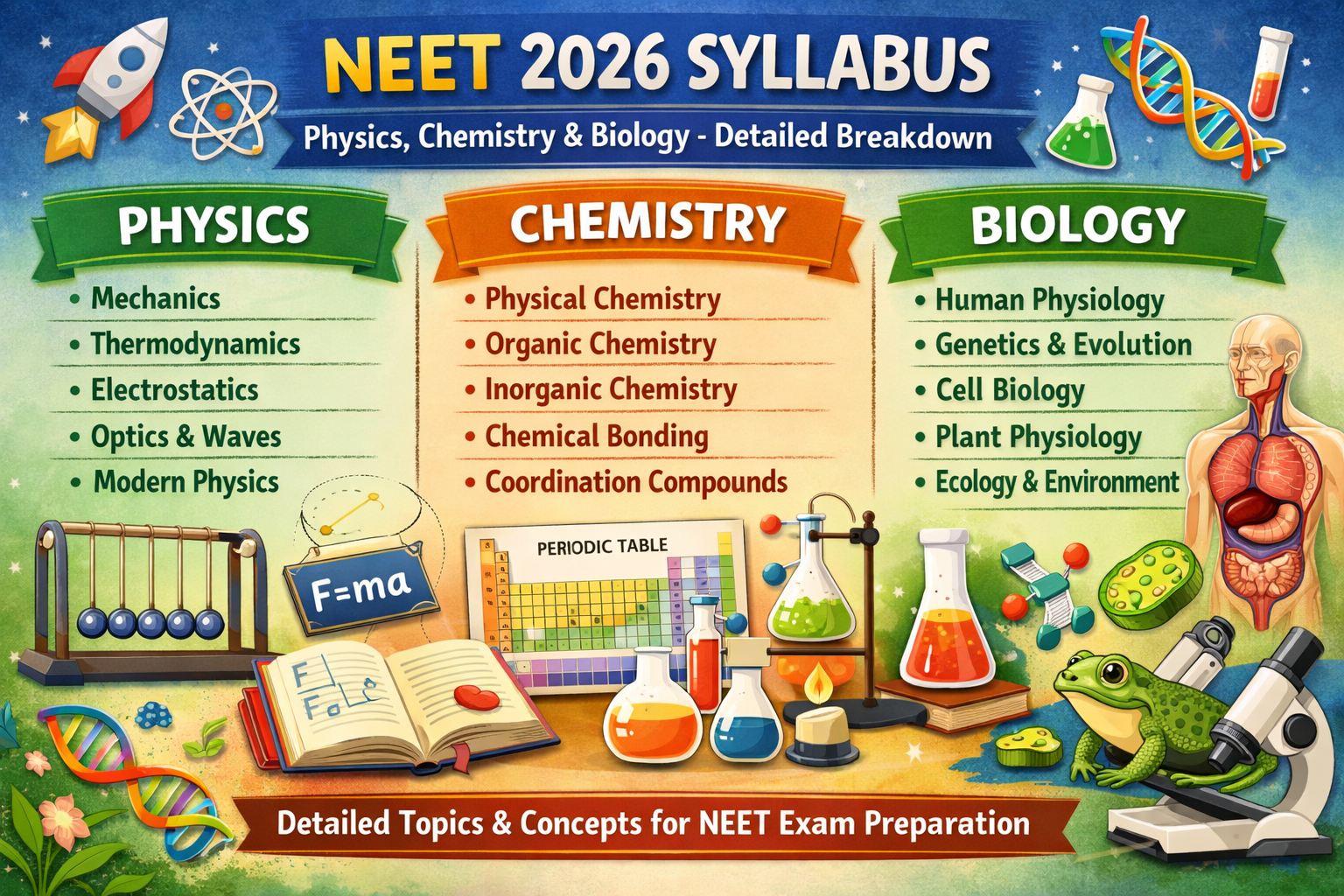
The NEET 2026 syllabus forms the backbone of medical entrance preparation. Since NEET questions are strictly based on Class 11 and Class 12 NCERT curriculum, understanding the exact syllabus, chapter-wise weightage, and important topics is crucial for scoring high. This article provides a detailed subject-wise breakdown of the NEET 2026 syllabus, helping aspirants plan smart preparation and revision strategies.
📌 NEET 2026 Syllabus Overview
Exam Conducting Body: National Testing Agency (NTA)
Syllabus Basis: NCERT Class 11 & 12
Subjects Covered:
Physics
Chemistry
Biology (Botany & Zoology)
📌 NCERT textbooks are the most important source for NEET preparation.
🔬 NEET 2026 Physics Syllabus – Detailed Breakdown
Physics in NEET focuses on conceptual clarity, numerical problem-solving, and application-based questions.
Class 11 Physics Syllabus
Physical World and Measurement
Kinematics
Laws of Motion
Work, Energy and Power
Motion of System of Particles and Rigid Body
Gravitation
Properties of Bulk Matter
Elasticity
Viscosity
Surface Tension
Thermodynamics
Behaviour of Perfect Gas and Kinetic Theory
Oscillations and Waves
Class 12 Physics Syllabus
Electrostatics
Current Electricity
Magnetic Effects of Current and Magnetism
Electromagnetic Induction and Alternating Currents
Electromagnetic Waves
Optics
Ray Optics
Wave Optics
Dual Nature of Radiation and Matter
Atoms and Nuclei
Electronic Devices
📌 High-weightage chapters: Mechanics, Current Electricity, Magnetism, Optics, Modern Physics
🧪 NEET 2026 Chemistry Syllabus – Detailed Breakdown
Chemistry is divided into Physical, Organic, and Inorganic Chemistry, with strong emphasis on NCERT facts and concepts.
Class 11 Chemistry Syllabus
Physical Chemistry
Some Basic Concepts of Chemistry
Structure of Atom
States of Matter
Thermodynamics
Equilibrium
Redox Reactions
Organic Chemistry
Organic Chemistry – Basic Principles & Techniques
Hydrocarbons
Inorganic Chemistry
Classification of Elements and Periodicity
Chemical Bonding and Molecular Structure
Hydrogen
s-Block Elements
Some p-Block Elements
Class 12 Chemistry Syllabus
Physical Chemistry
Solid State
Solutions
Electrochemistry
Chemical Kinetics
Surface Chemistry
Organic Chemistry
Haloalkanes and Haloarenes
Alcohols, Phenols and Ethers
Aldehydes, Ketones and Carboxylic Acids
Amines
Biomolecules
Polymers
Chemistry in Everyday Life
Inorganic Chemistry
General Principles and Processes of Metallurgy
p-Block Elements
d and f Block Elements
Coordination Compounds
📌 High-weightage areas: Organic reactions, NCERT Inorganic facts, Physical Chemistry numericals
🌱 NEET 2026 Biology Syllabus – Detailed Breakdown
Biology carries 50% of the total NEET marks, making it the most important subject.
Class 11 Biology Syllabus
Botany
Diversity in Living World
Structural Organisation in Plants and Animals
Cell Structure and Function
Plant Physiology
Morphology of Flowering Plants
Zoology
Structural Organisation in Animals
Animal Kingdom
Human Physiology
Class 12 Biology Syllabus
Botany
Reproduction in Organisms
Sexual Reproduction in Flowering Plants
Genetics and Evolution
Biology and Human Welfare
Biotechnology and Its Applications
Ecology and Environment
Zoology
Human Reproduction
Reproductive Health
Evolution
Human Health and Disease
Strategies for Enhancement in Food Production
📌 Biology questions are mostly direct, NCERT-based, and theory-oriented.
📊 Subject-Wise Weightage in NEET
| Subject | Approx. Weightage |
|---|---|
| Biology | 50% |
| Chemistry | 25% |
| Physics | 25% |
🧠 NEET 2026 Preparation Strategy Based on Syllabus
Physics
Focus on formulas and derivations
Practice numerical problems daily
Revise high-weightage chapters regularly
Chemistry
Memorize NCERT Inorganic line by line
Practice Organic reaction mechanisms
Solve Physical Chemistry numericals consistently
Biology
Read NCERT multiple times
Focus on diagrams, tables, and examples
Revise genetics and human physiology frequently
📘 Importance of NCERT for NEET 2026
Over 85–90% questions are directly or indirectly from NCERT
Biology questions are often word-to-word from NCERT
Inorganic Chemistry relies heavily on NCERT text
❓ Frequently Asked Questions (FAQs)
Q1. Is NEET 2026 syllabus based on NCERT?
Yes, the NEET syllabus is strictly based on NCERT Class 11 and 12.
Q2. Has the NEET 2026 syllabus changed?
As of now, no major changes have been announced. Candidates should follow the existing NCERT syllabus.
Q3. Which subject has the highest weightage in NEET?
Biology, with 360 marks, has the highest weightage.
Q4. Are deleted NCERT chapters included in NEET 2026?
Only chapters officially prescribed in the NEET syllabus should be prepared. Always follow the latest syllabus notification.
Q5. Is Class 11 syllabus important for NEET?
Yes, nearly 45–50% questions come from Class 11 topics.
Q6. How many times should I revise the NEET syllabus?
At least 3–4 complete revisions are recommended before the exam.
Conclusion
A strong command over the NEET 2026 syllabus for Physics, Chemistry, and Biology is essential for achieving a high score. Focus on NCERT clarity, repeated revision, and consistent practice to master every topic efficiently.