Introduction
Preparing for the UPSC Civil Services Examination (IAS 2026) in one year is challenging but absolutely achievable with a well-structured, integrated study plan. Every year, many aspirants crack UPSC within a year by following a disciplined strategy that combines Prelims, Mains, and Interview preparation instead of treating them as separate stages.
This article presents a month-wise, subject-wise, and phase-wise one-year integrated study plan for UPSC IAS 2026, designed to help aspirants maximize efficiency, avoid burnout, and build strong conceptual clarity along with answer-writing skills.
Why an Integrated Study Plan Is Essential for UPSC 2026
Traditional preparation separates Prelims and Mains, leading to:
Repetition of effort
Time wastage
Poor answer-writing skills
An integrated study plan ensures:
Simultaneous Prelims + Mains preparation
Early answer-writing practice
Continuous revision
Balanced focus on GS, Optional, Essay, and Ethics
👉 UPSC now tests depth, analysis, and application — not rote learning.
Understanding the UPSC IAS Exam Structure
UPSC Stages
Preliminary Examination – Objective (Qualifying)
Main Examination – Descriptive (Merit-based)
Personality Test (Interview)
Papers to Prepare
GS Paper I–IV
Essay
Optional Subject (Paper I & II)
CSAT (Prelims – qualifying)
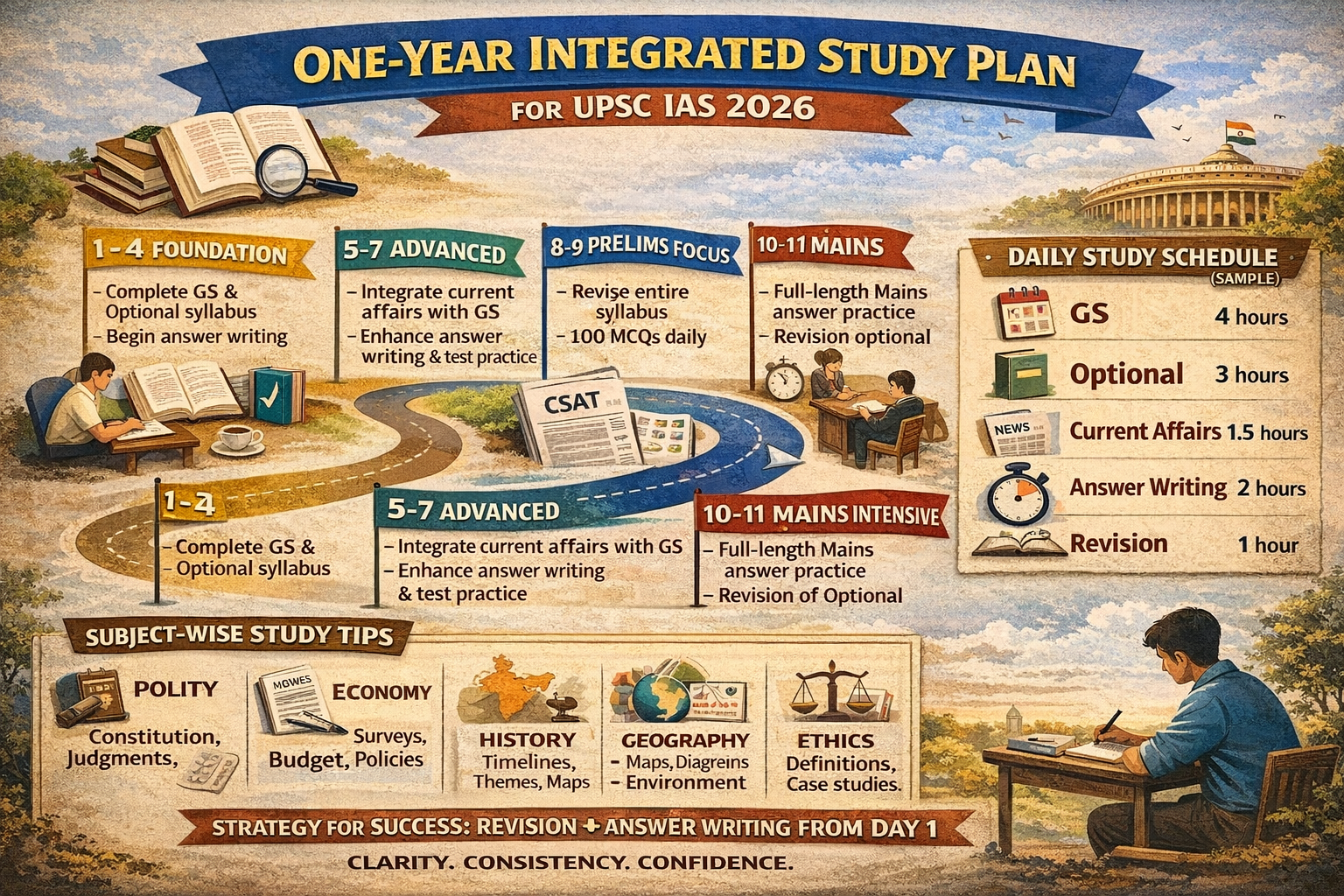
One-Year Integrated Study Plan: Overall Timeline
| Phase | Duration | Focus |
|---|---|---|
| Phase 1 | Months 1–4 | Foundation + Optional |
| Phase 2 | Months 5–7 | Advanced GS + Answer Writing |
| Phase 3 | Months 8–9 | Prelims Focus |
| Phase 4 | Months 10–11 | Mains Intensive |
| Phase 5 | Month 12 | Interview Readiness |
PHASE 1: Foundation Building (Months 1–4)
Objectives
Complete GS static syllabus
Finish Optional syllabus once
Build conceptual clarity
Start answer writing
Subjects to Cover
Polity
History (Ancient, Medieval, Modern)
Geography (Physical + Indian)
Economy (Basics)
Environment
Optional Subject (Paper I & II)
Daily Study Distribution
GS Static: 4–5 hours
Optional: 3 hours
Current Affairs: 1–1.5 hours
Answer Writing: 1 hour
📌 Answer Writing:
2–3 GS answers daily
Focus on structure, not perfection
PHASE 2: Advanced Preparation & Integration (Months 5–7)
Objectives
Integrate current affairs with GS
Improve answer writing
Strengthen Ethics & Essay
Begin test practice
Key Focus Areas
GS Paper II (Polity, Governance, IR)
GS Paper III (Economy, Security, Environment)
Ethics (GS IV)
Essay practice
Strategy
Weekly sectional tests
Ethics case studies every week
One essay every 15 days
Optional answer writing practice
👉 Use diagrams, flowcharts, and examples in answers.
PHASE 3: Prelims-Focused Preparation (Months 8–9)
Objectives
Revise entire syllabus
Practice MCQs intensively
Strengthen CSAT
Prelims Strategy
Daily MCQ practice (100 questions)
Revision of:
Polity
Economy
Environment
Geography
CSAT practice twice a week
📌 Avoid learning new sources — revision is the key to clearing Prelims.
PHASE 4: Mains Intensive Preparation (Months 10–11)
Objectives
Full-length Mains answer practice
Improve speed and presentation
Deep revision of Optional
Focus Areas
GS full-length tests
Optional full tests
Ethics case study practice
Essay weekly practice
Answer Writing Target
6–8 answers daily
Full GS paper simulation weekly
PHASE 5: Interview Readiness (Month 12)
Objectives
Personality development
DAF-based preparation
Opinion building on current issues
Activities
Mock interviews
Reading newspapers editorially
Practicing situational questions
Revising optional and GS highlights
Subject-Wise Strategy Overview
Polity
Constitution articles
Supreme Court judgments
Governance issues
Economy
Budget & Economic Survey
Basic concepts
Contemporary issues
History
Focus on themes, not facts
Use timelines and maps
Geography
Diagrams & maps
Current environmental issues
Ethics
Definitions + case studies
Real-life examples
Optional Subject Strategy
Complete syllabus early
Revise multiple times
Practice PYQs (last 10 years)
Focus on value addition
Optional = 500 marks, do not underestimate it.
Daily Integrated Study Plan (Sample)
| Activity | Time |
|---|---|
| GS Static | 4 hours |
| Optional | 3 hours |
| Current Affairs | 1.5 hours |
| Answer Writing | 2 hours |
| Revision | 1 hour |
Common Mistakes to Avoid
❌ Ignoring answer writing
❌ Waiting for Prelims result
❌ Studying too many resources
❌ Neglecting Ethics & Essay
❌ Inconsistent revision
Final Words for UPSC IAS 2026 Aspirants
A one-year preparation plan works only when it is:
Consistent
Integrated
Answer-oriented
Revision-driven
👉 UPSC does not reward those who study the most, but those who present the best.
Stay disciplined, trust your strategy, and refine continuously.
Frequently Asked Questions (FAQ)
Q1. Is one year enough to crack UPSC IAS 2026?
Yes. With a focused, integrated strategy and disciplined execution, one year is sufficient.
Q2. Should beginners follow a one-year integrated plan?
Yes, provided they maintain consistency and avoid overloading resources.
Q3. How many hours should I study daily for UPSC 2026?
On average, 8–10 quality hours daily are sufficient.
Q4. When should I start answer writing?
From the first month itself, even with basic answers.
Q5. Is optional subject more important than GS?
Both are equally important, but optional can be a rank booster.
Q6. How often should I revise the syllabus?
At least 3–4 full revisions before Mains.
Q7. Can working professionals follow this plan?
Yes, with slight customization and focused weekend utilization.