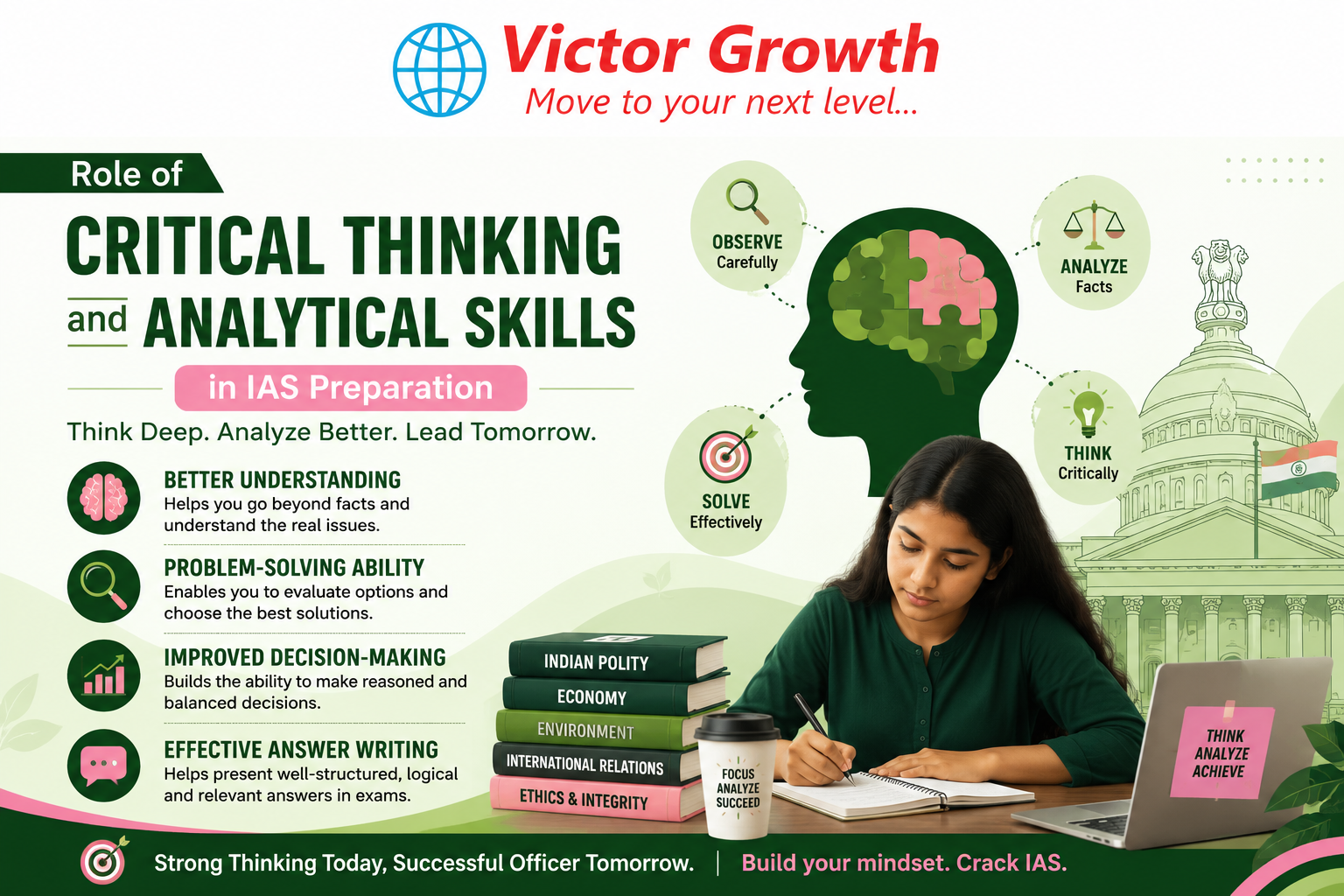
Why Every UPSC Aspirant Needs More Than Just Knowledge | Best IAS Coaching in Kerala
Preparing for the Union Public Service Commission (UPSC) Civil Services Examination is one of the most intellectually demanding journeys in India. Every year, lakhs of aspirants appear for the examination, but only a small percentage successfully secure a place in the prestigious Indian Administrative Service (IAS), Indian Police Service (IPS), Indian Foreign Service (IFS), and other Central Civil Services.
What distinguishes successful candidates from the rest is not merely the amount of information they possess but their ability to think critically, analyze complex issues, and present balanced solutions. UPSC is designed to identify future administrators who can make informed decisions, evaluate multiple perspectives, solve real-world problems, and uphold constitutional values.
This is why critical thinking and analytical skills are among the most essential qualities every IAS aspirant must develop. The best IAS coaching in Kerala emphasizes these skills from the very beginning of its IAS Foundation Programs, enabling students to excel not only in examinations but also in future administrative careers.
This comprehensive guide explains why critical thinking and analytical skills are crucial for IAS preparation, how they are tested in UPSC, and practical methods to develop them from the school years onward.
What is Critical Thinking?
Critical thinking is the ability to:
- Analyze information objectively
- Evaluate facts and evidence
- Question assumptions
- Understand different viewpoints
- Make logical decisions
- Solve problems effectively
Instead of accepting information at face value, critical thinkers ask:
- Why did this happen?
- What caused it?
- What evidence supports this?
- What are the possible consequences?
- Are there alternative solutions?
These habits are essential for future civil servants who deal with complex administrative and social issues.
What Are Analytical Skills?
Analytical skills refer to the ability to:
- Break complex problems into smaller parts
- Identify relationships between ideas
- Interpret data accurately
- Compare different viewpoints
- Draw logical conclusions
- Make evidence-based decisions
Analytical thinking enables IAS officers to understand policies, evaluate public issues, and recommend practical solutions.
Why UPSC Emphasizes Critical Thinking
Unlike many competitive examinations that focus on memorization, UPSC evaluates how candidates think.
The examination seeks individuals who can:
- Solve administrative challenges
- Understand governance issues
- Analyze national and international developments
- Make ethical decisions
- Balance competing interests
- Communicate reasoned opinions
This approach ensures that future administrators are prepared to handle real-world responsibilities.
How Critical Thinking Helps in UPSC Prelims
Although the Preliminary Examination is objective in nature, many questions require conceptual understanding rather than factual recall.
Critical thinking helps students:
- Eliminate incorrect options
- Interpret statements carefully
- Connect static subjects with current affairs
- Identify hidden clues in questions
- Avoid common logical errors
For example, questions on the environment, economy, science, and international relations often require conceptual analysis instead of direct memorization.
Importance in UPSC Mains Examination
The Mains Examination is where analytical ability becomes even more important.
Candidates must write balanced, structured answers on topics such as:
- Governance
- Social justice
- International relations
- Internal security
- Ethics
- Economy
- Environment
- Agriculture
- Science and technology
UPSC expects candidates to:
- Analyze causes
- Explain consequences
- Evaluate government policies
- Suggest practical recommendations
- Support arguments with examples
Simple factual answers rarely receive high marks.
Importance in UPSC Personality Test
The UPSC Personality Test evaluates much more than knowledge.
Interview board members assess:
- Independent thinking
- Decision-making ability
- Emotional maturity
- Logical reasoning
- Ethical judgment
- Confidence
- Balanced opinions
Candidates who think critically respond thoughtfully even to unexpected questions.
Critical Thinking Helps in Decision-Making
IAS officers make important decisions every day.
Examples include:
- Disaster management
- Law and order
- Public health
- Education policies
- Infrastructure development
- Environmental conservation
Good decisions require:
- Understanding the problem
- Collecting information
- Evaluating alternatives
- Considering public welfare
- Following constitutional principles
Critical thinking forms the foundation of this process.
Analytical Skills Improve Answer Writing
High-scoring UPSC answers are analytical rather than descriptive.
Students should learn to:
- Identify the core issue
- Explain multiple dimensions
- Present facts logically
- Include examples
- Offer practical solutions
- Conclude positively
This approach demonstrates administrative maturity.
Current Affairs Become More Meaningful
Reading current affairs is not about memorizing headlines.
Critical thinkers ask:
- Why was this policy introduced?
- Who benefits?
- What challenges remain?
- How does this affect governance?
- What improvements are possible?
Such analysis enriches both Prelims preparation and Mains answer writing.
Understanding Multiple Perspectives
Future administrators must remain impartial.
Critical thinking encourages students to examine:
- Economic perspectives
- Social perspectives
- Environmental concerns
- Constitutional principles
- Ethical considerations
Considering different viewpoints leads to balanced and inclusive decisions.
Problem-Solving Skills
Every administrative challenge requires structured problem-solving.
Examples include:
- Water scarcity
- Traffic management
- Healthcare access
- Rural development
- Urban planning
- Climate resilience
Analytical thinking enables aspirants to identify root causes, evaluate alternatives, and propose sustainable solutions.
Role in Ethics Paper
The UPSC Ethics paper tests integrity, honesty, accountability, and decision-making.
Critical thinking helps candidates:
- Analyze ethical dilemmas
- Balance conflicting interests
- Apply constitutional values
- Recommend ethical solutions
Strong reasoning often makes the difference between average and exceptional scores.
Building Leadership Qualities
Leadership is based on informed decision-making.
Students who develop analytical skills become better at:
- Listening to others
- Evaluating evidence
- Managing conflicts
- Inspiring teams
- Solving public problems
These qualities are essential for IAS officers.
How School Students Can Develop Critical Thinking
Students in Classes 8–12 can begin developing analytical abilities through simple daily habits.
Ask Questions
Instead of memorizing information, ask:
- Why?
- How?
- What if?
- What next?
Curiosity is the starting point of critical thinking.
Read Newspapers
Read editorials and explanatory articles rather than only headlines.
Focus on:
- Government policies
- Economy
- Science
- Environment
- International relations
Try to understand both the issue and the reasoning behind different viewpoints.
Participate in Group Discussions
Discussions improve:
- Logical reasoning
- Listening skills
- Public speaking
- Respect for differing opinions
These activities also build confidence.
Practice Debate
Debating encourages students to:
- Research thoroughly
- Build evidence-based arguments
- Analyze opposing views
- Think quickly
These are valuable skills for UPSC interviews.
Solve Case Studies
Case studies teach students how to:
- Understand real-life situations
- Evaluate alternatives
- Make balanced decisions
- Justify recommendations
Many IAS Foundation Programs include regular case study discussions.
Improve Reading Habits
Read books on:
- History
- Economics
- Science
- Public administration
- Biographies
- Governance
Wide reading broadens perspectives and strengthens analytical ability.
Practice Essay Writing
Essay writing develops:
- Logical structure
- Clarity of thought
- Balanced arguments
- Evidence-based reasoning
Writing regularly also improves communication skills.
Analyze Government Schemes
Whenever a new government initiative is announced, ask:
- What problem does it solve?
- Who benefits?
- What challenges might arise?
- How can implementation improve?
This habit prepares students for both UPSC Mains and interviews.
Common Mistakes That Limit Critical Thinking
Students should avoid:
- Memorizing without understanding
- Depending only on coaching notes
- Ignoring current affairs
- Accepting information without questioning
- Reading from a single source
- Avoiding discussions and debates
Independent thinking is essential for UPSC success.
Daily Activities to Improve Analytical Skills
Students can develop these skills through:
- Reading one newspaper editorial every day
- Solving one reasoning puzzle
- Writing a short opinion on current affairs
- Participating in discussions
- Revising concepts instead of memorizing facts
- Watching educational documentaries
- Reading biographies of great leaders
Small daily habits produce long-term improvement.
How the Best IAS Coaching in Kerala Develops Critical Thinking
A quality IAS Foundation Program focuses on holistic learning rather than rote preparation.
The best IAS coaching in Kerala provides:
- Interactive classroom discussions
- Editorial analysis
- Current affairs sessions
- Group discussions
- Case study practice
- Mock interviews
- Answer writing workshops
- Leadership development activities
- Personalized mentoring
- Continuous feedback
Students learn to think independently while strengthening their academic knowledge.
Why Victor Growth is Among the Best IAS Coaching in Kerala
Victor Growth’s IAS Foundation Program is designed to nurture analytical thinking and leadership qualities from an early stage. Instead of focusing solely on syllabus completion, the program emphasizes conceptual understanding, critical analysis, and practical problem-solving.
Key features include:
- Concept-based NCERT learning
- Daily current affairs discussions
- Editorial analysis sessions
- Answer writing practice
- Case study discussions
- Mock interviews
- Leadership and personality development workshops
- Regular quizzes and assessments
- Individual mentoring
- Structured preparation for UPSC and other competitive examinations
By helping students develop independent thinking and sound decision-making abilities, Victor Growth prepares future civil servants to meet the intellectual and ethical demands of public administration. This comprehensive approach makes it a preferred choice for students seeking the best IAS coaching in Kerala.
Conclusion
Critical thinking and analytical skills are no longer optional for UPSC aspirants—they are essential. The Civil Services Examination is designed to identify individuals who can understand complex issues, evaluate evidence, make ethical decisions, and provide practical solutions for society.
Students who begin developing these skills during their school years gain a significant advantage. Reading widely, analyzing current affairs, participating in discussions, writing regularly, and solving case studies gradually build the mindset required for success in UPSC and beyond.
With expert mentorship from the best IAS coaching in Kerala, aspiring civil servants can strengthen these abilities systematically and prepare not only to clear the examination but also to become competent, compassionate, and visionary administrators.
Frequently Asked Questions (FAQs)
1. Why is critical thinking important for IAS preparation?
Critical thinking helps aspirants analyze issues objectively, evaluate evidence, solve problems, and present balanced answers in the UPSC examination.
2. How are analytical skills tested in UPSC?
Analytical skills are assessed through conceptual questions in Prelims, analytical answer writing in Mains, case studies in the Ethics paper, and logical reasoning during the Personality Test.
3. Can school students develop critical thinking?
Yes. Students can build critical thinking through newspaper reading, discussions, debates, essay writing, case studies, and asking thoughtful questions about everyday issues.
4. Does critical thinking improve UPSC Mains scores?
Yes. High-scoring Mains answers analyze causes, consequences, challenges, and solutions rather than simply presenting facts.
5. How do current affairs improve analytical skills?
Current affairs encourage students to understand the reasons behind events, evaluate government policies, and examine issues from multiple perspectives.
6. Are analytical skills useful beyond the UPSC examination?
Absolutely. They are valuable in academics, interviews, leadership roles, public administration, business, law, research, and everyday decision-making.
7. How can students improve analytical thinking every day?
Students can read editorials, solve reasoning puzzles, write short opinions on current issues, participate in debates, discuss news, and practice structured problem-solving.
8. What common mistakes reduce critical thinking ability?
Rote memorization, relying on a single source, avoiding discussions, ignoring current affairs, and accepting information without questioning are common mistakes.
9. How does the best IAS coaching in Kerala help develop analytical skills?
Leading coaching institutes conduct current affairs discussions, case study analysis, editorial reviews, answer writing sessions, mock interviews, and mentorship programs that encourage independent thinking.
10. Why should students join an IAS Foundation Program early?
Early preparation allows students to gradually develop critical thinking, analytical reasoning, leadership, communication skills, and conceptual clarity, creating a strong foundation for UPSC and other competitive examinations.