Introduction
Mock tests play a decisive role in the success of aspirants preparing for the UPSC Civil Services Examination (CSE) 2026. While reading standard books and current affairs builds knowledge, mock tests convert knowledge into exam-ready performance.
Every year, many aspirants fail despite good preparation because they lack:
Time management
Question selection skills
Answer structuring ability
Psychological readiness
This article explains in detail how mock tests help in cracking both UPSC Prelims and Mains, how to use them effectively, and how many tests are actually required for UPSC 2026 success.
Why Mock Tests Are Crucial for UPSC 2026
UPSC is not just a knowledge test; it is a test of strategy, temperament, and execution under pressure.
Mock tests help aspirants:
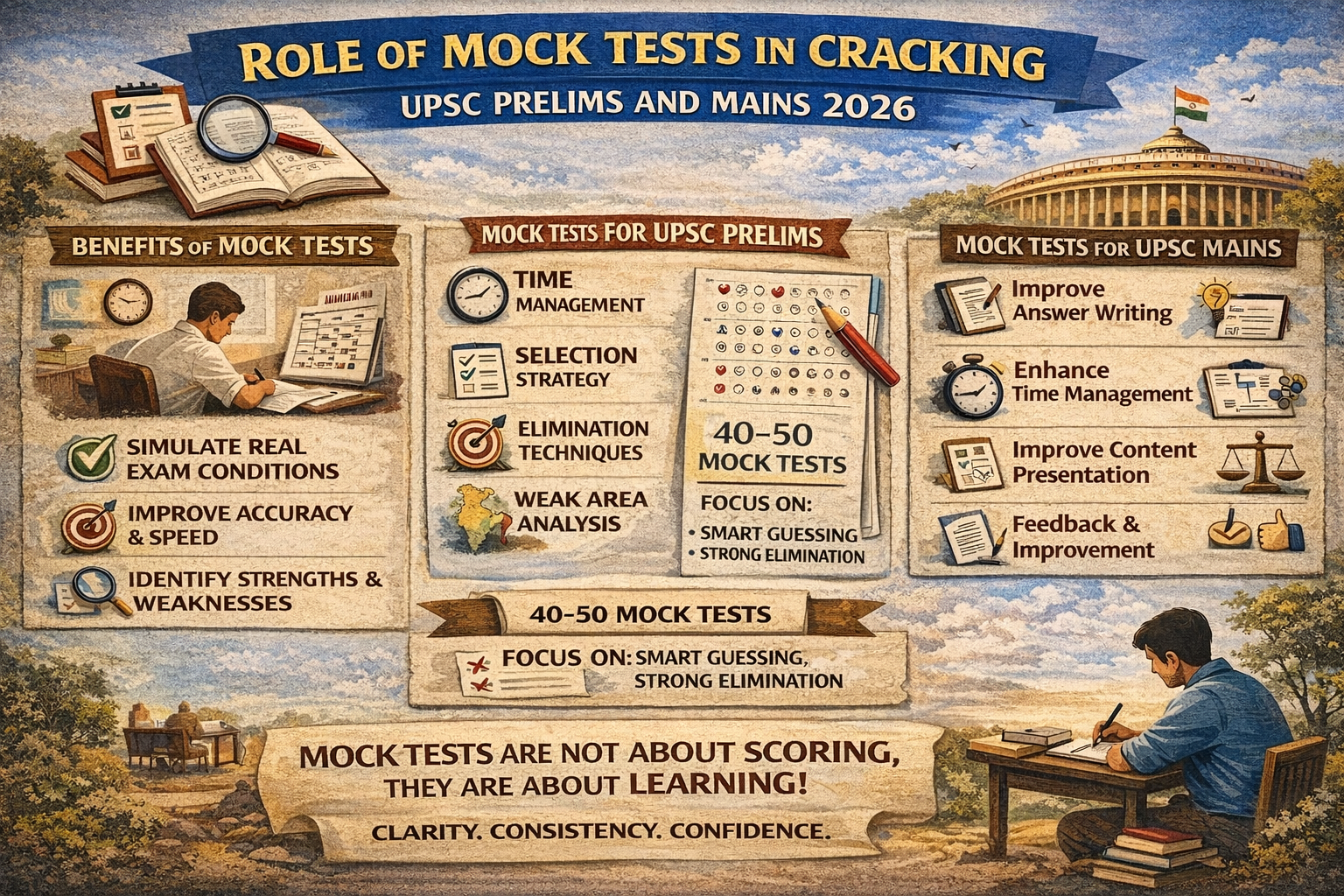
Simulate real exam conditions
Identify strengths and weaknesses
Improve accuracy and speed
Build confidence and exam temperament
👉 Serious UPSC aspirants treat mock tests as learning tools, not evaluation tools.
Role of Mock Tests in UPSC Prelims 2026
Understanding the Nature of Prelims
Objective-type questions
Negative marking
Limited time
High unpredictability
Clearing Prelims requires:
Accuracy
Smart guessing
Strong elimination skills
How Mock Tests Help in Prelims Preparation
1. Improve Time Management
Learn how much time to spend per question
Avoid getting stuck on difficult questions
2. Develop Question Selection Strategy
Identify easy vs tricky questions
Decide which questions to attempt first
3. Strengthen Elimination Techniques
Practice logical elimination
Reduce random guessing
4. Identify Weak Areas
Topic-wise performance analysis
Focus revision accordingly
5. Build Exam Temperament
Reduce panic
Improve focus and stamina
How Many Prelims Mock Tests Are Enough?
| Stage | Recommended Tests |
|---|---|
| Early preparation | 10–15 sectional tests |
| Mid-stage | 20–25 full-length tests |
| Final revision | 10–15 high-quality tests |
📌 Quality and analysis matter more than the number of tests.
Role of Mock Tests in UPSC Mains 2026
Understanding the Nature of Mains
Descriptive answer writing
Time-bound (3 hours per paper)
Emphasis on structure, clarity, and analysis
Mains success depends on:
Presentation
Content relevance
Answer writing speed
How Mock Tests Help in Mains Preparation
1. Improve Answer Writing Skills
Practice structured answers
Learn to write within word limits
2. Enhance Time Management
Write 20 answers in 3 hours
Maintain consistency till the end
3. Improve Content Presentation
Use headings, subheadings
Add diagrams, flowcharts, and maps
4. Feedback-Based Improvement
Identify repetition mistakes
Correct content gaps
5. Build Mental Endurance
Sitting for long hours
Writing under pressure
Importance of Evaluation & Feedback
A mock test without evaluation is almost useless.
Good feedback helps you:
Improve introductions and conclusions
Add value through examples and data
Eliminate irrelevant content
👉 Self-evaluation + mentor feedback is the best combination.
Role of Mock Tests in Optional Subjects
Optional papers carry 500 marks and are often rank-deciders.
Mock tests help by:
Improving subject depth
Aligning answers with UPSC demand
Enhancing answer flow and clarity
📌 Practice previous year question-based mock tests for best results.
Role of Mock Tests in Essay and Ethics Papers
Essay
Develop coherent flow
Balance philosophical and factual content
Improve expression and articulation
Ethics (GS Paper IV)
Practice case studies
Improve ethical reasoning
Use real-life examples effectively
Common Mistakes Aspirants Make with Mock Tests
❌ Taking too many tests without analysis
❌ Getting demotivated by low scores
❌ Ignoring feedback
❌ Comparing marks with others
❌ Treating mocks as exams instead of learning tools
How to Analyze Mock Tests Effectively
For Prelims
Categorize mistakes:
Knowledge-based
Conceptual
Silly mistakes
Maintain an error notebook
For Mains
Analyze:
Answer structure
Content relevance
Time per answer
Rewrite weak answers
Ideal Mock Test Strategy for UPSC 2026
| Phase | Mock Test Focus |
|---|---|
| Foundation stage | Sectional tests |
| Integration stage | Full-length GS & Optional |
| Prelims phase | Intensive MCQs |
| Mains phase | Full GS, Essay & Optional |
| Final stage | Revision-based tests |
Final Words for UPSC 2026 Aspirants
Mock tests are not meant to judge your intelligence but to train your mind for UPSC conditions.
👉 Those who analyze mock tests honestly and improve consistently are the ones who finally crack UPSC.
Consistency, patience, and learning from mistakes are the real keys to success.
Frequently Asked Questions (FAQ)
Q1. When should I start taking mock tests for UPSC 2026?
You should start sectional mock tests within 2–3 months of beginning preparation.
Q2. How many mock tests are enough to clear Prelims?
On average, 40–50 well-analyzed mock tests are sufficient.
Q3. Is it okay to score low in mock tests?
Yes. Mock tests are for learning. Improvement matters more than marks.
Q4. Are online mock tests sufficient or is offline better?
Both are effective. Choose what best simulates your actual exam environment.
Q5. Should beginners write full-length Mains mock tests?
Beginners should start with answer writing practice, then gradually move to full tests.
Q6. How important is test analysis compared to writing tests?
Analysis is more important than writing the test itself.
Q7. Can self-study aspirants crack UPSC using mock tests alone?
Mock tests are powerful tools, but they must be combined with strong conceptual study and revision.