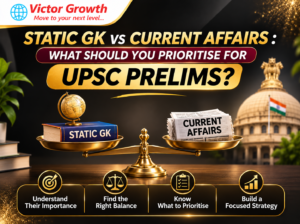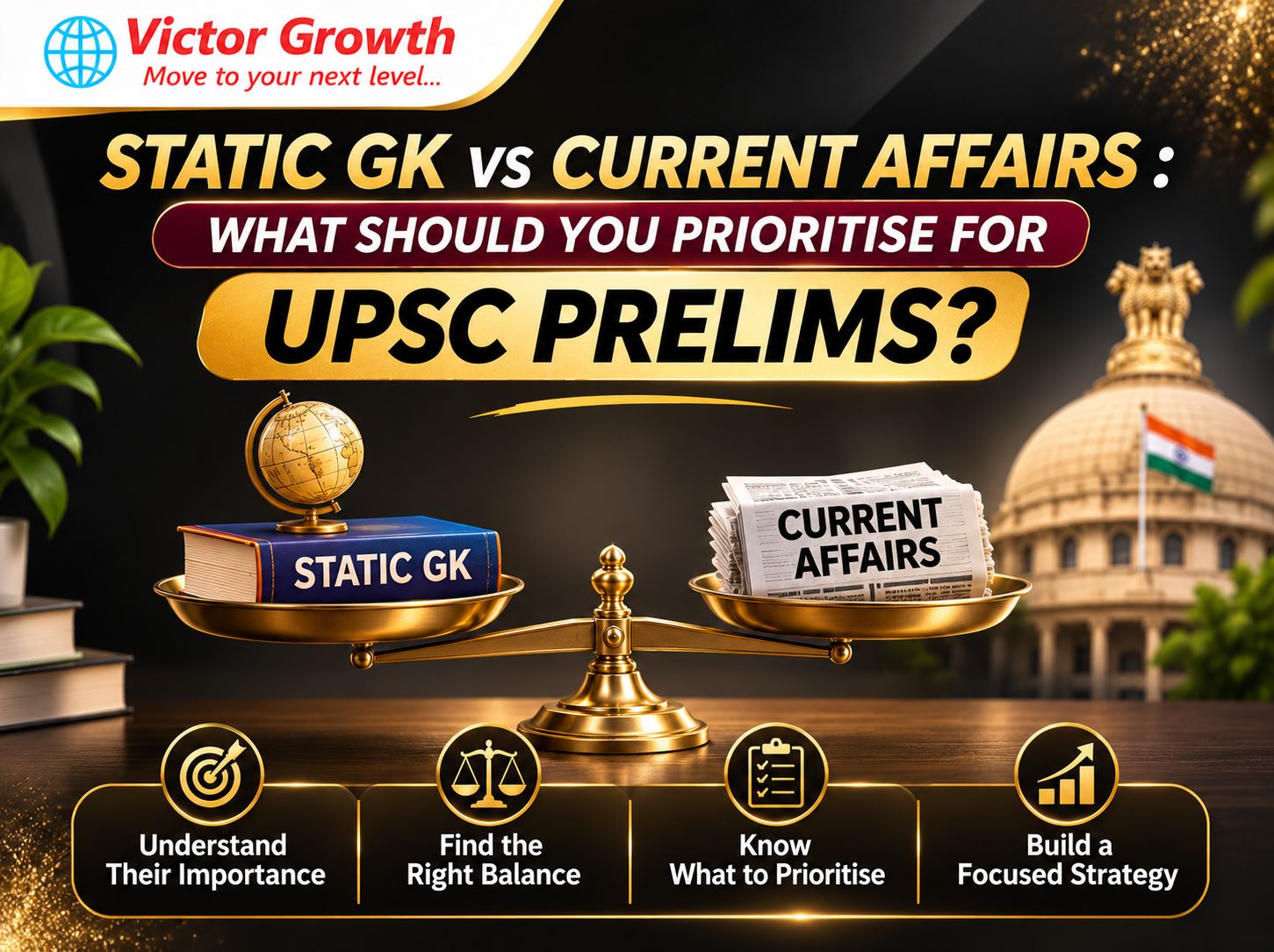
Preparing for UPSC Prelims 2027 requires a balanced understanding of both Static General Knowledge and Current Affairs. Many aspirants are confused about which area deserves more attention. Some spend most of their preparation time reading newspapers, while others concentrate entirely on textbooks and standard reference materials.
However, UPSC Prelims tests candidates on both conceptual knowledge and awareness of recent developments. The right strategy is not to choose one over the other but to understand how they are connected and prepare them systematically.
1. What Is Static GK in UPSC Preparation?
Static GK refers to information and concepts that remain relatively unchanged over time. These topics form the foundation of UPSC General Studies preparation.
Important areas include:
History: Ancient, Medieval, and Modern Indian History, freedom struggle, and art and culture.
Geography: Physical geography, Indian geography, climate, rivers, mountains, and natural resources.
Indian Polity: Constitution, fundamental rights, Parliament, judiciary, and constitutional bodies.
Economy: Basic economic concepts, banking, taxation, GDP, and inflation.
Environment: Ecosystems, biodiversity, conservation, and environmental concepts.
Science: Fundamental concepts of Physics, Chemistry, and Biology.
Static subjects help candidates understand the background of important events and developments.
2. What Is Current Affairs in UPSC Preparation?
Current Affairs refers to recent national and international developments relevant to the UPSC syllabus.
Important areas include:
Government schemes and policies.
National and international events.
Economic developments and Union Budget announcements.
Environmental issues and international conventions.
Science and technology developments.
Important reports and indices.
Defence exercises and space missions.
International organisations and agreements.
Current affairs questions often require candidates to connect recent developments with fundamental concepts.
3. Static GK vs Current Affairs: Key Differences
Static GK | Current Affairs |
|---|---|
Covers relatively permanent concepts | Covers recent developments |
Requires conceptual understanding | Requires regular updates |
Studied mainly through textbooks | Studied through newspapers and current affairs sources |
Can be revised using standard notes | Notes need periodic updates |
Builds the foundation of knowledge | Connects concepts with real-world events |
Both areas are important because UPSC questions may combine static knowledge with current developments.
4. Which Should You Prioritise for UPSC Prelims 2027?
Prioritise Static GK for a Strong Foundation
Static subjects should form the foundation of your preparation. Without understanding basic concepts, it can be difficult to answer analytical and application-based questions.
Start with NCERT textbooks and gradually move towards standard reference books. Give particular attention to Polity, History, Geography, Economy, and Environment.
Give Consistent Attention to Current Affairs
Current affairs should be studied alongside static subjects rather than postponed until the end of preparation.
For example:
While studying the Constitution, follow important Supreme Court judgments and constitutional developments.
While studying Economy, connect concepts with the Union Budget and RBI policies.
While studying Environment, follow climate conferences and biodiversity-related developments.
While studying Science, understand the significance of recent ISRO missions and technological developments.
This integrated approach makes learning more meaningful and improves retention.
5. How to Balance Static GK and Current Affairs
A balanced preparation strategy can help aspirants cover both areas without neglecting either.
Follow these methods:
Complete static concepts using NCERTs and standard textbooks.
Read a reliable newspaper daily.
Connect important current affairs with static subjects.
Prepare short notes for important developments.
Solve previous-year questions to understand UPSC question patterns.
Revise both static and current affairs every week.
Practise mock tests regularly to identify weak areas.
Avoid spending excessive time collecting current affairs information without understanding its relevance to the syllabus.
6. Suggested Daily Study Timetable
A simple timetable can help aspirants maintain consistency.
Activity | Suggested time |
|---|---|
Static subject preparation | 2 hours |
Newspaper and current affairs | 45 minutes |
Current affairs note-making | 15 minutes |
Practice MCQs and PYQs | 30 minutes |
Revision | 30 minutes |
This is a suggested routine. Candidates can adjust the timings according to their preparation level and daily responsibilities.
7. Important Sources for Static GK and Current Affairs
Choosing reliable study materials is essential for effective preparation.
For Static GK:
NCERT textbooks.
Standard reference books for Polity, History, Geography, and Economy.
Previous-year UPSC question papers.
Subject-wise revision notes.
For Current Affairs:
The Hindu or The Indian Express.
Press Information Bureau (PIB).
Economic Survey and Union Budget.
RBI and relevant government ministry websites.
Monthly current affairs compilations.
Use limited resources and revise them regularly instead of following multiple sources for the same information.
8. Common Mistakes to Avoid
Many aspirants struggle because they do not maintain a balance between static subjects and current affairs.
Avoid these mistakes:
Studying current affairs without understanding basic concepts.
Ignoring static subjects while reading newspapers.
Collecting too many current affairs materials.
Memorising news without understanding its background.
Not connecting current affairs with the UPSC syllabus.
Neglecting revision and practice questions.
Ignoring CSAT while concentrating on General Studies.
Remember, both conceptual understanding and awareness of recent developments are necessary for effective UPSC preparation.
9. Choose the Right Coaching and Academic Guidance
Proper academic guidance can help candidates understand the relationship between static subjects and current affairs. Regular classes, updated study materials, practice questions, and mock test analysis can make preparation more structured.
Students searching for the best NDA coaching in Kerala should compare faculty experience, teaching methods, study materials, and test facilities. However, NDA and UPSC Civil Services have different syllabuses and examination patterns. UPSC aspirants should select a programme specifically designed for Civil Services preparation.
Frequently Asked Questions (FAQs)
1. Is Static GK more important than Current Affairs for UPSC Prelims 2027?
Both are important. Static GK builds conceptual knowledge, while current affairs helps candidates understand recent developments and their connection with the syllabus.
2. How much time should I spend on current affairs daily?
Around 30–60 minutes daily is a practical starting point. Focus on important developments rather than reading every news item.
3. Can I prepare current affairs without studying static subjects?
It is not advisable. Basic static knowledge is necessary to understand the background and significance of current developments.
4. Which subjects should I prioritise for Static GK?
Focus on History, Geography, Indian Polity, Economy, Environment, and basic Science.
5. Are newspapers enough for UPSC current affairs preparation?
Newspapers are useful, but candidates should also follow relevant government announcements, official reports, and monthly revision materials.
6. Should I make separate notes for Static GK and Current Affairs?
You can maintain separate notes initially, but connecting current developments with relevant static topics makes revision more effective.
7. How can I improve my preparation in both areas?
Follow a daily routine that includes static subject study, current affairs, previous-year questions, MCQ practice, and regular revision.
Conclusion
Static GK and Current Affairs are equally important components of UPSC Prelims 2027 preparation. Static subjects provide the conceptual foundation, while current affairs help aspirants understand how those concepts apply to real-world developments. Instead of prioritising one and ignoring the other, follow an integrated preparation strategy. Use reliable study materials, connect current events with static concepts, practise previous-year questions, and revise consistently. A balanced approach can help aspirants improve their knowledge, accuracy, and confidence for the examination.