
Introduction
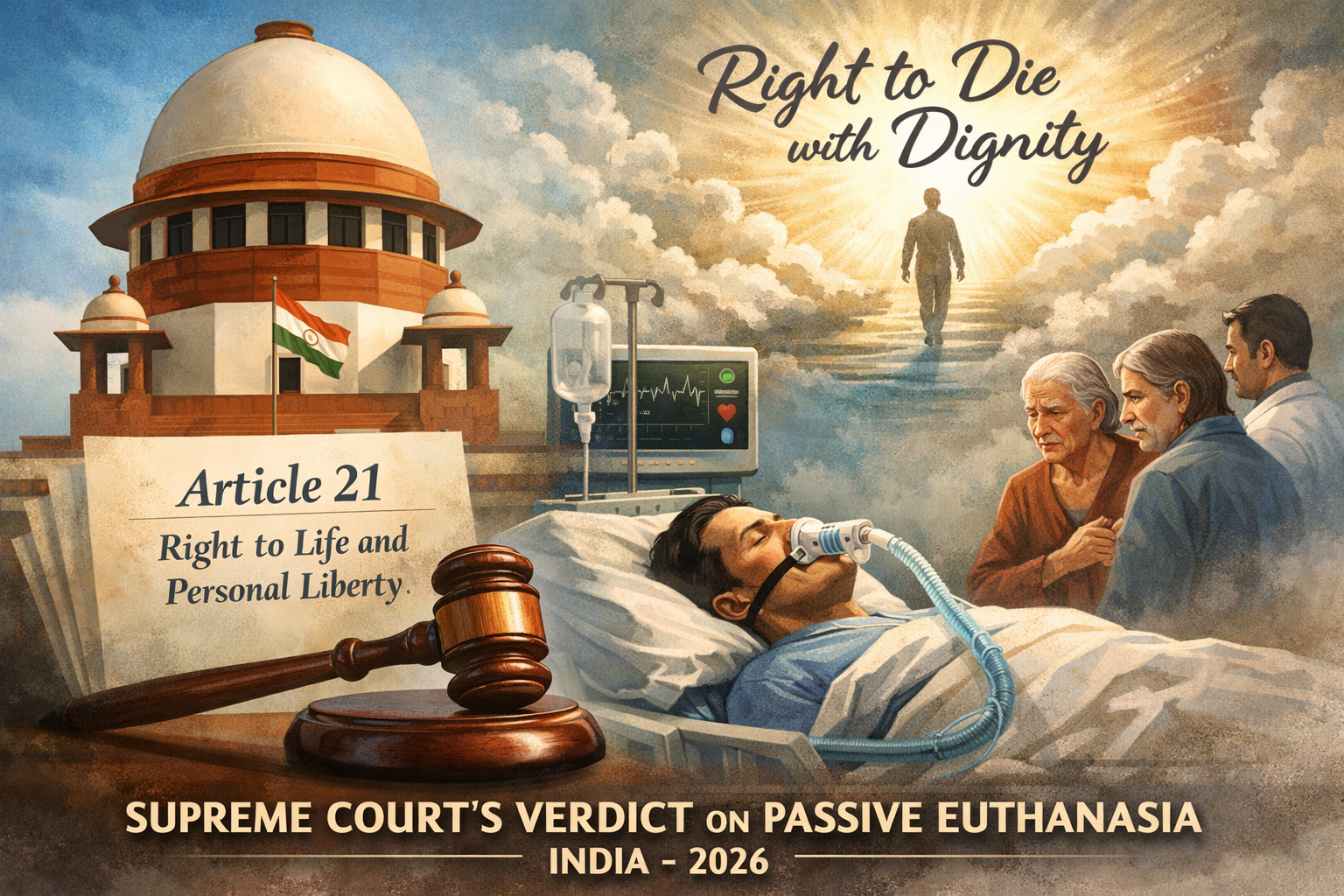
In March 2026, the Supreme Court of India delivered a landmark judgment permitting passive euthanasia in a specific case. The decision allowed the withdrawal of life-sustaining treatment for a patient who had remained in a permanent vegetative state for more than 13 years after a severe brain injury.
This verdict revived the national debate on the “Right to Die with Dignity” and highlighted the ethical and legal challenges related to end-of-life medical decisions in India.
What is Euthanasia?
Euthanasia refers to intentionally ending a person’s life to relieve suffering, especially in cases of severe illness or irreversible medical conditions.
Types of Euthanasia
1. Active Euthanasia
-
Involves directly causing the death of a patient.
-
Example: administering a lethal injection.
-
Illegal in India.
2. Passive Euthanasia
-
Involves withdrawing or withholding life-sustaining medical treatment.
-
Example: removing ventilators or stopping artificial feeding.
-
Permitted under strict legal guidelines in India.
Background of the 2026 Supreme Court Case
The case involved Harish Rana, a man who had remained in a permanent vegetative state for about 13 years following severe injuries in 2013.
His parents approached the Supreme Court seeking permission to withdraw life support after doctors confirmed that recovery was medically impossible.
After reviewing medical reports and hearing the arguments, the Supreme Court allowed the withdrawal of life-sustaining treatment. This marked one of the most significant judicial decisions on passive euthanasia in India.
The Court observed that allowing the patient to pass away peacefully was not abandonment but rather respecting human dignity and compassion.
Constitutional Basis: Right to Die with Dignity
The Supreme Court connected passive euthanasia to Article 21 of the Indian Constitution, which guarantees the Right to Life and Personal Liberty.
The Court interpreted Article 21 broadly to include:
-
The right to live with dignity
-
The right to die with dignity in certain circumstances
-
Protection from prolonged suffering in irreversible medical conditions
Important Supreme Court Judgments on Euthanasia
1. Aruna Shanbaug Case (2011)
This was the first major case in India dealing with euthanasia. The Supreme Court allowed passive euthanasia under strict conditions and required approval from the High Court along with medical board verification.
2. Common Cause v. Union of India (2018)
In this judgment, the Supreme Court recognized the concept of “living wills” or advance directives, allowing individuals to state in advance that life-support treatment should be withdrawn if they become terminally ill.
3. Harish Rana Case (2026)
The Supreme Court allowed withdrawal of life support for a patient in a permanent vegetative state, reinforcing the concept of dignified death and highlighting the need for clearer legal guidelines on end-of-life care.
Guidelines for Passive Euthanasia in India
Passive euthanasia can be allowed only under strict safeguards.
Key safeguards include:
-
Medical confirmation that the patient’s condition is irreversible and incurable.
-
Examination and recommendation by multiple medical boards.
-
Consent from family members or the presence of a living will by the patient.
-
Review and approval by hospital authorities and legal procedures.
These safeguards aim to prevent misuse and ensure ethical medical practice.
Ethical Issues in Euthanasia
Arguments Supporting Passive Euthanasia
-
Respect for human dignity
-
Relief from prolonged suffering
-
Respect for patient autonomy
-
Avoiding unnecessary medical intervention
Arguments Opposing Passive Euthanasia
-
Risk of misuse or pressure from relatives
-
Religious and cultural opposition
-
Fear that vulnerable patients may be exploited
-
Ethical duty of doctors to preserve life
Significance of the 2026 Verdict
The Supreme Court verdict is significant because it:
-
Strengthens the principle of Right to Die with Dignity.
-
Clarifies the legal position of passive euthanasia in India.
-
Highlights the need for clear legislation on end-of-life decisions.
-
Brings attention to the importance of palliative care and medical ethics.
The judgment also revived discussions about how society should deal with terminal illness and irreversible medical conditions.
Conclusion
The Supreme Court’s verdict on passive euthanasia represents a major development in Indian constitutional and medical law. By allowing withdrawal of life-support in exceptional circumstances, the Court attempted to balance human dignity, compassion, and legal safeguards.
However, the issue remains sensitive and complex. The decision highlights the need for a comprehensive legal framework and ethical guidelines to regulate end-of-life decisions in India.