A Complete Guide for Aspirants Preparing for the Indian Air Force Officer Selection
The Air Force Common Admission Test (AFCAT) is one of the most prestigious defence examinations in India, offering young men and women the opportunity to join the Indian Air Force as commissioned officers. Every year, thousands of candidates apply for AFCAT with dreams of serving the nation in the Flying Branch, Ground Duty (Technical), and Ground Duty (Non-Technical) branches.
However, clearing AFCAT requires much more than passing a written examination. The selection process is designed to identify candidates who possess intelligence, leadership qualities, decision-making ability, communication skills, physical fitness, and officer-like qualities required in the Indian Air Force.
Many successful candidates credit their achievement to systematic preparation under the guidance of the best AFCAT coaching in Kerala, where they receive training not only for the written examination but also for the Air Force Selection Board (AFSB) interview and medical examinations.
This comprehensive guide explains every stage of the AFCAT selection process, helping aspirants understand what to expect and how to prepare effectively.
Overview of the AFCAT Selection Process
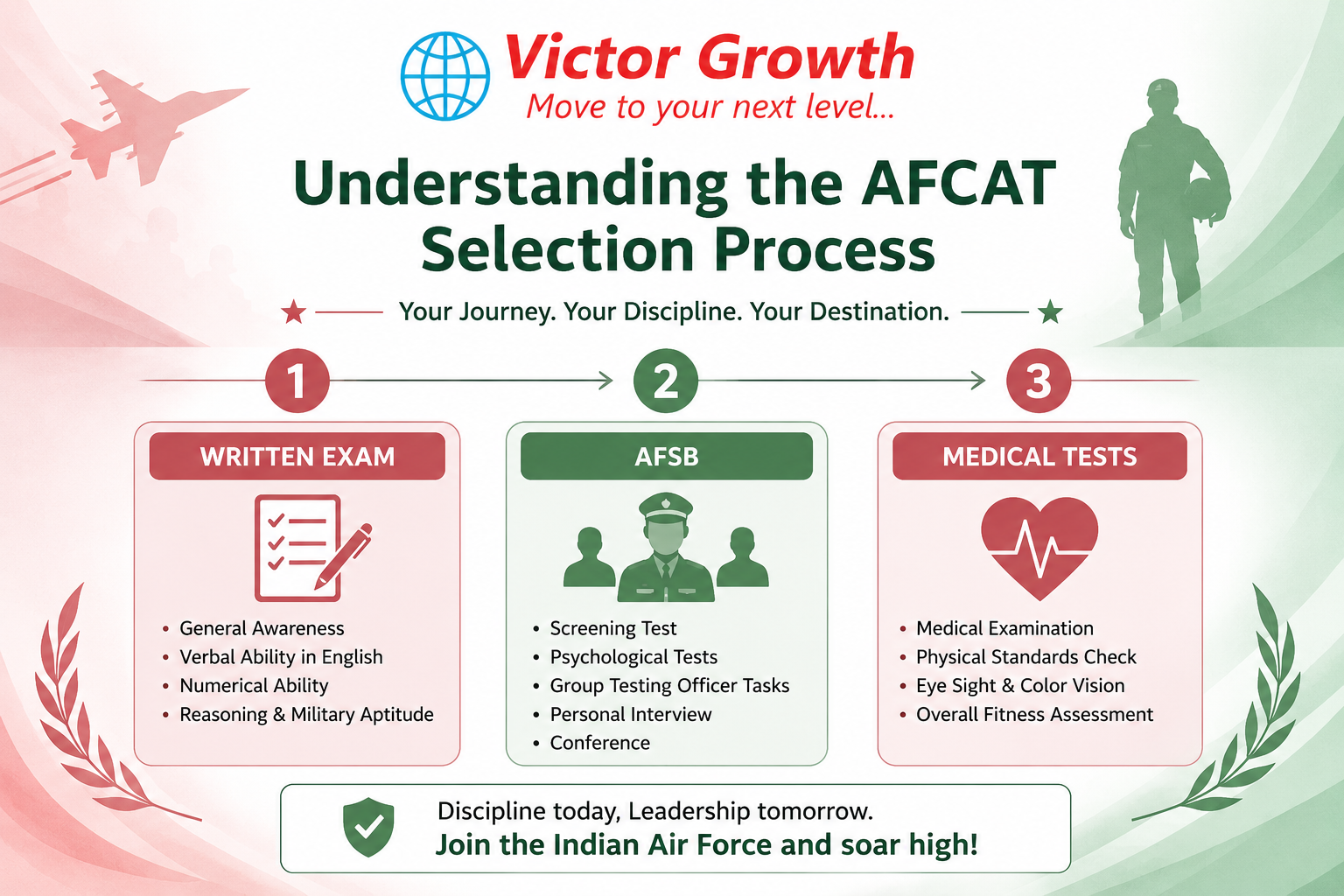
The AFCAT selection process consists of multiple stages:
Stage 1
AFCAT Written Examination
Stage 2
AFSB (Air Force Selection Board) Interview
Stage 3
Medical Examination
Stage 4
Final Merit List
Candidates must successfully clear each stage to move forward in the selection process.
Why Understanding the AFCAT Selection Process Is Important
Many aspirants focus exclusively on the written examination and begin preparing for the AFSB interview only after receiving a call letter. This approach often results in poor performance during the interview stage.
Candidates preparing under the best AFCAT coaching in Kerala are usually trained simultaneously for:
- AFCAT Written Examination
- Psychological Tests
- Group Tasks
- Personal Interviews
- Medical Standards
This integrated approach significantly improves selection chances.
Stage 1: AFCAT Written Examination
The written examination serves as the first screening stage.
Its objective is to evaluate:
- Academic knowledge
- General awareness
- Reasoning ability
- Communication skills
- Numerical aptitude
AFCAT Exam Pattern
The AFCAT written exam generally includes questions from four major sections:
General Awareness
Topics include:
- Current Affairs
- History
- Geography
- Polity
- Economics
- Defence Knowledge
- Science and Technology
Verbal Ability in English
Questions may cover:
- Vocabulary
- Grammar
- Comprehension
- Error Detection
- Sentence Completion
Numerical Ability
Important areas include:
- Percentage
- Ratio and Proportion
- Average
- Time and Work
- Profit and Loss
- Algebra
Reasoning and Military Aptitude
Questions focus on:
- Logical Reasoning
- Analytical Ability
- Pattern Recognition
- Spatial Ability
How to Prepare for the AFCAT Written Examination
Successful candidates generally follow a structured preparation plan:
Understand the Syllabus
Study only relevant topics.
Build Strong Fundamentals
Strengthen basic concepts.
Read Current Affairs Daily
Stay updated on national and international developments.
Practice Mock Tests
Improve speed and accuracy.
Revise Regularly
Retention is critical for success.
The best AFCAT coaching in Kerala typically provides study materials, mock tests, and expert guidance for all subjects.
AFCAT Written Exam Result
After the examination, candidates who achieve the required cut-off score become eligible for the next stage:
Air Force Selection Board (AFSB) Interview
This is the most important stage of the AFCAT selection process.
Stage 2: Air Force Selection Board (AFSB) Interview
The AFSB interview assesses whether a candidate possesses the qualities required to become an Air Force officer.
Unlike the written examination, the AFSB focuses on:
- Personality
- Leadership
- Communication
- Teamwork
- Decision-making
- Emotional stability
The AFSB process usually spans several days.
AFSB Stage I: Screening Test
The first day consists of screening tests.
Only candidates who clear this stage proceed further.
Officer Intelligence Rating (OIR) Test
The OIR test evaluates:
- Verbal Intelligence
- Non-Verbal Intelligence
- Analytical Thinking
- Logical Reasoning
The questions are generally objective in nature.
Picture Perception and Discussion Test (PPDT)
Candidates are shown a picture for a brief period.
They must:
Write a Story
Based on the image shown.
Participate in Group Discussion
Discuss their story with other candidates.
The assessors evaluate:
- Observation skills
- Communication
- Confidence
- Team participation
Many candidates fail at this stage due to poor communication skills or inability to work effectively in a group.
AFSB Stage II
Candidates who clear Stage I remain for the complete assessment process.
Psychological Tests
Psychological testing is designed to assess the candidate’s subconscious personality traits.
Thematic Apperception Test (TAT)
Candidates view images and write stories.
The assessors evaluate:
- Imagination
- Leadership
- Problem-solving approach
- Positive attitude
Word Association Test (WAT)
Words are displayed one after another.
Candidates must write their immediate thoughts.
This evaluates:
- Personality traits
- Thought processes
- Attitude
Situation Reaction Test (SRT)
Candidates are presented with situations and must write their reactions.
The objective is to assess:
- Decision-making
- Practical judgment
- Leadership qualities
Self Description Test (SDT)
Candidates describe:
- Themselves
- Parents’ opinions
- Friends’ opinions
- Teachers’ opinions
This helps assess self-awareness and honesty.
Group Testing Officer (GTO) Tasks
The GTO series evaluates candidates in a group environment.
Group Discussion (GD)
Topics are generally based on:
- National Issues
- Defence Topics
- Current Affairs
The assessors evaluate:
- Communication
- Knowledge
- Confidence
- Teamwork
Group Planning Exercise (GPE)
Candidates work together to solve practical problems.
The exercise assesses:
- Planning ability
- Leadership
- Cooperation
Progressive Group Task (PGT)
Teams solve outdoor obstacles together.
Evaluated qualities include:
- Team spirit
- Resourcefulness
- Leadership
Half Group Task (HGT)
A smaller team performs similar tasks.
This allows assessors to evaluate individual participation more closely.
Command Task
Candidates lead a team to complete a specific task.
The assessors observe:
- Leadership
- Decision-making
- Communication
Individual Obstacles
Candidates attempt a series of physical obstacles.
The test evaluates:
- Courage
- Stamina
- Determination
Lecturette
Candidates speak on a given topic.
This assesses:
- Public speaking
- Confidence
- Clarity of thought
Personal Interview
The Personal Interview is one of the most important components of AFSB.
Interviewers assess:
- Personality
- Awareness
- Confidence
- Family Background
- Educational Record
- Career Goals
- General Knowledge
The interview is designed to determine whether a candidate possesses officer-like qualities.
Candidates attending the best AFCAT coaching in Kerala often undergo multiple mock interviews before appearing for AFSB.
AFSB Conference
At the end of the process, all assessors review the candidate’s performance.
The Conference determines whether the candidate is:
Recommended
or
Not Recommended
Recommended candidates proceed to the medical examination stage.
Stage 3: Medical Examination
Candidates recommended by the AFSB must undergo comprehensive medical evaluations.
The purpose is to ensure that candidates meet the medical standards required for Air Force service.
Medical Tests Conducted
General Physical Examination
Assessment of:
- Height
- Weight
- Body proportions
Vision Standards
Vision requirements vary by branch.
Special emphasis is placed on:
- Visual acuity
- Color vision
- Eye health
Flying Branch candidates generally have stricter standards.
Hearing Test
Candidates must possess normal hearing ability.
ENT Examination
Evaluation of:
- Ear
- Nose
- Throat
Dental Examination
Oral health and dental fitness are assessed.
Cardiovascular Examination
Heart health is carefully evaluated.
Laboratory Tests
Tests may include:
- Blood Tests
- Urine Tests
- Other diagnostic evaluations
Orthopedic Examination
Assessment of:
- Bones
- Joints
- Posture
- Physical fitness
Common Reasons for Medical Rejection
Candidates may face medical issues related to:
- Poor eyesight
- Hearing deficiencies
- Obesity
- Underweight conditions
- Orthopedic problems
- Chronic medical conditions
Maintaining fitness during AFCAT preparation is highly recommended.
Stage 4: Final Merit List
The final merit list is prepared based on:
AFCAT Written Examination Performance
AFSB Recommendation
Medical Fitness
Available Vacancies
Only candidates meeting all criteria receive final selection.
Training at the Air Force Academy
Selected candidates undergo training at the prestigious:
Air Force Academy
Training includes:
- Military Discipline
- Physical Conditioning
- Leadership Development
- Academic Training
- Professional Military Education
The duration varies depending on the branch.
Commissioning as an Indian Air Force Officer
After successful completion of training, candidates are commissioned as officers in the Indian Air Force.
They begin their careers in:
Flying Branch
Pilots and aviation officers.
Ground Duty Technical Branch
Engineering and technical roles.
Ground Duty Non-Technical Branch
Administration, logistics, education, accounts, and other support functions.
This marks the successful completion of the AFCAT selection journey.
How the Best AFCAT Coaching in Kerala Helps Throughout the Selection Process
Professional coaching institutes provide:
Written Exam Preparation
Comprehensive syllabus coverage and mock tests.
Current Affairs Guidance
Regular updates and study materials.
Psychological Test Training
Practice for TAT, WAT, SRT, and SDT.
GTO Task Preparation
Leadership and group activity training.
Personal Interview Coaching
Mock interviews and personality development.
Medical Awareness Guidance
Information regarding Air Force medical standards.
These advantages significantly improve a candidate’s chances of selection.
Conclusion
The AFCAT selection process is designed to identify well-rounded individuals capable of becoming leaders in the Indian Air Force. Success requires preparation for every stage—not just the written examination.
From the AFCAT written test and AFSB interview to the medical examination and final merit list, each stage evaluates different aspects of a candidate’s personality, intelligence, leadership, and fitness.
By understanding the complete process and preparing under the guidance of the best AFCAT coaching in Kerala, aspirants can approach every stage with confidence and maximize their chances of becoming commissioned officers in the Indian Air Force.
Frequently Asked Questions (FAQs)
1. What are the stages of the AFCAT selection process?
The AFCAT selection process includes the Written Examination, AFSB Interview, Medical Examination, and Final Merit List.
2. What is the AFCAT written exam?
It is the first stage of selection that evaluates General Awareness, English, Numerical Ability, and Reasoning & Military Aptitude.
3. What is the AFSB interview?
The Air Force Selection Board interview assesses leadership qualities, personality, communication skills, intelligence, and officer-like qualities.
4. What is the OIR test in AFSB?
The Officer Intelligence Rating (OIR) test evaluates verbal and non-verbal intelligence.
5. What is PPDT?
Picture Perception and Discussion Test (PPDT) evaluates observation skills, story-writing ability, communication, and teamwork.
6. What psychological tests are conducted in AFSB?
TAT, WAT, SRT, and Self Description Test are conducted to assess personality traits and decision-making abilities.
7. What happens after clearing AFSB?
Candidates undergo a detailed medical examination to verify fitness standards.
8. Can candidates be rejected during the medical examination?
Yes. Candidates who do not meet the prescribed Air Force medical standards may be declared medically unfit.
9. Where do selected candidates undergo training?
Selected candidates undergo training at the Air Force Academy before commissioning.
10. Why should I join the best AFCAT coaching in Kerala?
The best AFCAT coaching in Kerala provides complete guidance for the written examination, AFSB interview, psychological tests, GTO tasks, mock interviews, and medical awareness, helping candidates maximize their chances of selection into the Indian Air Force.