Preparing for the UPSC Civil Services Examination (IAS) 2026 while managing a full-time job is challenging—but absolutely achievable with the right strategy. Many successful IAS officers have cracked the exam while working, proving that smart planning matters more than long study hours.
This article provides a complete, practical, and realistic roadmap for working professionals aiming to clear UPSC IAS 2026 efficiently.
Why Working Aspirants Need a Smart Strategy for UPSC 2026
Working aspirants face unique constraints such as:
Limited daily study hours
Mental fatigue after office work
Difficulty attending full-time coaching
Inconsistent revision time
Hence, success depends on focused study, intelligent resource selection, and disciplined execution, not on studying 10–12 hours daily.
Understanding the UPSC IAS 2026 Exam Structure
Before planning, clarity on the exam is essential:
1. UPSC Prelims
Objective type
GS Paper I (100 questions)
CSAT (Qualifying – 33%)
2. UPSC Mains
9 descriptive papers
Essay, GS I–IV, Optional I & II
3. Personality Test (Interview)
👉 Working aspirants must integrate Prelims + Mains preparation from Day 1.
Step-by-Step Smart Preparation Strategy for Working Aspirants
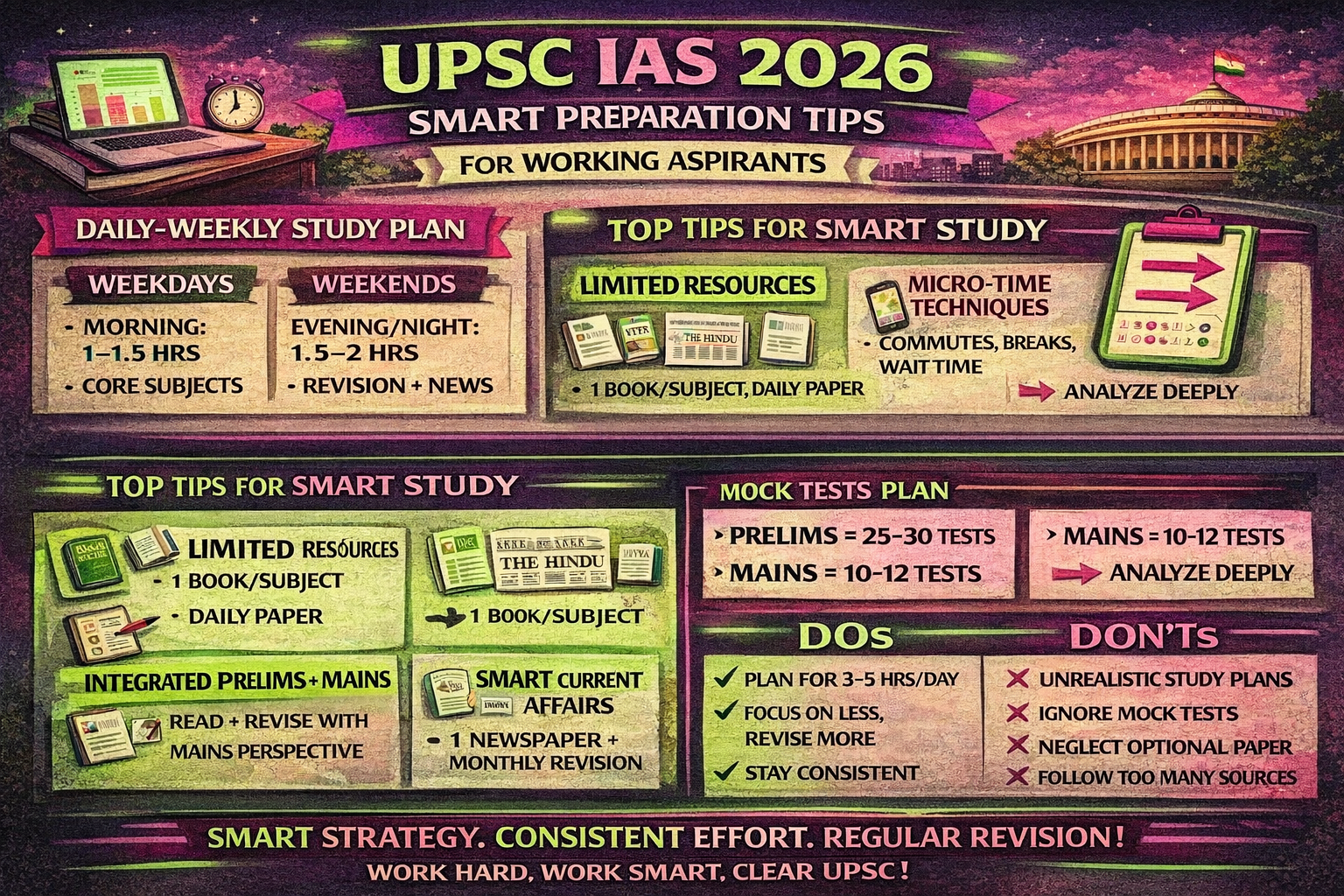
1. Create a Realistic Daily Study Plan (3–5 Hours)
Instead of copying full-time aspirants’ schedules, follow this practical breakup:
Weekdays
Morning: 1–1.5 hours (core subjects)
Evening/Night: 1.5–2 hours (revision, current affairs)
Weekends
6–8 hours/day for:
Answer writing
Mock tests
Optional subject
👉 Consistency matters more than duration.
2. Choose Limited but High-Quality Resources
Avoid the biggest mistake—too many books.
Must-Have Basic Resources:
NCERTs (Selective reading)
Standard books (1 per subject)
Daily newspaper (The Hindu / Indian Express)
Monthly current affairs magazine
Rule:
📌 One subject = One book = Multiple revisions
3. Integrated Prelims + Mains Preparation
Working aspirants cannot afford separate preparation cycles.
How to integrate?
Read topics with Mains answer perspective
Make short notes with:
Keywords
Data
Examples
Practice MCQs + 2–3 Mains answers weekly
This saves time and boosts retention.
4. Smart Time Utilization Techniques
Use Micro-Time Wisely:
Commute time → Podcasts / News analysis
Lunch breaks → Revision of short notes
Weekends → Mock tests & writing practice
Even 30 minutes daily = 180 hours/year.
5. Current Affairs: The Backbone of UPSC 2026
For working aspirants, current affairs must be structured and concise.
Best Approach:
Daily newspaper (45 minutes max)
Monthly compilation for revision
Link current issues with:
GS papers
Essay
Optional
📌 Avoid reading multiple newspapers.
6. Answer Writing Strategy for Busy Aspirants
You don’t need daily writing practice initially.
Smart Plan:
Start with 2 answers/day (weekends)
Use:
Introduction–Body–Conclusion format
Diagrams & flowcharts
Focus on quality, not quantity
Gradually increase frequency 4–5 months before Mains.
7. Mock Tests: Quality Over Quantity
Working aspirants should avoid test overload.
Ideal Test Plan:
Prelims: 25–30 full-length tests
Mains: Sectional tests + 8–10 full-length tests
📌 Analyze every test deeply—this matters more than scores.
8. Optional Subject Strategy for Working Professionals
Choose an optional:
With overlap in GS
Availability of resources
Interest & background relevance
Allocate:
Weekends mainly for optional
Daily 30–45 minutes on weekdays
Early completion of optional gives a major advantage.
9. Health, Sleep & Stress Management
A tired mind cannot retain information.
Essentials:
6–7 hours of sleep
Light exercise / walking
Avoid burnout by:
Weekly breaks
Short leisure activities
A healthy routine ensures long-term consistency.
10. When Should Working Aspirants Take Leave?
Strategic leaves are better than long breaks.
Ideal Leave Plan:
1–2 months before Prelims
3 months before Mains (if possible)
Use leave time only for:
Revision
Tests
Weak areas
Common Mistakes Working Aspirants Must Avoid
❌ Unrealistic study schedules
❌ Ignoring answer writing
❌ Excessive resource collection
❌ Delaying mock tests
❌ Comparing with full-time aspirants
Final 6-Month Smart Focus Plan for UPSC IAS 2026
| Phase | Focus Area |
|---|---|
| Months 1–2 | Core subjects + Current Affairs |
| Months 3–4 | Revision + Answer Writing |
| Month 5 | Intensive Mock Tests |
| Month 6 | Final Revision & Weak Areas |
Conclusion
Cracking UPSC IAS 2026 as a working aspirant is not about sacrificing your job—it’s about smart preparation. With disciplined planning, limited resources, regular revision, and focused practice, working professionals can compete confidently with full-time aspirants.
Remember:
Consistency beats intensity. Strategy beats struggle.
Frequently Asked Questions (FAQs)
Q1. Can a working professional really crack UPSC IAS 2026?
Yes. Many IAS officers cleared UPSC while working full-time. Smart planning and consistency are key.
Q2. How many hours should a working aspirant study daily?
3–5 focused hours on weekdays and 6–8 hours on weekends are sufficient.
Q3. Is coaching necessary for working aspirants?
Not compulsory. Online courses, test series, and self-study are often more flexible and effective.
Q4. When should working aspirants start preparation for UPSC 2026?
Ideally, 12–15 months before Prelims with integrated Prelims + Mains preparation.
Q5. How to manage current affairs with a job?
Limit newspaper reading to 45 minutes daily and rely on monthly compilations for revision.
Q6. Is it necessary to quit the job for UPSC?
No. Quitting is a personal choice, not a requirement. Many succeed without leaving their jobs.