Preparing for UPSC Prelims 2027 while managing college, work, and personal responsibilities can be challenging. Working professionals often have limited study hours, while students need to balance their academic commitments with competitive examination preparation.
However, clearing UPSC Prelims is not about studying for 12–14 hours every day. It requires consistency, proper time management, regular revision, and a well-planned study schedule.
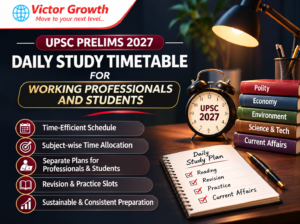
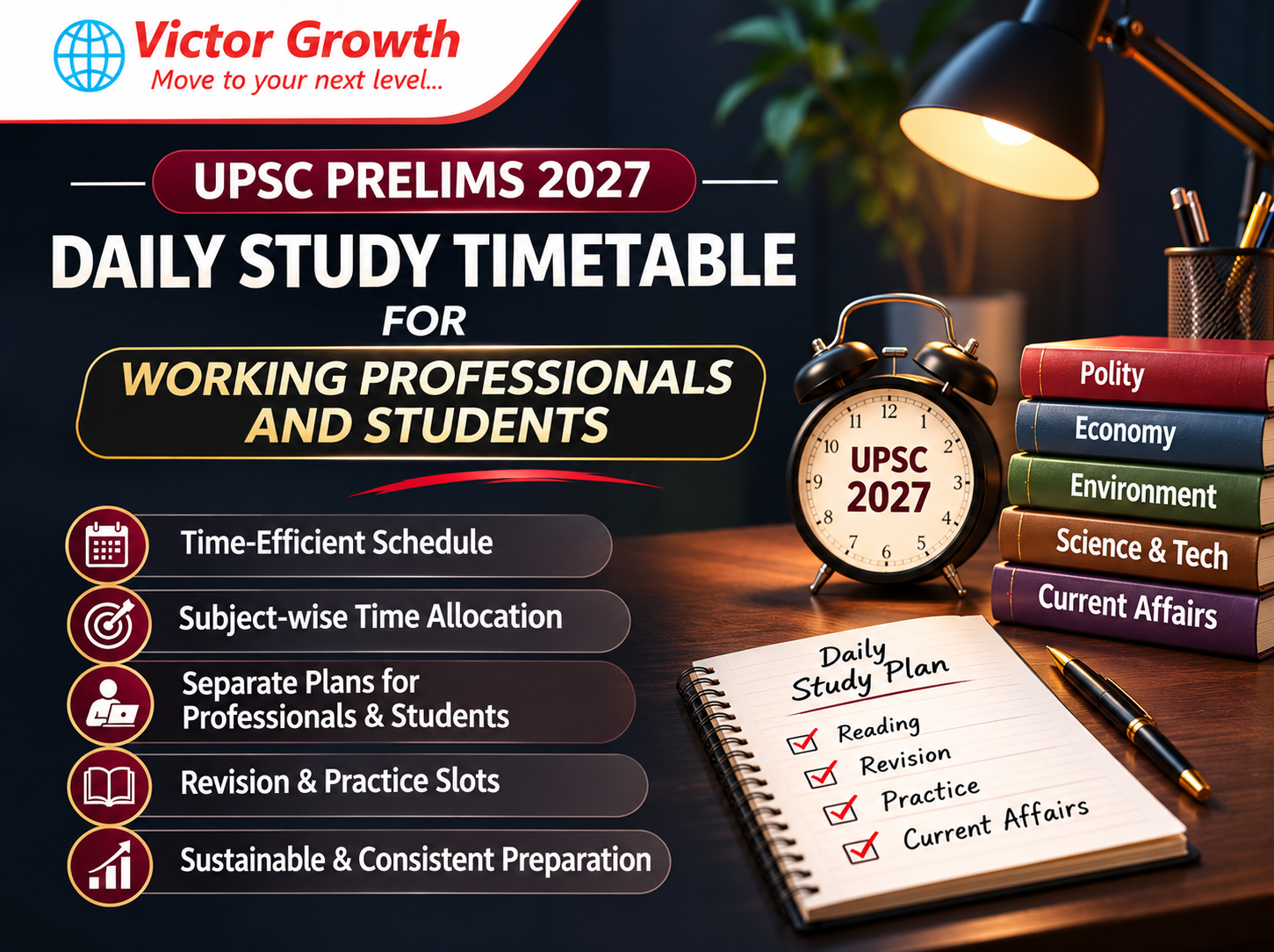
A practical daily timetable helps aspirants cover the UPSC syllabus systematically without neglecting their work or education.
1. How Many Hours Should You Study Daily for UPSC Prelims 2027?
The number of study hours depends on your daily responsibilities and preparation level.
Working Professionals: 3–4 hours on weekdays and 6–7 hours on weekends.
College Students: 4–6 hours daily, depending on their class schedule.
Full-Time Aspirants: 7–9 focused study hours daily.
These are suggested targets, not fixed requirements. The quality of your preparation is more important than the number of hours spent studying.
2. Daily Study Timetable for Working Professionals
Working professionals should make the best use of early mornings, lunch breaks, and evenings.
Suggested timetable:
Time | Activity |
|---|---|
5:30 AM – 6:30 AM | Study static subjects |
6:30 AM – 7:00 AM | Newspaper and current affairs |
7:00 AM – 9:00 AM | Get ready and travel to work |
Lunch break (20–30 minutes) | Revise short notes |
7:00 PM – 8:00 PM | Study another GS subject |
8:00 PM – 8:30 PM | Dinner and relaxation |
8:30 PM – 9:15 PM | Practise MCQs and revise |
9:15 PM onwards | Rest and sleep |
Tips for working professionals:
Study difficult subjects during your most productive hours.
Use weekends to complete pending topics.
Listen to current affairs discussions during suitable travel time.
Avoid unnecessary mobile usage during study sessions.
Maintain a realistic schedule that allows sufficient sleep.
3. Daily Study Timetable for College Students
College students have an advantage because they may have more flexibility in their daily schedules. They should balance college studies with UPSC preparation.
Suggested timetable:
Time | Activity |
|---|---|
5:30 AM – 7:00 AM | Study History or Geography |
7:00 AM – 8:00 AM | Newspaper and current affairs |
8:00 AM – 9:00 AM | Breakfast and college preparation |
College hours | Attend classes and complete academic work |
4:30 PM – 5:30 PM | Revise morning topics |
5:30 PM – 6:30 PM | Study Polity or Economy |
6:30 PM – 7:00 PM | Break |
7:00 PM – 8:00 PM | Practise MCQs |
8:00 PM – 8:30 PM | Quick revision |
Students should adjust this timetable according to their college timings and examination schedules.
4. Subject-Wise Weekly Study Plan for UPSC Prelims 2027
Following a weekly subject rotation helps candidates cover all major areas of the UPSC syllabus.
Day | Subject |
|---|---|
Monday | Indian Polity |
Tuesday | History |
Wednesday | Geography |
Thursday | Indian Economy |
Friday | Environment and Ecology |
Saturday | Science and Technology |
Sunday | Current Affairs, revision and mock tests |
Along with these subjects, practise CSAT regularly. Do not ignore it, as qualifying in Paper II is compulsory.
5. How to Balance Static Subjects and Current Affairs
Both static subjects and current affairs are important for UPSC Prelims.
Follow these simple methods:
Read a reliable newspaper daily for 30–45 minutes.
Connect important news with topics in the UPSC syllabus.
Prepare short notes for important developments.
Revise monthly current affairs.
Practise current affairs-based MCQs regularly.
Avoid spending several hours reading unnecessary news. Focus on examination-relevant developments.
6. Importance of Revision and Mock Tests
Studying new topics every day without revision can reduce retention. Therefore, include revision and question practice in your timetable.
Revise previously studied topics every week.
Solve 20–30 MCQs daily, adjusting the number based on your preparation stage.
Attempt topic-wise tests after completing each subject.
Analyse mistakes and understand why an answer is incorrect.
Take full-length mock tests regularly as the examination approaches.
Mock tests help improve accuracy, time management, and confidence.
7. Common Timetable Mistakes to Avoid
Many aspirants prepare ambitious timetables but struggle to follow them consistently.
Avoid these mistakes:
Planning to study for too many hours without considering work or college.
Ignoring revision while completing new topics.
Studying multiple subjects without a clear plan.
Spending excessive time on newspapers and current affairs.
Avoiding CSAT preparation.
Skipping mock tests and question practice.
Sacrificing sleep to complete unrealistic daily targets.
A timetable should be flexible enough to accommodate unexpected work, college assignments, and personal responsibilities.
8. The Role of Proper Coaching and Guidance
Balancing UPSC preparation with work or college becomes easier with a structured learning plan and proper academic guidance. Experienced faculty, organised study materials, regular assessments, and doubt-clearing sessions can help aspirants use their available time effectively.
Students searching for the best NDA coaching in Kerala should compare teaching quality, faculty experience, study materials, and test facilities. However, NDA and UPSC Civil Services are different examinations. UPSC aspirants should select a programme specifically designed for Civil Services preparation.
Frequently Asked Questions (FAQs)
1. Can working professionals prepare for UPSC Prelims 2027?
Yes. Working professionals can prepare successfully with a realistic timetable, consistent study, regular revision, and effective time management.
2. How many hours should a working professional study daily for UPSC?
Around 3–4 focused hours on weekdays and 6–7 hours on weekends can be a practical target.
3. What is the best time to study for UPSC?
Early morning and evening are suitable for many aspirants. However, the best time depends on individual productivity and daily responsibilities.
4. Can college students prepare for UPSC along with their degree?
Yes. College students can start with NCERT books, understand the UPSC syllabus, follow current affairs, and gradually move towards advanced study materials.
5. Should I study all UPSC subjects every day?
No. Follow a subject-wise timetable and maintain daily current affairs, revision, and question practice.
6. How important are mock tests for UPSC Prelims 2027?
Mock tests help candidates understand the examination pattern, improve accuracy, identify weak areas, and develop time-management skills.
7. Is one year enough to prepare for UPSC Prelims?
It can be enough for some candidates, depending on their existing knowledge, study hours, and consistency. A structured preparation strategy is essential.
Conclusion
Preparing for UPSC Prelims 2027 while managing work or college is possible with proper planning and discipline. Choose a realistic daily timetable, divide subjects across the week, follow current affairs, and make revision and mock tests part of your routine. Avoid comparing your study hours with other aspirants. Consistency, smart time management, and focused preparation are the keys to making steady progress towards your UPSC goal.