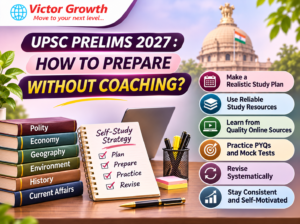
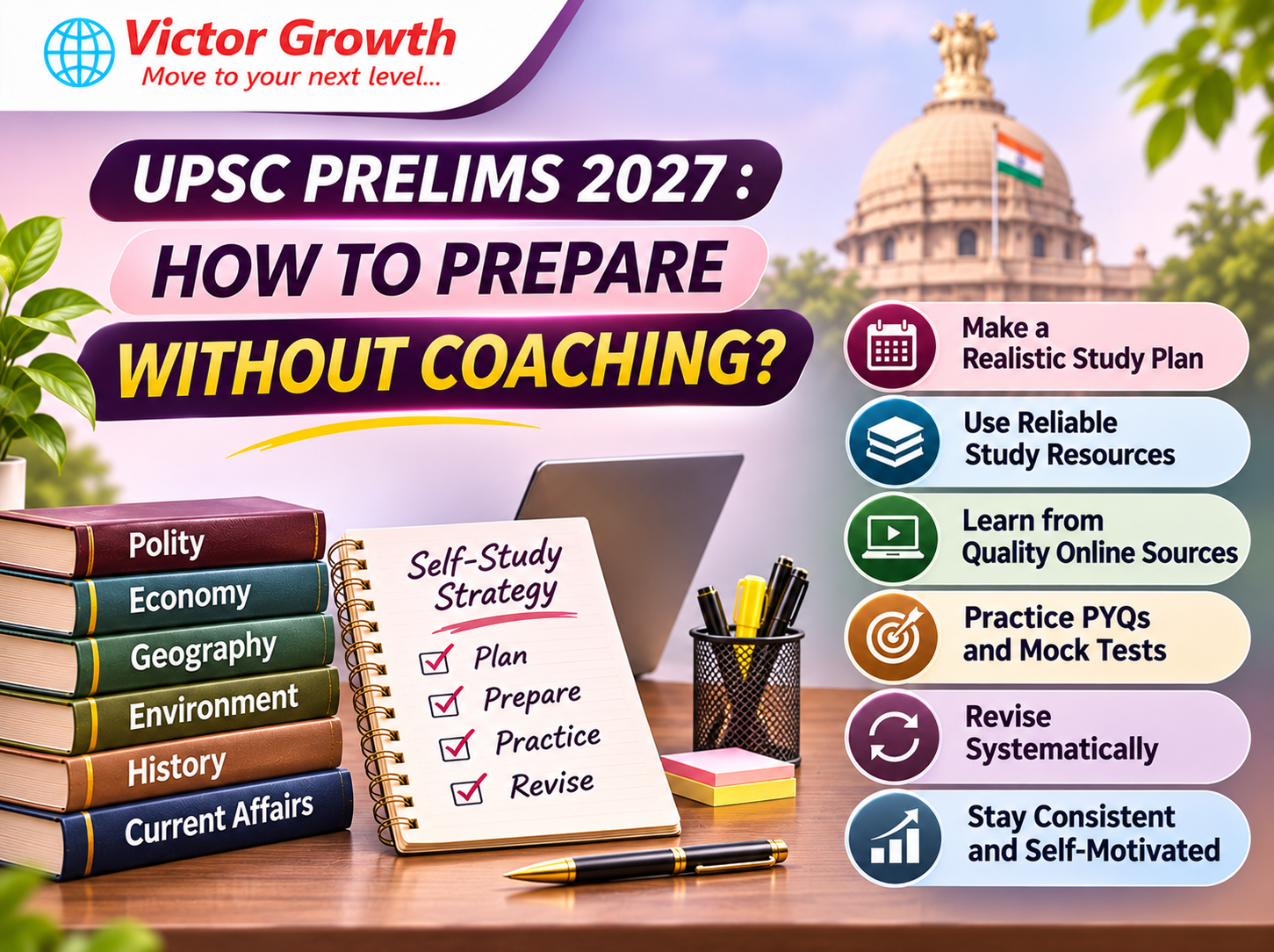
Preparing for UPSC Civil Services Prelims 2027 without joining a coaching institute is absolutely possible with the right strategy, discipline, and study materials. Many aspirants choose self-study because it offers flexibility, reduces financial expenses, and allows them to prepare according to their own learning pace.
However, self-study requires proper planning, regular revision, and continuous evaluation. Without classroom guidance, candidates must take responsibility for understanding the syllabus, selecting reliable resources, following current affairs, and practising mock tests.
Here is a practical guide to preparing for UPSC Prelims 2027 without coaching.
1. Understand the UPSC Prelims Syllabus and Exam Pattern
The first step in self-preparation is understanding the official UPSC syllabus and examination pattern.
The Preliminary Examination consists of two objective-type papers:
Particulars | General Studies Paper I | CSAT Paper II |
|---|---|---|
Total questions | 100 | 80 |
Maximum marks | 200 | 200 |
Duration | 2 hours | 2 hours |
Nature | Merit-based | Qualifying |
Minimum qualifying marks | No separate minimum | 33% |
Both papers have negative marking for incorrect answers. CSAT is qualifying in nature, but candidates must clear it to qualify for the Mains examination.
Read the syllabus carefully and divide it into subjects such as History, Geography, Polity, Economy, Environment, Science and Technology, and Current Affairs.
2. Start with NCERT Books
NCERT textbooks are among the most useful resources for beginners. They explain fundamental concepts in simple language and help build a strong foundation.
Prioritise these subjects:
History: NCERT History textbooks from Classes 6–12.
Geography: Classes 6–12 Geography textbooks.
Polity: Class 11 Political Science, particularly Indian Constitution at Work.
Economy: Class 11 Indian Economic Development and Class 12 Introductory Macroeconomics.
Science: Classes 6–10 Science textbooks.
Environment: Relevant Biology and Geography chapters.
You do not need to read every chapter from every textbook. Select topics according to the UPSC syllabus.
3. Choose Limited and Reliable Study Materials
One common mistake among self-study aspirants is collecting too many books and online resources.
Choose a limited set of standard reference books for each subject and revise them regularly.
Subject | Suggested resource |
|---|---|
History | NCERTs and a standard Modern Indian History reference |
Geography | NCERTs and a standard Geography reference |
Polity | Indian Polity by M. Laxmikanth |
Economy | NCERTs and a standard Indian Economy reference |
Environment | A reliable Environment and Ecology reference |
Science and Technology | NCERTs and relevant current affairs |
The objective is not to read as many books as possible but to understand and revise the important concepts thoroughly.
4. Follow Current Affairs Daily
Current affairs are essential for UPSC Prelims. Self-study aspirants should develop a regular habit of reading and analysing important news.
Useful sources include:
The Hindu or The Indian Express.
Press Information Bureau (PIB).
Economic Survey.
Union Budget.
RBI website.
Relevant government ministry websites.
Focus on government schemes, economic developments, environmental issues, international relations, science and technology, and important national developments.
Prepare short notes and connect current affairs with static subjects instead of memorising isolated facts.
5. Solve Previous-Year Question Papers
Previous-year questions (PYQs) help aspirants understand the actual UPSC question pattern and identify important topics.
Follow these methods:
Practise at least 10 years of available Prelims question papers.
Solve subject-wise questions after completing each topic.
Analyse both correct and incorrect answers.
Identify frequently tested concepts.
Maintain a notebook of mistakes.
Revise important questions regularly.
Do not simply memorise previous-year answers. Understand the concepts behind them.
6. Practise Mock Tests Regularly
Mock tests are particularly important for candidates preparing without coaching because they provide an opportunity to evaluate their preparation independently.
Start with subject-wise tests.
Gradually attempt full-length mock tests.
Practise within the actual two-hour examination limit.
Analyse incorrect answers after every test.
Improve time management and elimination techniques.
Take CSAT mock tests regularly.
You can use a reliable online test series if you need structured assessments and detailed explanations.
7. Prepare Short Notes for Effective Revision
Self-study becomes easier when important information is organised properly.
Prepare separate notes for:
Important constitutional articles and amendments.
Historical events and timelines.
Geography maps and important locations.
Economic concepts and government schemes.
Environmental conventions and species.
Science and technology developments.
Monthly current affairs.
Use bullet points, tables, and flowcharts. Avoid copying entire paragraphs from textbooks.
8. Follow a Daily Study Timetable
A realistic timetable helps maintain consistency throughout preparation.
Suggested daily timetable:
Time | Activity |
|---|---|
6:00 AM – 8:00 AM | Static subject preparation |
8:00 AM – 8:30 AM | Newspaper and current affairs |
10:00 AM – 12:00 PM | Second subject |
2:00 PM – 3:00 PM | Practice MCQs and PYQs |
4:00 PM – 5:00 PM | CSAT preparation |
7:00 PM – 8:00 PM | Revision and short notes |
Adjust the schedule according to your personal commitments. Focus on consistent study rather than unrealistic daily targets.
9. Do Not Neglect CSAT Preparation
Many aspirants concentrate entirely on General Studies and postpone CSAT preparation. This can become a major problem.
Practise:
Reading comprehension.
Logical reasoning.
Analytical ability.
Basic mathematics.
Data interpretation.
Candidates who are weak in mathematics should start early and practise regularly. Remember, scoring at least 33% in CSAT is compulsory.
10. Common Mistakes to Avoid During Self-Study
Avoid these mistakes while preparing independently:
Studying without understanding the syllabus.
Frequently changing study materials.
Ignoring current affairs.
Avoiding previous-year questions.
Neglecting mock tests and CSAT.
Making lengthy notes.
Not revising completed subjects.
Following an unrealistic timetable.
Depending entirely on free online videos without a structured plan.
Self-study requires discipline and regular performance evaluation.
11. Is Coaching Necessary? How to Choose the Right Guidance
Coaching is not compulsory for clearing UPSC. However, structured classes, experienced faculty, doubt-clearing sessions, and regular test series can make preparation more organised.
If you are comparing options such as the best NDA coaching in Kerala, consider faculty experience, study materials, test facilities, and individual academic support. However, NDA and UPSC Civil Services are different examinations, so UPSC aspirants should select a programme specifically designed for Civil Services preparation.
Even self-study candidates can benefit from joining a test series or taking occasional academic guidance without enrolling in a full-time coaching programme.
Frequently Asked Questions (FAQs)
1. Can I clear UPSC Prelims 2027 without coaching?
Yes. Candidates can prepare through self-study with the right books, current affairs resources, previous-year questions, mock tests, and regular revision.
2. How many hours should I study daily for UPSC self-preparation?
Around 6–8 focused hours can be a useful target for full-time aspirants. Working professionals and college students can follow a flexible schedule.
3. Which books should beginners read first?
Start with relevant NCERT textbooks for History, Geography, Polity, Economy, and Science. Then move towards standard reference books.
4. Are online resources enough for UPSC preparation?
Online resources can be useful, but choose reliable sources and follow a structured study plan. Avoid depending on multiple platforms for the same topic.
5. Is a test series necessary for self-study aspirants?
A test series is not compulsory, but regular mock tests help evaluate preparation, improve accuracy, and develop time management.
6. How important are previous-year questions?
PYQs are extremely useful for understanding question patterns, identifying important topics, and improving conceptual clarity.
7. Should I prepare for CSAT from the beginning?
Yes. Regular practice is especially important for candidates who are weak in mathematics, reasoning, or comprehension.
Conclusion
Preparing for UPSC Prelims 2027 without coaching is possible with proper planning, discipline, and consistent effort. Understand the syllabus, begin with NCERT books, choose limited resources, follow current affairs, solve previous-year questions, and practise mock tests regularly. Give equal importance to General Studies and CSAT, and revise every subject systematically. Remember, coaching can provide guidance, but your consistency, preparation strategy, and dedication play a major role in your UPSC journey.