
Introduction
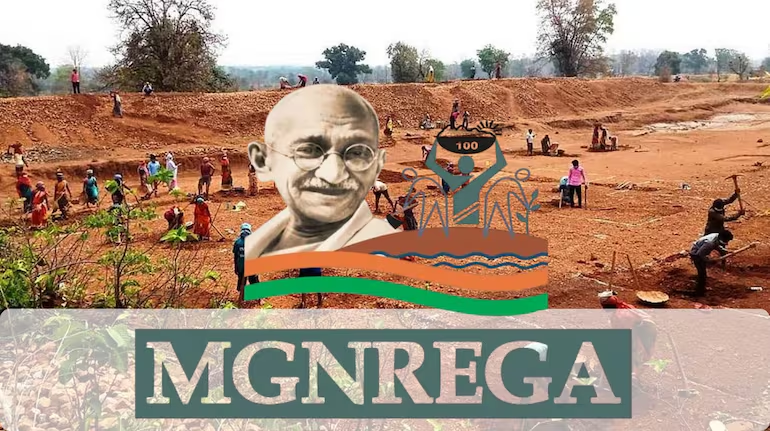
The Union government has proposed the “Viksit Bharat — Guarantee For Rozgar And Ajeevika Mission (Gramin)” (VB-G RAM G) Bill, aimed at replacing the Mahatma Gandhi National Rural Employment Guarantee Act, 2005 (MGNREGA).
The proposed law marks a paradigm shift in rural employment policy, moving from a rights-based, demand-driven framework to a budget-controlled, supply-driven scheme, aligned with the government’s vision of Viksit Bharat @2047.
MGNREGA: Core Features (Background)
Enacted in 2005
Provides a legal right to employment
Guarantees 100 days of unskilled wage employment per rural household
Demand-driven: Employment must be provided if demanded
Cost sharing:
Centre: 100% wages + 75% material cost
States: 25% material cost
Effective ratio: 90:10 (Centre:States)
Universal coverage of all rural areas
Strong transparency tools:
Social audits
Right to unemployment allowance
Key Features of VB-G RAM G Bill
1. Shift from Demand-Driven to Supply-Driven Model
Employment will be provided only within a fixed budget determined annually by the Union government.
State-wise allocations will be capped, irrespective of actual demand.
Ends the automatic obligation of the government to provide work on demand.
📌 UPSC relevance: Shift from rights-based welfare to allocation-based welfare.
2. Increased Guaranteed Workdays
Guaranteed employment increased from:
100 days → 125 days
However, the guarantee is not legally enforceable like under MGNREGA due to budget caps.
3. Greater Financial Burden on States
Cost-Sharing Pattern (Section 22(2)):
| Category of States | Centre | State |
|---|---|---|
| NE States + Himalayan States/UTs | 90% | 10% |
| All other States | 60% | 40% |
🔹 Earlier effective burden on States: ~10%
🔹 Now increased to 40% for most States
📌 Issue: Fiscal stress on poorer States, contradicting cooperative federalism.
4. Centralisation of Control
(a) Budget Allocation
Centre will decide State-wise “normative allocation” based on parameters prescribed by itself.
States cannot demand additional funds even during distress (e.g., drought, migration).
(b) Area Selection
Centre will notify specific rural areas where the scheme will operate.
Ends the universal rural coverage of MGNREGA.
📌 UPSC Angle: Federalism, decentralisation, role of States.
5. Agricultural Season “Work Blackout”
Programme may be paused during peak agricultural seasons
Objective: Ensure labour availability for agriculture
Criticism:
Reduces income security
Ignores agricultural distress periods
6. Technological Interventions Codified
Previously administrative measures under MGNREGA are now given statutory backing:
Mobile app-based attendance
Aadhaar-based payments
Geo-tagging of worksites
📌 Concern:
Exclusion of workers due to:
Poor connectivity
Aadhaar failures
Digital divide
Government’s Justification (Statement of Objects & Reasons)
The government argues that:
Rural India has undergone significant socio-economic transformation
Improvements in:
Roads, housing, electrification
Financial inclusion and digital access
Rural workforce now aspires for:
Higher incomes
Skill-based livelihoods
Climate-resilient development
Hence, a new rural development framework is needed.
Criticism & Opposition View
Rights-Based Framework Diluted
MGNREGA architects (e.g., Nikhil Dey, MKSS) argue:
End of Right to Work
Workers reduced to passive beneficiaries
Loss of unemployment allowance
Excessive Centralisation
Centre controls:
Budget
Areas
Timing
Weakens:
Local governance
Panchayati Raj institutions
Financial Unsustainability for States
40% cost share is impractical for fiscally weak States
Democratic Rollback
NREGA Sangharsh Morcha calls it:
A rollback of constitutional and democratic guarantees
A move from people-centric welfare to technocratic surveillance
Key Differences: MGNREGA vs VB-G RAM G
| Aspect | MGNREGA | VB-G RAM G |
|---|---|---|
| Nature | Rights-based law | Scheme-like legislation |
| Approach | Demand-driven | Supply-driven |
| Coverage | Universal rural | Centre-notified areas |
| Budget | Open-ended | Fixed & capped |
| State share | ~10% | Up to 40% |
| Accountability | Legal entitlement | Limited accountability |
UPSC Mains Analysis
Positives
Increased workdays
Better monitoring through technology
Focus on livelihood diversification
Negatives
Dilution of Right to Work
Fiscal burden on States
Exclusion risks
Undermines cooperative federalism
Reduces social safety net during distress
Way Forward (Balanced Answer)
Retain rights-based core of MGNREGA
Allow flexible budgets during emergencies
Strengthen Panchayati Raj institutions
Balance technology with human oversight
Ensure Centre–State consultation in allocation
Prelims Pointers
MGNREGA enacted: 2005
VB-G RAM G Bill introduced: 2025
Shift: Demand-driven → Supply-driven
Guaranteed days: 125
Cost sharing for most States: 60:40
Focus: Viksit Bharat @2047
Conclusion
The VB-G RAM G Bill represents a fundamental transformation of India’s rural employment architecture. While it seeks to modernise and align rural employment with long-term development goals, critics argue that it weakens constitutional guarantees, federal balance, and worker entitlements. For UPSC, it is a crucial example of the tension between efficiency-driven governance and rights-based welfare.