
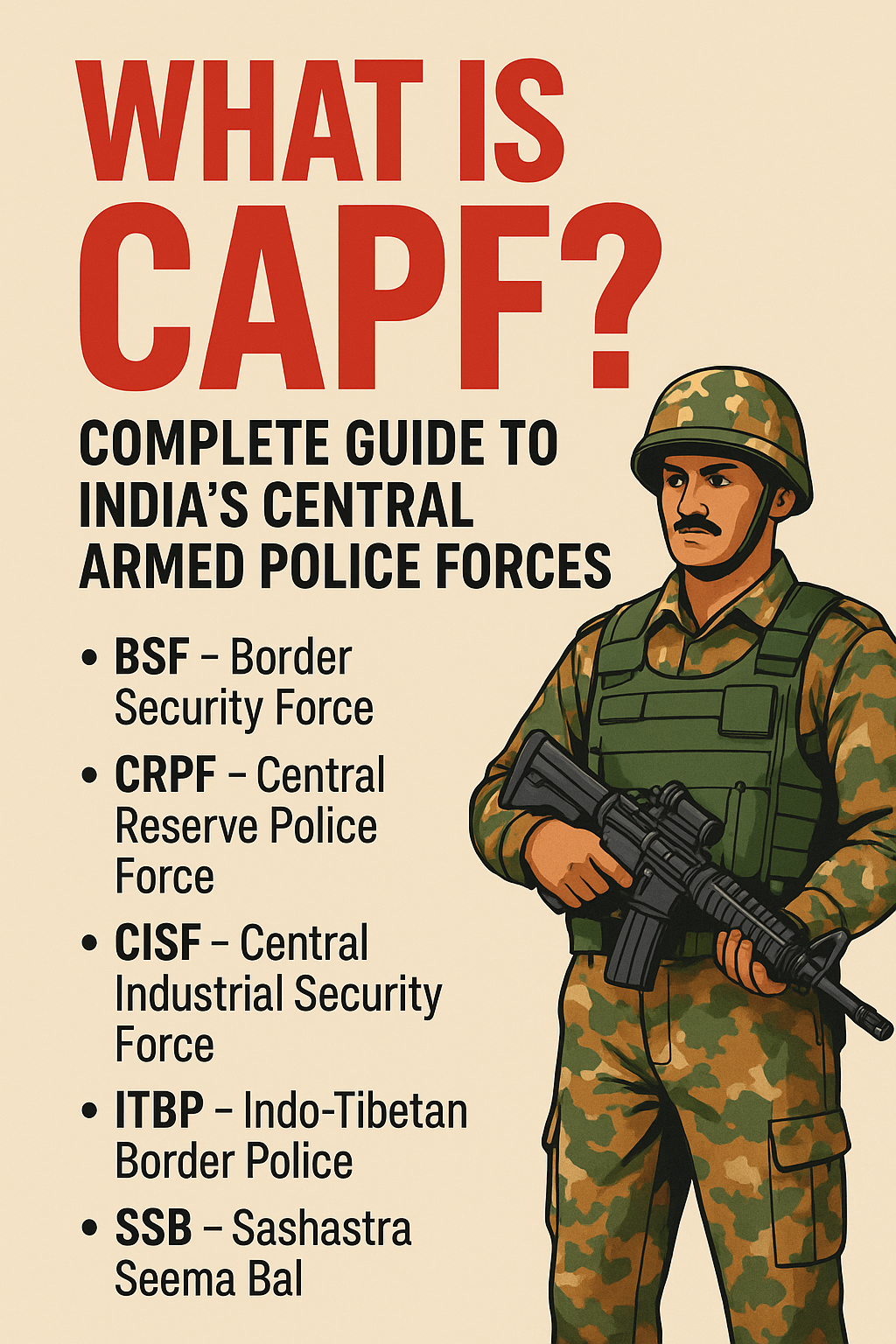
The Central Armed Police Forces (CAPF) are among India’s most important uniformed services, responsible for maintaining internal security, guarding borders, combating terrorism, and assisting civil authorities during emergencies.
For lakhs of aspirants preparing for CAPF AC, SSC, UPSC, and defence exams, understanding CAPF’s structure, roles, ranks, and recruitment process is essential.
This comprehensive guide explains everything you need to know — from CAPF meaning to roles, salary, ranks, training, and career prospects.
⭐ What is CAPF? (Simple Definition)
CAPF stands for Central Armed Police Forces, a group of five paramilitary forces under the Ministry of Home Affairs (MHA).
They are responsible for border protection, internal security, counter-insurgency, VIP security, and assisting the State Police during law-and-order situations.
List of the 5 CAPF Forces
| CAPF Force | Full Form | Primary Role |
|---|---|---|
| BSF | Border Security Force | Guards India’s land borders with Pakistan & Bangladesh |
| CRPF | Central Reserve Police Force | Internal security, riots control, counter-insurgency |
| CISF | Central Industrial Security Force | Security of airports, metros, PSUs & critical infrastructure |
| ITBP | Indo-Tibetan Border Police | Guards India-China (LAC) border in the Himalayas |
| SSB | Sashastra Seema Bal | Guards Nepal & Bhutan borders, counter-insurgency support |
Additionally, two other major central forces are often grouped with CAPF:
NSG (National Security Guard) – Counter-terrorism, hostage rescue
AR (Assam Rifles) – Counter-insurgency in the Northeast
However, officially only BSF, CRPF, CISF, ITBP & SSB are categorized as CAPF.
Why CAPF Is Important for India
The CAPF are the backbone of India’s internal and border security. Their key contributions include:
✔ Border Security & Surveillance
Prevent illegal infiltration, trafficking, smuggling, and cross-border terrorism.
✔ Maintaining Internal Security
Handle riots, Naxal operations, elections, civil unrest, and natural disasters.
✔ Securing National Assets
Airports, metros, nuclear plants, PSU factories, government buildings, and VIP protection.
✔ Humanitarian Assistance
CAPF teams provide rescue & relief during floods, earthquakes, and landslides.
✔ International Peacekeeping
Many CAPF personnel serve in UN Peacekeeping Missions, enhancing India’s global recognition.
CAPF Organizational Structure
1. Head of CAPF
Each force is headed by a Director General (DG), an IPS officer.
2. Cadres
Gazetted Officers (Assistant Commandant and above)
Non-Gazetted Ranks (Sub-Inspector, Constable, etc.)
3. Control
Operated under the Ministry of Home Affairs (MHA), not Ministry of Defence.
CAPF Ranks (Officer & Non-Officer)
Gazetted Officer Ranks
Director General (DG)
Special DG
Additional DG
Inspector General (IG)
Deputy Inspector General (DIG)
Commandant
Second-in-Command
Deputy Commandant
Assistant Commandant (AC) – Entry-level Officer Rank
Non-Gazetted Ranks
Subedar Major
Inspector
Sub-Inspector
ASI
Head Constable
Constable
CAPF Recruitment: How to Join CAPF
There are two major entry routes:
1️⃣ UPSC CAPF AC (Assistant Commandant) – Officer Entry
Eligibility
Nationality: Indian
Age: 20–25 years (with category relaxations)
Qualification: Graduate in any discipline
Selection Process
Written Exam — Paper 1 & 2
Physical Efficiency Test (PET)
Medical Examination
Interview / Personality Test
Final Merit List
Successful candidates become Assistant Commandants (AC)—Group A Officers.
2️⃣ Non-Officer Entry (Constable, SI Recruitment)
Recruitment handled through:
SSC GD (Constable)
SSC CPO (SI)
Recruitment Boards of CAPFs
CAPF Salary & Benefits (2025)
Assistant Commandant (AC) Salary
Pay Level: Level 10 (₹56,100 – ₹1,77,500)
Plus allowances:
HRA
DA
Risk Allowance
Ration Money
Transport Allowance
Medical Facilities
Other Benefits
Pension under NPS
CSD Canteen facilities
Housing
Leave benefits
Job security
Quick promotions based on merit
Training of CAPF Personnel
Training focuses on:
Weapons handling
Counter-insurgency
Physical fitness
Disaster management
Law and human rights
Border surveillance systems
Major academies include:
BSF Academy, Tekanpur
CRPF Academy, Kadarpur
ITBP Academy, Mussoorie
CISF Academy, Hyderabad
SSB Academy, Bhopal
Difference Between CAPF, Paramilitary & Army
| Feature | CAPF | Paramilitary (e.g., Assam Rifles) | Indian Army |
|---|---|---|---|
| Control | Ministry of Home Affairs | Dual control (MoHA & MoD) | Ministry of Defence |
| Function | Internal security | Counter-insurgency | External & internal security |
| Recruitment | UPSC, SSC | Various | NDA, CDS, TES |
| Uniform | Distinct for each force | Slight variations | Olive green |
Career Growth in CAPF
Career progression for officers:
Assistant Commandant → Deputy Commandant → Commandant → DIG → IG → ADG → DG
High-performing officers can be deputed to:
RAW
IB
NSG
Anti-Naxal Operations
UN Peacekeeping Forces
Conclusion
The Central Armed Police Forces (CAPF) play a critical role in protecting India. For aspirants, a CAPF career offers:
Discipline
Leadership
Adventure
Financial stability
A chance to serve the nation
Whether you aim to join through UPSC CAPF AC, SSC GD, or SSC CPO, CAPF promises a rewarding and honorable career.
Frequently Asked Questions (FAQ)
1. What is the full form of CAPF?
CAPF stands for Central Armed Police Forces.
2. How many CAPF forces are there in India?
There are five CAPF forces: BSF, CRPF, CISF, ITBP & SSB.
3. Who controls the CAPF?
The Ministry of Home Affairs (MHA) controls and administers the CAPF.
4. What is the highest rank in CAPF?
Director General (DG) is the highest rank.
5. Which exam is required to become a CAPF officer?
You must clear the UPSC CAPF AC Examination to become an officer.
6. What is the difference between Army and CAPF?
Army handles external defence, while CAPF handles internal security & border guarding.
7. What is the salary of a CAPF Assistant Commandant?
Approx ₹56,100 – ₹1,77,500 plus allowances.
8. Is CAPF a government job?
Yes, CAPF is a prestigious Central Government Group A & B service.
9. Are women eligible for CAPF?
Yes, women can join CAPF in both officer and non-officer roles.