A Complete Guide to Building Awareness, Analytical Thinking, and Leadership Skills | Best IAS Coaching in Kerala
For many school students, becoming an Indian Administrative Service (IAS) officer is a dream inspired by the desire to serve society, contribute to nation-building, and make a meaningful difference in people’s lives. While academic excellence is essential, success in the Union Public Service Commission (UPSC) Civil Services Examination requires much more than textbook knowledge. One of the most important aspects of UPSC preparation is staying updated with current affairs.
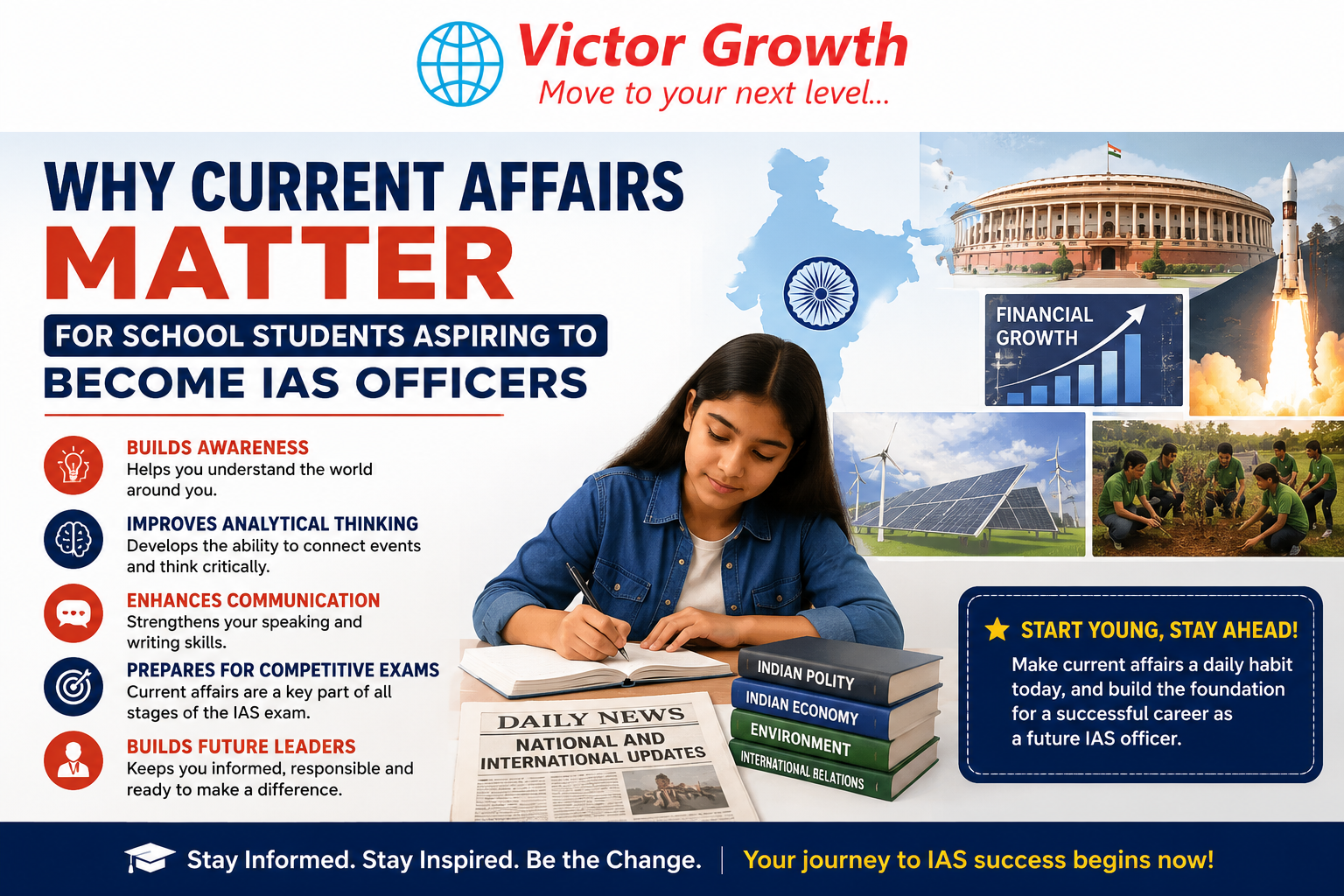
Current affairs are not simply about knowing today’s headlines. They help students understand how governments function, how policies affect society, how economies grow, and how global events influence India. Students who begin following current affairs during Classes 8–12 develop critical thinking, analytical skills, communication abilities, and decision-making qualities that are essential for both the UPSC examination and future administrative responsibilities.
The best IAS coaching in Kerala encourages students to cultivate the habit of reading and analyzing current affairs from an early age. This article explains why current affairs are vital for school students aspiring to become IAS officers and provides practical strategies to develop this habit effectively.
What Are Current Affairs?
Current affairs refer to recent events and developments that influence society, governance, economics, science, technology, international relations, the environment, education, sports, and culture.
Examples include:
- Government policies and schemes
- Parliamentary proceedings
- Supreme Court judgments
- Economic developments
- Scientific discoveries
- Space missions
- Climate change initiatives
- International summits
- Elections
- Sports achievements
- Awards and honors
- Major national and global events
Understanding these topics helps students connect classroom knowledge with real-world situations.
Why Current Affairs Are Important for Future IAS Officers
An IAS officer is responsible for implementing government policies, solving public problems, managing crises, and making informed administrative decisions.
To perform these responsibilities effectively, officers must understand:
- National issues
- Global developments
- Public administration
- Economic trends
- Environmental challenges
- Social welfare programs
- Technological advancements
Current affairs build this awareness long before students enter civil services.
Current Affairs Form the Backbone of the UPSC Examination
The UPSC Civil Services Examination is closely linked to contemporary developments.
Current affairs influence:
UPSC Prelims
Questions often relate to:
- Government schemes
- International organizations
- Environment
- Science and Technology
- Geography
- Economy
- Awards
- Reports and indices
Students with consistent current affairs preparation perform better in objective questions.
UPSC Mains
The Mains Examination requires analytical answers.
Topics include:
- Governance
- International relations
- Internal security
- Economy
- Ethics
- Social justice
- Disaster management
- Agriculture
- Education
- Healthcare
Current affairs provide real-life examples that enrich answers and demonstrate deeper understanding.
UPSC Personality Test (Interview)
During the interview, candidates are expected to discuss:
- Recent national developments
- International events
- Public policies
- Economic issues
- Social challenges
Students who build current affairs awareness from school years naturally develop confidence in discussions.
Why School Students Should Start Reading Current Affairs Early
Many students believe current affairs are only necessary after graduation.
In reality, early exposure offers several advantages.
Students gradually develop:
- Curiosity
- Reading habits
- Critical thinking
- Vocabulary
- Communication skills
- Analytical reasoning
- Decision-making ability
These qualities become increasingly valuable throughout school, college, and competitive exam preparation.
Current Affairs Improve General Knowledge
General knowledge is not limited to historical facts or geographical information.
Current affairs help students understand:
- Recent government initiatives
- Scientific innovations
- Environmental developments
- International relations
- Sports achievements
- Cultural events
This broad knowledge improves quiz performance, school projects, debates, and competitive examinations.
Current Affairs Strengthen School Subjects
One of the biggest advantages of reading current affairs is that it complements classroom learning.
For example:
History
Students understand:
- Historical anniversaries
- Freedom movement commemorations
- Cultural heritage preservation
Geography
Students learn about:
- Natural disasters
- Climate change
- Monsoon patterns
- International boundaries
- Environmental conservation
Political Science
Current affairs explain:
- Parliament sessions
- Constitutional amendments
- Elections
- Judicial decisions
- Government institutions
Economics
Students understand:
- Inflation
- Union Budget
- Banking reforms
- Employment
- GDP
- Digital economy
Science
Current developments include:
- Space missions
- Artificial Intelligence
- Biotechnology
- Medical discoveries
- Renewable energy
This integrated learning improves both school performance and UPSC preparation.
Current Affairs Develop Analytical Thinking
UPSC does not reward rote memorization.
Instead, students should ask:
- Why did this event happen?
- Who is affected?
- What are the long-term consequences?
- What solutions are possible?
This habit transforms students into independent thinkers capable of solving complex problems.
Current Affairs Improve Communication Skills
Reading newspapers regularly improves:
- Vocabulary
- Grammar
- Sentence formation
- Public speaking
- Presentation skills
- Debate participation
Students become more confident in expressing their opinions with facts and logic.
Current Affairs Encourage Responsible Citizenship
Future IAS officers must understand society.
Reading about:
- Education
- Healthcare
- Agriculture
- Women’s empowerment
- Rural development
- Environmental conservation
- Public welfare
helps students become responsible and informed citizens who appreciate the challenges faced by different communities.
How Current Affairs Build Leadership Qualities
Leadership begins with awareness.
Students who understand current issues can:
- Participate in discussions
- Suggest practical solutions
- Respect diverse opinions
- Think critically
- Make informed decisions
These qualities are fundamental for future administrators.
Best Sources for Current Affairs
The best IAS coaching in Kerala recommends relying on authentic and reliable resources.
Newspapers
Students should read:
- The Hindu
- The Indian Express
Focus on:
- National news
- International affairs
- Economy
- Science
- Environment
- Editorials
Avoid entertainment and sensational content.
Government Publications
Students in higher secondary classes can read selected articles from:
- Yojana
- Kurukshetra
- Press Information Bureau (PIB)
These provide authentic information about government policies and development initiatives.
Educational Websites
Trusted educational portals can help students:
- Revise current affairs
- Practice quizzes
- Watch explanatory videos
- Improve understanding of complex topics
Always verify information from credible sources.
How to Read Current Affairs Effectively
Reading every news article is unnecessary.
Students should follow a structured approach.
Step 1: Read Headlines
Identify important developments.
Step 2: Read in Detail
Focus on topics related to:
- Governance
- Economy
- Science
- Environment
- International relations
Step 3: Understand the Background
Ask:
- What caused this event?
- Why is it important?
- What is its impact?
Step 4: Make Notes
Maintain a notebook covering:
- Government schemes
- Awards
- Reports
- Important judgments
- International events
- Science updates
Step 5: Revise Weekly
Revision helps students retain information for longer periods.
Common Mistakes Students Should Avoid
Avoid:
- Reading only headlines
- Depending entirely on social media
- Memorizing facts without understanding
- Ignoring editorials
- Reading too many sources simultaneously
- Studying irregularly
Quality and consistency matter more than quantity.
Daily Current Affairs Routine for School Students
A simple routine could include:
Morning (15–20 minutes)
- Read newspaper headlines.
Evening (20–25 minutes)
- Read one editorial or explanatory article.
- Make short notes.
Weekend
- Revise the week’s current affairs.
- Attempt a quiz.
- Discuss important events with teachers or parents.
Even 30–45 minutes daily is enough to build strong awareness over time.
Benefits Beyond UPSC
Current affairs also help students succeed in:
- School examinations
- Scholarship tests
- Olympiads
- Quiz competitions
- Group discussions
- Public speaking
- Essay competitions
- Interviews
- Leadership programs
The knowledge gained remains valuable throughout life.
How the Best IAS Coaching in Kerala Supports Current Affairs Preparation
Professional guidance helps students develop the right reading habits and analytical skills.
The best IAS coaching in Kerala provides:
- Daily current affairs sessions
- Newspaper analysis
- Weekly quizzes
- Monthly current affairs magazines
- Editorial discussions
- Government policy analysis
- Interactive classroom debates
- Concept-based explanations
- Individual mentoring
- Integrated preparation with NCERT subjects
This structured approach ensures students understand current events rather than simply memorizing them.
Why Victor Growth is Among the Best IAS Coaching in Kerala
Victor Growth’s IAS Foundation Program emphasizes current affairs as an essential component of early UPSC preparation. Students are trained to develop a habit of reading, analyzing, and discussing important national and international developments while strengthening their school academics.
The program includes:
- Daily newspaper analysis
- Current affairs classes
- Weekly quizzes and discussions
- NCERT-integrated learning
- Leadership and personality development
- Essay and answer-writing practice
- Expert faculty guidance
- Individual mentoring
- Regular performance assessments
- Structured study plans for Classes 8–12
By combining academic excellence with awareness of real-world issues, Victor Growth prepares students not only for competitive examinations but also for responsible leadership, making it one of the preferred choices for students seeking the best IAS coaching in Kerala.
Conclusion
Current affairs are much more than a collection of daily news stories. They help students understand the world, develop analytical thinking, strengthen communication skills, and build the leadership qualities expected of future civil servants.
Students who begin following current affairs during their school years gain a significant advantage in UPSC preparation, school education, and overall personality development. By reading reliable newspapers, maintaining notes, participating in discussions, and staying consistently curious, young aspirants can gradually develop the knowledge and confidence needed to succeed.
With expert guidance from the best IAS coaching in Kerala, school students can transform current affairs from a daily habit into a powerful foundation for a successful career in the Indian Administrative Service.
Frequently Asked Questions (FAQs)
1. Why are current affairs important for school students preparing for UPSC?
Current affairs help students understand governance, economics, science, environment, and global developments while improving analytical thinking, communication skills, and decision-making abilities required for the UPSC examination.
2. When should students start reading current affairs?
Students should begin during Classes 8–12. Early exposure helps them build reading habits, vocabulary, and awareness gradually without academic pressure.
3. Which newspaper is best for IAS Foundation students?
The Hindu and The Indian Express are highly recommended because of their reliable coverage of national issues, international affairs, editorials, science, economy, and governance.
4. How much time should students spend on current affairs every day?
School students can spend 30–45 minutes daily reading newspapers, making notes, and revising important developments.
5. Should students make notes while reading current affairs?
Yes. Maintaining concise notes on government schemes, international events, science updates, environment, and important reports makes revision easier and improves retention.
6. Can current affairs improve school academic performance?
Yes. Current affairs complement subjects such as History, Geography, Political Science, Economics, Science, and English by connecting classroom concepts with real-world developments.
7. Are social media platforms sufficient for current affairs preparation?
No. Students should rely primarily on authentic sources such as newspapers, government publications, and trusted educational platforms. Social media should only be used cautiously and for supplementary updates.
8. How do current affairs help in the UPSC Interview?
Regular reading helps students discuss national and international issues confidently, demonstrate balanced opinions, and showcase awareness of governance and public policy during the Personality Test.
9. How does the best IAS coaching in Kerala help students with current affairs?
Leading coaching institutes provide daily newspaper analysis, current affairs classes, quizzes, editorial discussions, expert mentoring, and structured revision plans to help students understand and retain important developments.
10. Why should school students join an IAS Foundation Program?
An IAS Foundation Program develops current affairs awareness, conceptual clarity, leadership skills, communication abilities, and disciplined study habits from an early stage, providing a strong foundation for UPSC and other competitive examinations.