
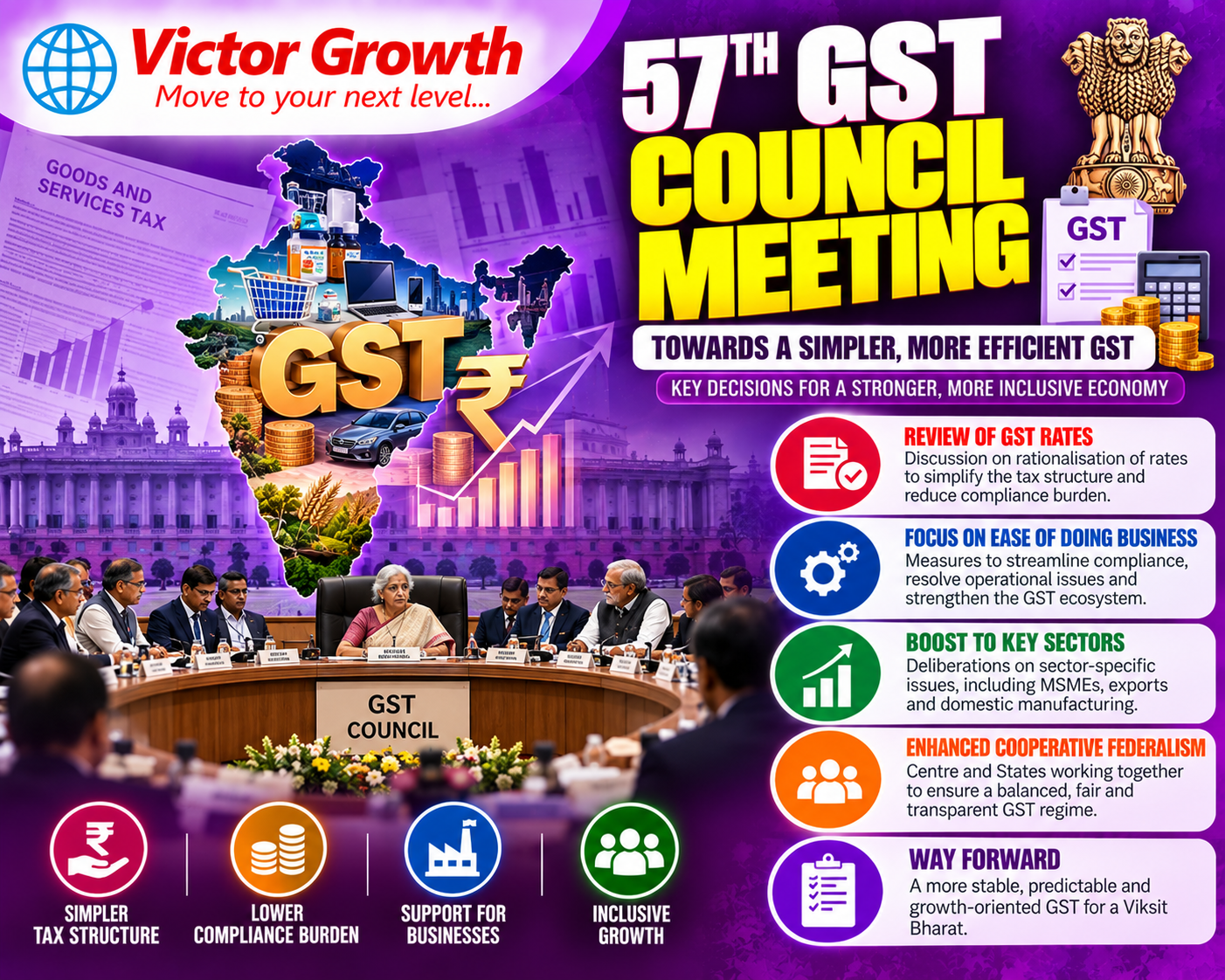
The 57th meeting of the GST Council is being held on 8 October 2026 at Bharat Mandapam, New Delhi, under the chairmanship of Union Finance Minister Nirmala Sitharaman.
The meeting comes more than a year after the 56th GST Council meeting and focuses primarily on structural and procedural reforms rather than another major round of GST rate rationalisation. Key issues under consideration include Input Tax Credit (ITC), GST registration, refunds, compliance, dispute resolution and enforcement powers.
Note: As the meeting is underway, the following are reported proposals/issues under consideration and should not be treated as final GST Council decisions until officially notified.
What is the GST Council?
The GST Council is a constitutional body established under Article 279A of the Constitution through the 101st Constitutional Amendment Act, 2016.
It consists of:
Union Finance Minister – Chairperson
Union Minister of State in charge of Revenue or Finance
Finance/Taxation Minister or another nominated minister from each State
The Council makes recommendations on important GST-related matters, including tax rates, exemptions, threshold limits and principles of taxation.
It is an important example of cooperative federalism because both the Union and States participate in GST decision-making.
Major Issues Before the 57th GST Council
1. Input Tax Credit Reforms
One of the major areas of discussion is the Input Tax Credit mechanism.
Proposals reportedly seek to make ITC rules more practical for genuine taxpayers, including addressing situations where a buyer faces difficulties because of a supplier’s default.
A simpler ITC framework could reduce working-capital pressure and GST-related disputes for businesses.
2. Faster GST Refunds
The Council is expected to consider measures to streamline the refund process, particularly for businesses and exporters.
Faster refunds can improve liquidity and reduce the cost of compliance.
3. Simplification of GST Registration
Simplifying and speeding up GST registration is another important reform area.
The objective is to reduce procedural delays while maintaining safeguards against fraudulent registrations.
4. GST Compliance and Returns
The meeting is also considering reforms to GST returns and related procedures.
The broader objective is to make the GST system easier for compliant businesses, particularly MSMEs and small taxpayers.
5. Decriminalisation and Arrest Powers
A significant issue is the proposed reform of GST enforcement provisions.
The Council is reportedly examining whether certain GST offences should be decriminalised and whether the arrest powers of GST officers should be modified.
The proposal has generated debate because the government needs to balance taxpayer facilitation with effective action against deliberate tax evasion and fraud.
Why is the 57th GST Council Meeting Important?
The focus of the 57th meeting represents an important shift in GST reform.
The earlier phase of GST reform concentrated heavily on tax rates and rate rationalisation. The current emphasis is increasingly on improving the functioning of the GST ecosystem.
The reforms can potentially:
Reduce compliance costs
Improve ease of doing business
Increase certainty for taxpayers
Improve cash flow through faster refunds
Reduce litigation
Strengthen the ITC mechanism
Improve the efficiency of GST administration
Encourage voluntary compliance
This approach is particularly important for MSMEs, exporters and service-sector businesses.
GST and Cooperative Federalism
GST replaced multiple Central and State indirect taxes with a unified framework.
The GST Council provides an institutional mechanism through which the Centre and States collectively determine the evolution of the tax system.
Thus, GST is not merely a tax reform but also an important experiment in fiscal cooperative federalism.
UPSC Relevance
Prelims
Important facts:
GST Council → Article 279A
Constitutional basis → 101st Constitutional Amendment Act, 2016
GST introduced → 1 July 2017
Chairperson → Union Finance Minister
Nature → Constitutional body
57th meeting → 8 October 2026
Venue → Bharat Mandapam, New Delhi
Mains – GS Paper III
The topic is relevant to:
Tax reforms
Fiscal federalism
Cooperative federalism
Ease of doing business
MSME development
Digital governance
Tax compliance
Public finance
Possible UPSC Mains Question
“GST has evolved from a major tax-rate reform into a broader exercise in improving tax administration and cooperative federalism. Discuss in the context of the 57th GST Council Meeting.”
Conclusion
The 57th GST Council Meeting is significant because the next phase of GST reform is increasingly focused on improving the system’s efficiency rather than merely changing tax rates. Reforms relating to ITC, refunds, registration, compliance and enforcement could make GST more taxpayer-friendly while strengthening India’s indirect tax administration.
For UPSC aspirants, the meeting is important for understanding the intersection of taxation, fiscal federalism, cooperative governance and ease of doing business.