The Union Public Service Commission (UPSC) Civil Services Examination is one of India’s most prestigious and competitive examinations. Every year, over a million aspirants dream of becoming IAS, IPS, IFS, IRS, and other Civil Servants. However, one question troubles almost every beginner:
Should I prepare through self-study or join an IAS coaching institute?
The answer isn’t the same for everyone. Some aspirants have successfully cracked UPSC through disciplined self-study, while many others have benefited immensely from structured coaching and mentorship.
In this detailed guide, we compare Self-Study vs IAS Coaching across every important aspect of UPSC preparation. If you’re searching for the best IAS coaching in Kerala, this article will help you make an informed decision.
Understanding the UPSC Examination
Before deciding your preparation strategy, it’s important to understand what UPSC demands.
The Civil Services Examination consists of:
- Preliminary Examination
- Main Examination
- Personality Test (Interview)
The exam tests:
- Conceptual understanding
- Analytical thinking
- Decision-making
- Writing skills
- Current affairs awareness
- Personality and communication
Aspirants require consistency, discipline, proper planning, and continuous evaluation over a preparation period of 12–24 months.
What is Self-Study?
Self-study means preparing independently without enrolling in a formal coaching institute.
Students depend on:
- NCERT textbooks
- Standard reference books
- Newspapers
- Government reports
- Online resources
- Previous Year Question Papers
- Mock tests
- Self-discipline
The entire preparation strategy is designed and managed by the aspirant.
Advantages of Self-Study
1. Complete Flexibility
Students can:
- Study at their own pace
- Choose their own schedule
- Spend extra time on difficult subjects
- Revise whenever necessary
There is complete freedom in planning the preparation.
2. Cost-Effective
Self-study significantly reduces expenses.
Students mainly spend on:
- Books
- Test Series
- Internet
- Newspapers
This makes it suitable for aspirants with budget constraints.
3. Develops Independent Thinking
UPSC values analytical ability.
Self-study encourages:
- Critical thinking
- Independent analysis
- Better conceptual clarity
- Problem-solving skills
4. Personalized Learning
Every student learns differently.
Self-study allows aspirants to:
- Select preferred resources
- Skip unnecessary material
- Focus on weaker areas
- Customize revision schedules
Limitations of Self-Study
While self-study has advantages, it also presents challenges.
Lack of Structured Guidance
Many beginners struggle with:
- Understanding the syllabus
- Choosing books
- Prioritizing topics
- Time management
Without expert guidance, preparation can become directionless.
Information Overload
The internet contains unlimited UPSC content.
Many aspirants waste valuable time:
- Watching random YouTube videos
- Downloading excessive PDFs
- Following multiple sources
This often creates confusion.
No Expert Feedback
Self-study makes it difficult to evaluate:
- Answer writing
- Essay quality
- Ethics case studies
- Mock test performance
Constructive feedback is essential for improvement.
Motivation Issues
Preparing alone for one or two years can become mentally exhausting.
Many students:
- Lose consistency
- Feel isolated
- Experience self-doubt
- Quit midway
What is IAS Coaching?
IAS coaching institutes provide structured preparation under experienced faculty.
Most reputed institutes offer:
- Classroom teaching
- Online live classes
- Recorded lectures
- Printed study materials
- Test Series
- Answer writing practice
- Current affairs programme
- Interview guidance
- Personal mentorship
Advantages of IAS Coaching
1. Structured Learning
One of the biggest benefits of coaching is systematic preparation.
Students receive:
- Well-planned syllabus coverage
- Daily schedules
- Weekly targets
- Revision plans
- Regular assessments
This keeps preparation organized.
2. Expert Faculty
Experienced mentors help students:
- Understand difficult concepts
- Learn examination trends
- Avoid common mistakes
- Build effective strategies
Their experience saves valuable preparation time.
3. Personalized Mentorship
Good coaching institutes provide:
- Individual counselling
- Performance analysis
- Doubt clearing
- Study planning
- Motivation
Mentorship ensures continuous improvement.
4. Regular Mock Tests
Quality coaching institutes conduct:
- Prelims tests
- Mains answer writing
- Essay evaluation
- Ethics practice
- CSAT tests
- Full-length mock examinations
Regular testing improves confidence and exam temperament.
5. Better Answer Writing
UPSC Mains requires excellent presentation.
Coaching helps students learn:
- Answer structure
- Use of diagrams
- Flowcharts
- Data incorporation
- Time management
- Introduction and conclusion techniques
6. Current Affairs Integration
Reputed institutes simplify current affairs through:
- Daily newspaper analysis
- Monthly magazines
- Editorial discussions
- Government reports
- Budget analysis
- Economic Survey
Students understand how to connect current events with static subjects.
7. Interview Preparation
The Personality Test requires professional guidance.
Mock interviews improve:
- Communication
- Confidence
- Body language
- Decision-making
- DAF analysis
Limitations of IAS Coaching
Even coaching has certain limitations.
Cost
Good coaching institutes require financial investment.
Students should compare:
- Faculty quality
- Study materials
- Mentorship
- Test Series
- Overall value
rather than choosing solely based on fees.
Dependence on Coaching
Some aspirants rely entirely on classroom teaching.
Remember:
Coaching provides guidance—not guaranteed success.
Self-study remains essential.
Fixed Schedule
Some students may find classroom timings less flexible than independent study.
Hybrid and online learning options help overcome this limitation.
Self-Study vs IAS Coaching: A Detailed Comparison
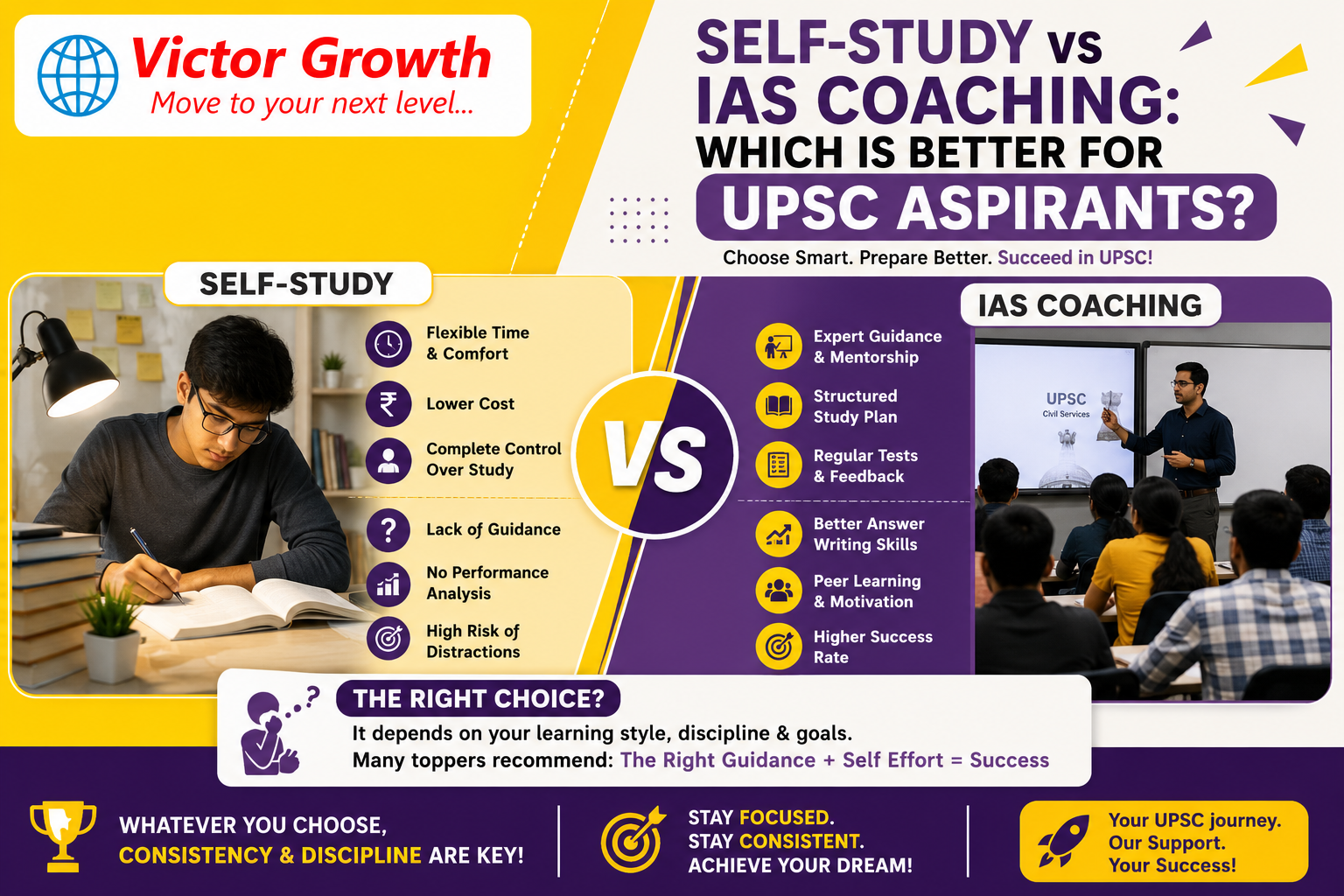
| Parameter | Self-Study | IAS Coaching |
|---|---|---|
| Cost | Lower | Higher |
| Flexibility | Very High | Moderate |
| Structured Learning | Limited | Excellent |
| Faculty Guidance | No | Yes |
| Answer Writing Evaluation | Difficult | Regular |
| Test Series | Self-arranged | Structured |
| Motivation | Self-driven | Mentor-supported |
| Current Affairs Guidance | Independent | Systematic |
| Interview Preparation | Limited | Comprehensive |
| Time Management | Self-planned | Guided |
| Peer Learning | Limited | Strong |
| Suitable for Beginners | Challenging | Highly Recommended |
Who Should Choose Self-Study?
Self-study is ideal for aspirants who:
- Have strong self-discipline
- Understand the UPSC syllabus
- Can prepare independent study plans
- Are comfortable learning from books
- Have limited financial resources
- Can evaluate their own performance objectively
Who Should Choose IAS Coaching?
IAS coaching is beneficial for:
- Beginners
- Working professionals
- College students
- Repeat aspirants
- Students needing structured guidance
- Aspirants seeking personalized mentorship
- Candidates struggling with answer writing
Can You Combine Self-Study and Coaching?
Yes—and for many aspirants, this is the most effective approach.
A balanced strategy includes:
- Coaching for guidance and structure
- Self-study for revision and concept building
- Mock tests for evaluation
- Mentorship for continuous improvement
- Independent answer writing practice
This combination provides the advantages of both methods.
Why Many Aspirants Prefer the Best IAS Coaching in Kerala
Kerala has emerged as a preferred destination for UPSC preparation because leading institutes provide:
- Experienced UPSC mentors
- Comprehensive study materials
- Personalized mentorship
- Small batch sizes
- Regular mock tests
- Answer writing programmes
- Interview guidance
- Online and offline learning options
- Affordable coaching compared to metro cities
Choosing the best IAS coaching in Kerala can help aspirants build a strong foundation while maintaining the discipline required for long-term success.
Tips to Make the Right Decision
Before choosing between self-study and coaching, ask yourself:
✔ Do I understand the UPSC syllabus?
✔ Can I remain disciplined for 12–24 months?
✔ Do I need expert guidance?
✔ Am I confident in answer writing?
✔ Can I evaluate my own mistakes?
✔ Do I need motivation and accountability?
Your answers will help determine the most suitable preparation strategy.
Final Thoughts
There is no universal answer to the debate between Self-Study vs IAS Coaching. Both approaches have produced successful UPSC candidates.
Self-study offers flexibility, independence, and affordability, while coaching provides structure, mentorship, expert guidance, and regular evaluation. For many aspirants, the ideal strategy is a combination of both—using coaching for direction and self-study for consistent practice and revision.
If you are new to UPSC or need personalized guidance, joining the best IAS coaching in Kerala can help you avoid common mistakes, stay motivated, and prepare systematically. Ultimately, success in UPSC depends not on whether you choose coaching or self-study, but on your dedication, consistency, smart planning, and perseverance.
Frequently Asked Questions (FAQs)
1. Can I crack UPSC through self-study alone?
Yes. Many candidates have cleared UPSC through disciplined self-study. However, success requires a clear strategy, reliable resources, regular revision, and consistent practice.
2. Is IAS coaching necessary for UPSC preparation?
Coaching is not mandatory, but it provides structured guidance, experienced faculty, mentorship, test series, and answer writing evaluation that can make preparation more effective.
3. Which is better for beginners: self-study or coaching?
Beginners generally benefit from coaching because it helps them understand the syllabus, choose the right resources, build a study plan, and avoid common mistakes.
4. Can I combine self-study with IAS coaching?
Yes. Combining coaching with disciplined self-study is often the most effective strategy. Coaching provides guidance, while self-study reinforces concepts through revision and practice.
5. How many hours should I study daily for UPSC?
Quality matters more than quantity. Most serious aspirants study 6–10 focused hours daily, along with regular revision and mock tests.
6. How important is mentorship in UPSC preparation?
Mentorship can save time, improve strategy, identify weaknesses, and provide motivation. Experienced mentors also help with answer writing, current affairs, and interview preparation.
7. What should I look for in the best IAS coaching in Kerala?
Choose an institute with experienced faculty, structured study plans, updated study materials, regular test series, personalized mentorship, answer writing practice, current affairs coverage, interview guidance, and positive student feedback.
8. Is online IAS coaching as effective as classroom coaching?
Yes. High-quality online coaching with live classes, recorded lectures, digital study materials, mentorship, and regular mock tests can be as effective as classroom coaching when paired with disciplined self-study.