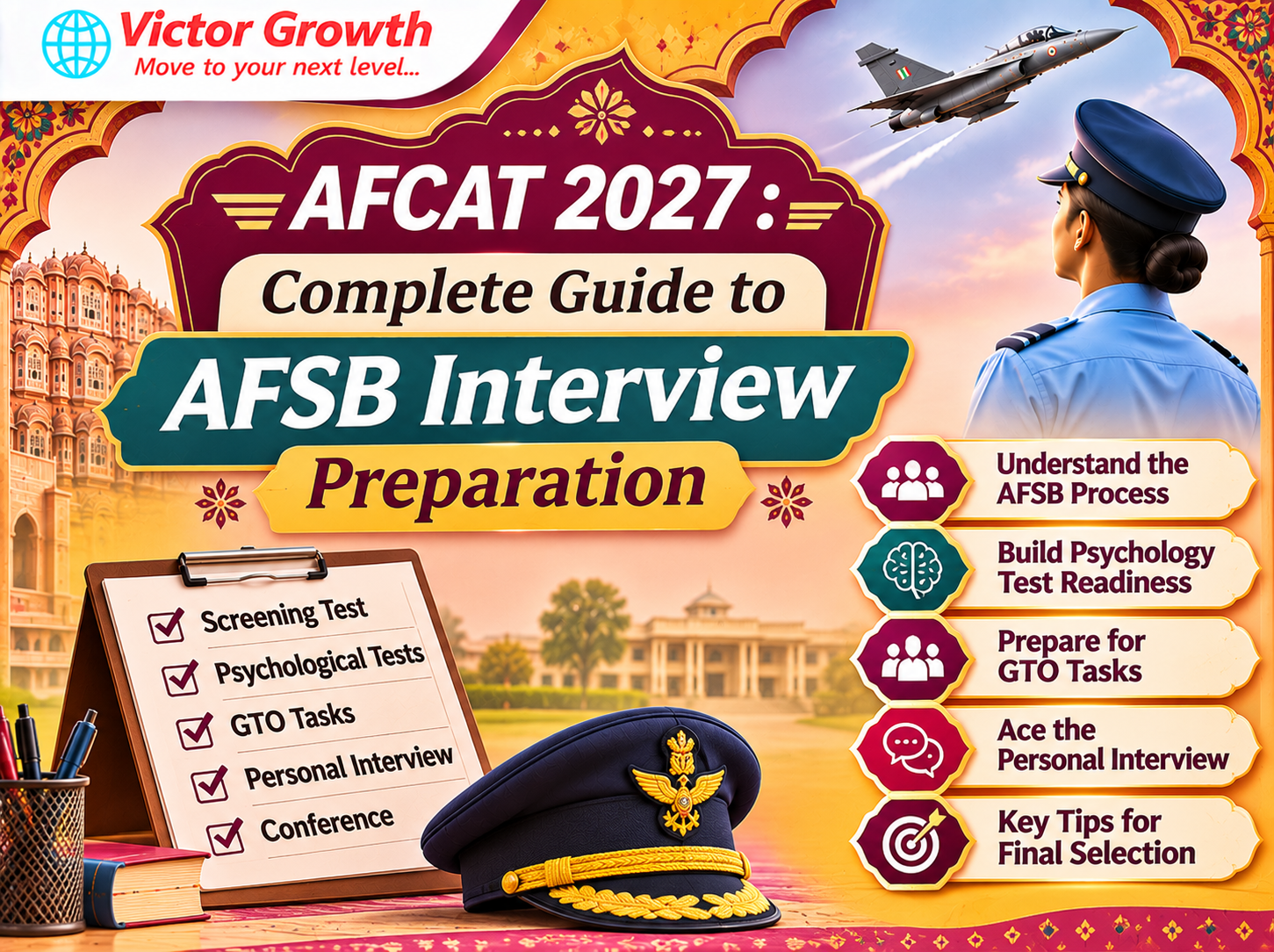
Clearing the AFCAT written examination is an important achievement for candidates who dream of becoming officers in the Indian Air Force. However, qualifying in the written examination is only the first step. Candidates shortlisted for the next stage must attend the Air Force Selection Board (AFSB) interview, which evaluates their personality, intelligence, communication skills, leadership qualities, and suitability for a career as an Air Force officer.
AFSB preparation requires more than memorising answers. Candidates must develop confidence, improve their problem-solving abilities, and learn to express their thoughts clearly.
This guide explains the AFSB selection process, important tests, preparation strategies, and common mistakes to avoid while preparing for AFCAT 2027.
1. What Is the AFSB Interview?
The Air Force Selection Board (AFSB) is the selection process conducted by the Indian Air Force to assess candidates who qualify through the applicable entry routes, including AFCAT.
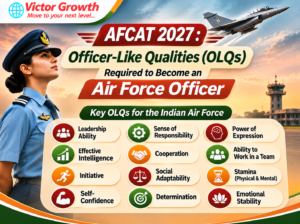
The selection process evaluates candidates for officer-like qualities such as:
Leadership and responsibility.
Effective communication.
Logical thinking and decision-making.
Teamwork and cooperation.
Confidence and initiative.
Emotional stability.
Adaptability and problem-solving skills.
The objective is to assess whether a candidate has the qualities required to become an officer in the Indian Air Force.
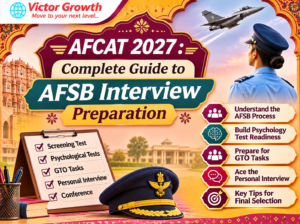
2. AFSB Interview Selection Process
The AFSB selection process generally consists of two stages, followed by medical examination and final merit requirements.
Stage I: Screening Test
Stage I is the initial screening process. It generally includes:
A. Officer Intelligence Rating (OIR) Test
This test evaluates reasoning and problem-solving abilities. Questions may cover:
Verbal reasoning.
Non-verbal reasoning.
Logical patterns.
Number and letter series.
Classification.
Analogy.
Preparation Tips:
Practise reasoning questions daily.
Improve observation and logical thinking.
Solve timed aptitude exercises.
Focus on accuracy and speed.
B. Picture Perception and Discussion Test (PPDT)
Candidates are shown a picture and asked to write a story based on their perception. They then participate in a group discussion.
Preparation should focus on:
Observing the picture carefully.
Identifying the main character and situation.
Creating a realistic and constructive story.
Explaining ideas clearly.
Listening to other candidates.
Participating confidently in the group discussion.
Candidates who qualify Stage I proceed to Stage II.
Stage II: Psychological Tests, Group Tests and Interview
Stage II evaluates the candidate’s personality, thinking ability, teamwork, leadership, and communication skills.
A. Psychological Tests
These tests assess a candidate’s thought process, imagination, personality, and responses to different situations.
Common tests include:
Thematic Apperception Test (TAT): Candidates write stories based on a series of pictures.
Word Association Test (WAT): Candidates respond to words with their immediate thoughts.
Situation Reaction Test (SRT): Candidates write how they would respond to different situations.
Self-Description Test (SD): Candidates describe themselves through different perspectives, such as family, friends, teachers, and their own understanding.
Preparation Tips:
Practise expressing thoughts naturally.
Develop a positive and practical approach to situations.
Avoid memorising artificial answers.
Understand your strengths and areas for improvement.
Be honest and consistent in your responses.
B. Group Testing Officer (GTO) Tasks
GTO tasks evaluate teamwork, leadership, cooperation, communication, and practical problem-solving.
These may include:
Group Discussion (GD).
Group Planning Exercise.
Progressive Group Task.
Half Group Task.
Individual Obstacles.
Group Obstacle Race.
Command Task.
Lecturette.
Preparation Tips:
Participate in group activities.
Practise explaining your ideas clearly.
Listen to other people’s opinions.
Develop teamwork and leadership skills.
Maintain physical fitness.
Focus on cooperation rather than dominating the group.
C. Personal Interview
The personal interview is an important part of the AFSB process. The interviewing officer may ask questions about your background, education, interests, family, achievements, and motivation to join the Indian Air Force.
Common interview questions include:
Tell me about yourself.
Why do you want to join the Indian Air Force?
What are your strengths and weaknesses?
Why have you chosen the Flying, Technical, or Ground Duty branch?
What are your hobbies and interests?
What do you know about the Indian Air Force?
How do you handle difficult situations?
What are your future goals?
Preparation Tips:
Prepare a clear introduction about yourself.
Know your educational background thoroughly.
Be aware of your hobbies and achievements.
Read about the Indian Air Force and its roles.
Answer honestly instead of memorising scripted responses.
Maintain confidence and natural communication.
3. How to Prepare for AFSB Interview for AFCAT 2027
Follow these strategies to improve your preparation:
Improve Communication Skills
Practise speaking in English regularly. Read newspapers, discuss current affairs, and try explaining topics in your own words.
Develop General Awareness
Stay updated on:
Indian Air Force developments.
Defence exercises and military operations.
National and international current affairs.
Important defence equipment and aircraft.
India’s neighbouring countries and defence relations.
Practise Reasoning Questions
Solve verbal and non-verbal reasoning questions regularly to improve logical thinking and decision-making.
Maintain Physical Fitness
Group tasks and outdoor activities require physical effort. Include walking, running, stretching, and basic fitness exercises in your routine according to your ability.
Understand Your Own Personality
Reflect on your strengths, weaknesses, achievements, responsibilities, and experiences. Self-awareness helps you answer interview questions naturally and confidently.
4. Important Documents to Carry for AFSB
Candidates should carefully follow the instructions in their official AFSB call letter. Commonly required documents include:
AFSB call letter.
AFCAT admit card or relevant examination documents.
Original educational certificates and mark sheets.
Valid photo identification.
Passport-size photographs.
Other documents specified in the call letter.
Carry the required originals and photocopies as instructed. Requirements may vary depending on the candidate’s entry and educational qualifications.
5. Common Mistakes to Avoid During AFSB Preparation
Avoid these mistakes while preparing:
Memorising answers instead of understanding yourself.
Giving exaggerated or dishonest answers.
Ignoring communication skills.
Dominating group discussions.
Avoiding physical fitness preparation.
Having limited knowledge about the Indian Air Force.
Showing a lack of teamwork.
Losing confidence after making mistakes.
Preparing only for the personal interview while ignoring psychological and GTO tests.
Remember, AFSB evaluates your overall personality rather than just your ability to answer questions.
6. Choosing the Right Coaching for Defence Exam Preparation
Proper guidance can help candidates understand the AFSB process, practise psychological tests, improve communication, and develop confidence in group activities.
Students searching for the best NDA coaching in Kerala should evaluate coaching institutes based on faculty experience, study materials, practical training, mock tests, and individual guidance.
Victor Growth Coaching Centre in Kochi provides guidance for defence examination aspirants. Candidates preparing for AFCAT should choose a programme that includes AFCAT-specific written examination preparation and AFSB interview guidance.
NDA and AFCAT are separate examinations with different eligibility requirements and selection procedures. Aspirants should select a course that matches their intended entry.
7. Daily AFSB Preparation Routine
A simple daily routine can help candidates develop the necessary skills.
Activity | Daily Time |
|---|---|
Newspaper and current affairs | 20 minutes |
English communication practice | 20 minutes |
Reasoning questions | 20 minutes |
Psychological test practice | 20 minutes |
Personal interview preparation | 15 minutes |
Physical fitness | 30 minutes |
Along with this routine, participate in group discussions and practise speaking on different topics.
Frequently Asked Questions (FAQs)
1. What is the AFSB interview in AFCAT 2027?
AFSB is the selection process conducted by the Indian Air Force to assess candidates who qualify through AFCAT and other applicable entry routes. It evaluates intelligence, personality, leadership, communication, and suitability for officer roles.
2. How many stages are there in the AFSB selection process?
The selection process generally has two stages: Stage I screening and Stage II psychological tests, GTO tasks, and personal interview. Medical examination and final merit requirements follow as applicable.
3. Is the AFSB interview difficult?
AFSB can be challenging because it evaluates different aspects of a candidate’s personality. Consistent preparation, self-awareness, communication practice, and teamwork can help candidates perform confidently.
4. What is the PPDT in AFSB?
Picture Perception and Discussion Test involves observing a picture, writing a story based on it, and participating in a group discussion.
5. How can I prepare for the AFSB personal interview?
Understand your background, educational qualifications, hobbies, achievements, and reasons for joining the Indian Air Force. Practise answering questions honestly and clearly.
6. Is physical fitness important for AFSB?
Yes. Physical fitness helps candidates participate effectively in outdoor group tasks and other activities during the selection process.
7. Can I prepare for AFSB while studying for the AFCAT written examination?
Yes. It is beneficial to develop communication skills, general awareness, reasoning ability, and physical fitness alongside written examination preparation.
8. Does clearing AFCAT guarantee selection into the Indian Air Force?
No. Candidates must also qualify in the AFSB process, meet applicable medical standards, and satisfy final merit and other entry requirements.
Conclusion
AFSB interview preparation is an essential part of the AFCAT 2027 selection journey. Candidates should focus on developing communication skills, leadership qualities, teamwork, logical thinking, self-confidence, and physical fitness.
Do not prepare only to give impressive answers. Work on becoming a responsible, confident, and well-informed individual. With consistent practice and the right guidance, you can approach the AFSB selection process with greater confidence and move closer to your dream of joining the Indian Air Force.