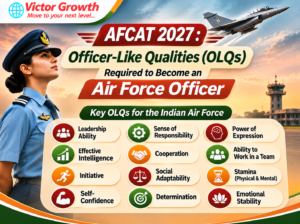
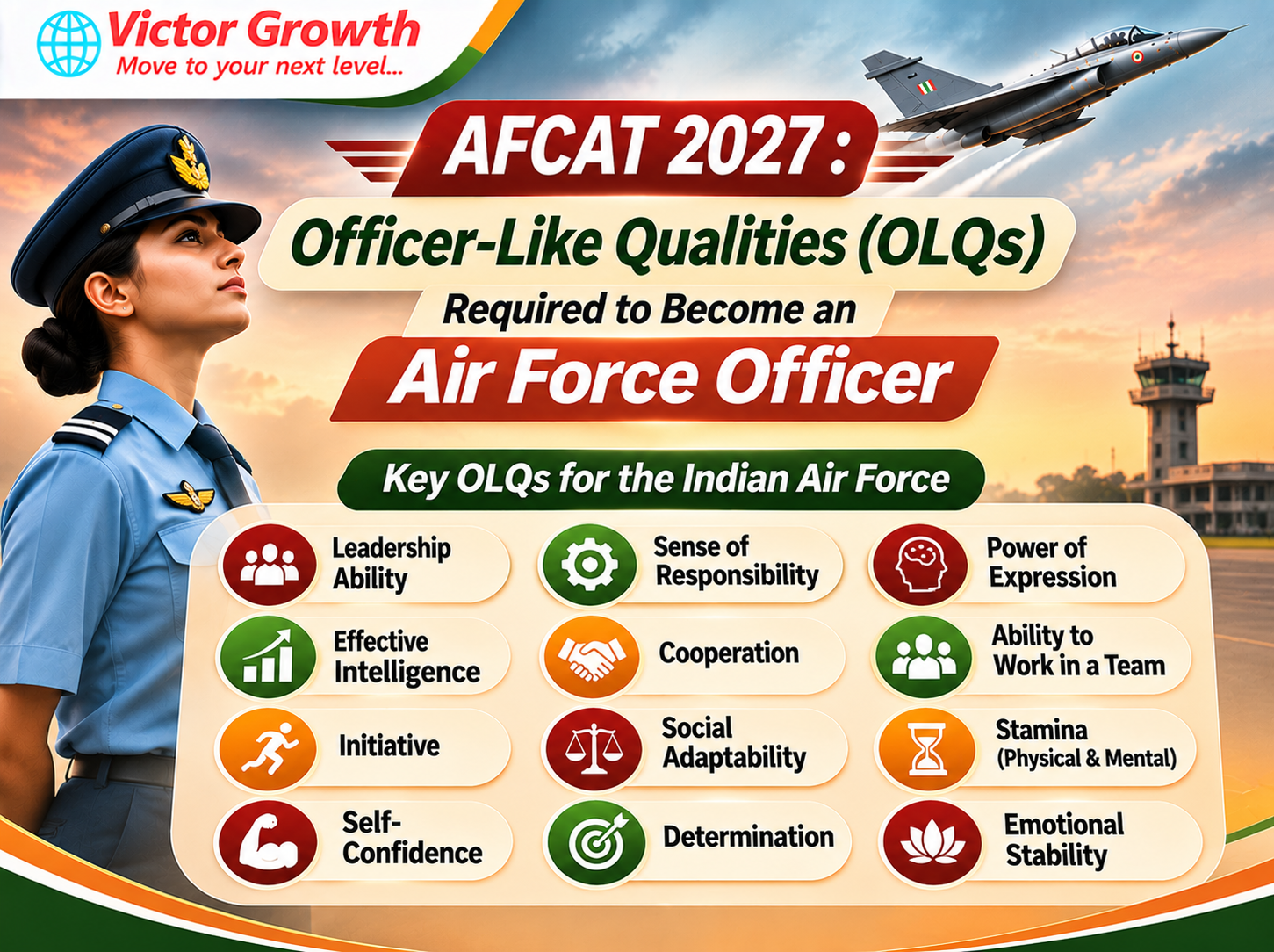
Becoming an officer in the Indian Air Force is a dream for many defence aspirants. However, clearing the AFCAT written examination alone is not enough. Candidates must also demonstrate the personality traits, leadership abilities, and decision-making skills required to become responsible officers.
These qualities are commonly known as Officer-Like Qualities (OLQs). They play an important role in the Air Force Selection Board (AFSB) assessment, where candidates are evaluated through psychological tests, group tasks, and personal interviews.
Understanding and developing these qualities can help AFCAT 2027 aspirants prepare more effectively for the selection process.
1. What Are Officer-Like Qualities (OLQs)?
Officer-Like Qualities are a set of personal attributes that indicate a candidate’s potential to become an effective officer in the Armed Forces.
They reflect how a person thinks, communicates, makes decisions, handles responsibilities, and works with others.
During AFSB, assessors observe candidates in different situations to understand their personality and suitability for military leadership.
OLQs are generally grouped into four broad factors comprising 15 qualities.
2. The 15 Officer-Like Qualities Required in AFSB
Factor 1: Planning and Organising Ability
This factor focuses on how effectively a candidate understands situations, plans actions, and uses available resources.
1. Effective Intelligence
The ability to understand problems and find practical solutions using common sense and logical thinking.
How to develop it: Practise reasoning questions, solve everyday problems, and learn to think independently.
2. Reasoning Ability
The ability to analyse information, understand situations, and reach logical conclusions.
How to develop it: Solve puzzles, aptitude questions, and analytical reasoning exercises.
3. Organising Ability
The ability to arrange resources, manage responsibilities, and complete tasks systematically.
How to develop it: Plan your daily activities, manage your time, and take responsibility for assigned tasks.
4. Power of Expression
The ability to communicate ideas clearly and confidently.
How to develop it: Read newspapers, participate in discussions, practise public speaking, and improve vocabulary.
Factor 2: Social Adjustment
This factor evaluates how well a candidate interacts with people and adapts to different social situations.
5. Social Adaptability
The ability to adjust to different people, environments, and situations.
How to develop it: Participate in group activities and become comfortable interacting with people from different backgrounds.
6. Cooperation
The willingness and ability to work together towards a common objective.
How to develop it: Participate in team activities, listen to others, and offer support when needed.
7. Sense of Responsibility
The ability to accept duties, complete assigned work, and remain accountable for decisions.
How to develop it: Complete tasks on time, fulfil commitments, and take ownership of mistakes.
Factor 3: Social Effectiveness
This factor focuses on a candidate’s ability to influence others positively and contribute effectively in group situations.
8. Initiative
The ability to take the first step without waiting for others to provide instructions.
How to develop it: Volunteer for responsibilities, suggest practical solutions, and take action when appropriate.
9. Self-Confidence
The ability to trust your abilities and face challenges without unnecessary fear.
How to develop it: Prepare regularly, participate in discussions, and learn from mistakes.
10. Speed of Decision
The ability to make timely decisions after considering available information.
How to develop it: Practise situation-based questions and learn to evaluate options quickly.
11. Ability to Influence the Group
The ability to guide and motivate others towards a common goal through communication and positive behaviour.
How to develop it: Practise teamwork, express your ideas clearly, and respect different opinions.
12. Liveliness
The ability to remain energetic, enthusiastic, and positive while participating in different activities.
How to develop it: Maintain a healthy routine, participate actively, and approach challenges with a positive attitude.
Factor 4: Dynamic Qualities
These qualities reflect a candidate’s ability to remain determined, courageous, and emotionally balanced while facing challenges.
13. Determination
The ability to continue working towards a goal despite difficulties.
How to develop it: Set realistic goals, follow a consistent routine, and avoid giving up after setbacks.
14. Courage
The ability to face difficult situations and take responsible action despite fear.
How to develop it: Step outside your comfort zone, accept challenges, and develop confidence through experience.
15. Stamina
The ability to maintain physical and mental energy while performing tasks over a period of time.
How to develop it: Exercise regularly, maintain healthy habits, and practise activities that improve endurance.
3. How Are OLQs Evaluated During the AFSB Interview?
The AFSB selection process includes different assessments that help evaluate a candidate’s personality and behaviour.
AFSB Assessment | Qualities commonly observed |
|---|---|
OIR Test | Reasoning and effective intelligence |
PPDT | Observation, expression, and confidence |
Psychological Tests | Thought process, responsibility, and decision-making |
Group Tasks | Cooperation, initiative, leadership, and social adaptability |
Personal Interview | Self-confidence, communication, determination, and responsibility |
Candidates should understand that OLQs are not evaluated through one test alone. Assessors consider performance across different activities to form an overall picture of the candidate.
4. Practical Ways to Develop OLQs Before AFCAT 2027
OLQs cannot be developed simply by memorising definitions. They improve through everyday experiences, consistent practice, and self-development.
Follow these practical suggestions:
Improve communication: Read newspapers and practise speaking on different topics.
Develop leadership: Take responsibility in college, workplace, or community activities.
Build teamwork: Participate in sports and group projects.
Improve decision-making: Practise logical reasoning and situation-based exercises.
Develop discipline: Follow a realistic daily routine.
Improve fitness: Include walking, running, and basic exercises in your routine.
Build self-awareness: Understand your strengths, weaknesses, achievements, and areas for improvement.
Stay informed: Follow national affairs, international developments, and defence-related news.
5. Common Mistakes to Avoid During OLQ Preparation
Many candidates misunderstand OLQs and make avoidable mistakes during AFSB preparation.
Avoid the following:
Memorising psychological test answers.
Pretending to have qualities that you do not demonstrate naturally.
Dominating group discussions.
Ignoring teamwork and cooperation.
Giving exaggerated answers during personal interviews.
Neglecting physical fitness.
Focusing only on the interview while ignoring other AFSB assessments.
Losing confidence after making mistakes.
The goal is to develop genuine qualities rather than create an artificial personality for the selection board.
6. Choosing the Right Coaching for Defence Exam Preparation
Proper guidance can help candidates understand the AFCAT syllabus, practise reasoning questions, improve communication, and become familiar with the AFSB selection process.
Students searching for the best NDA coaching in Kerala should compare institutes based on faculty experience, syllabus coverage, study materials, mock tests, and individual guidance.
Victor Growth Coaching Centre in Kochi provides guidance for defence examination aspirants. Candidates preparing for AFCAT should look for programmes that include written examination preparation and AFSB-specific training.
Remember that NDA and AFCAT are different examinations with separate eligibility requirements and selection procedures. Choose a coaching programme according to your intended defence entry.
7. Daily Routine to Develop Officer-Like Qualities
Activity | Time |
|---|---|
Newspaper reading | 20 minutes |
English speaking practice | 15 minutes |
Reasoning exercises | 20 minutes |
Group discussion or topic speaking | 15 minutes |
Physical exercise | 30 minutes |
Self-assessment | 10 minutes |
Following this routine consistently can help candidates improve their communication, confidence, reasoning, and discipline.
Frequently Asked Questions (FAQs)
1. What are Officer-Like Qualities in AFSB?
Officer-Like Qualities are personal attributes that indicate a candidate’s potential to become an effective military officer. They include leadership, cooperation, responsibility, courage, determination, and decision-making.
2. How many Officer-Like Qualities are assessed in AFSB?
There are 15 commonly recognised OLQs, grouped into four factors: Planning and Organising Ability, Social Adjustment, Social Effectiveness, and Dynamic Qualities.
3. Are OLQs important for AFCAT 2027?
Yes. OLQs are important during the AFSB selection process, which candidates must qualify after clearing the written examination.
4. Can Officer-Like Qualities be developed?
Yes. Candidates can develop these qualities through regular practice, teamwork, communication, physical activities, responsibility, and self-improvement.
5. Which OLQs are important for leadership?
Initiative, self-confidence, cooperation, responsibility, ability to influence the group, and decision-making are particularly useful for leadership.
6. How are OLQs tested during AFSB?
They are assessed through psychological tests, group activities, personal interviews, and other selection exercises. Overall performance is considered rather than relying on a single test.
7. Is English fluency compulsory to demonstrate OLQs?
Clear communication is important, but candidates should focus on expressing their ideas confidently and understandably rather than using complicated English.
8. Can coaching help in developing OLQs?
Structured coaching and practice can help candidates understand AFSB activities, improve communication, and prepare for group and psychological tests. However, genuine personality development requires consistent effort in everyday life.
Conclusion
Officer-Like Qualities are essential for candidates aspiring to become officers in the Indian Air Force. AFCAT 2027 aspirants should understand that AFSB is not simply an interview but a comprehensive assessment of personality, leadership, teamwork, and decision-making.
Start developing these qualities through daily activities, communication practice, group participation, physical fitness, and self-discipline. Focus on becoming responsible, confident, and cooperative rather than trying to memorise ideal answers.
With consistent preparation and genuine self-improvement, you can approach the AFSB selection process with greater confidence and move closer to your dream of serving the Indian Air Force.