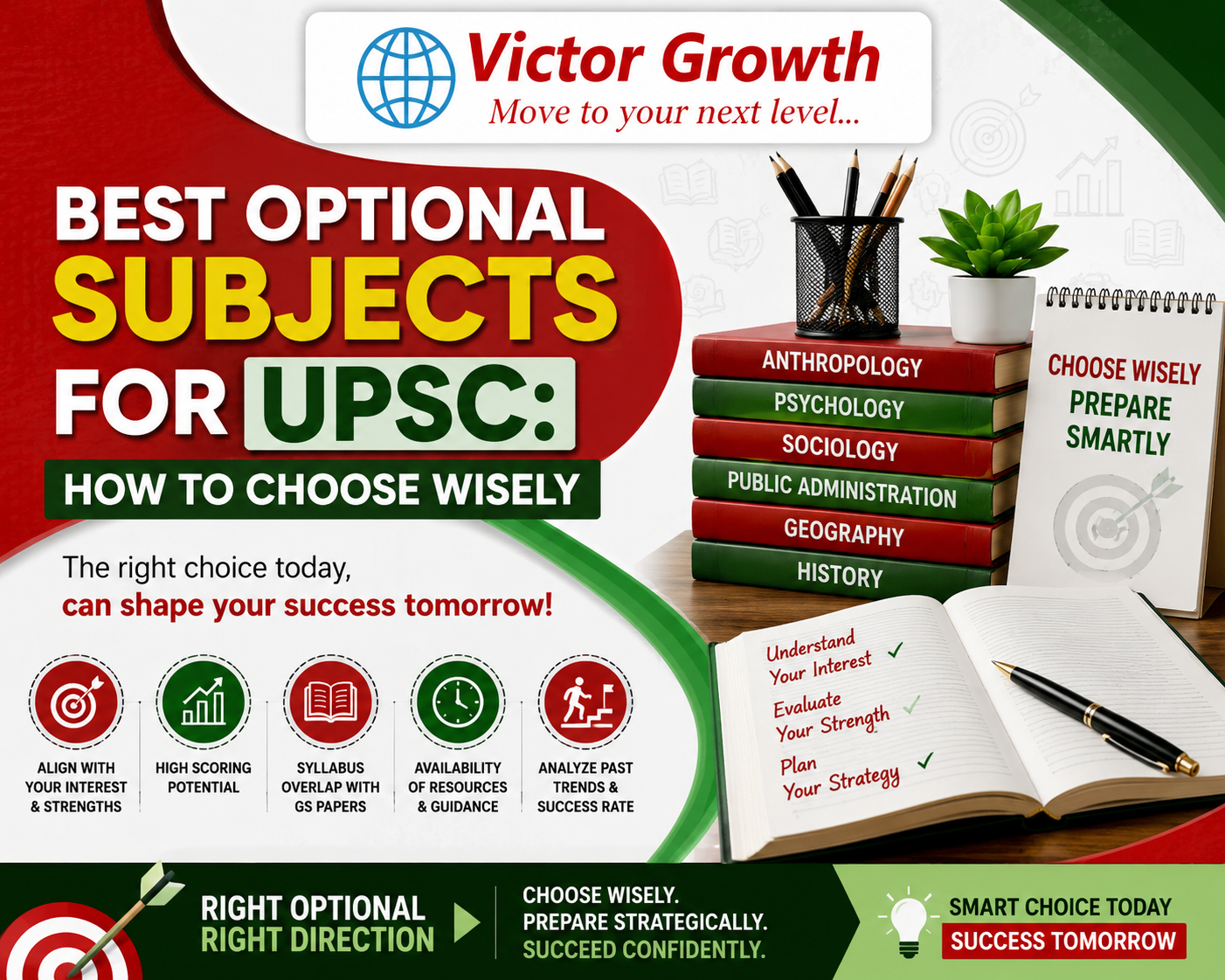
Choosing the right optional subject is one of the most important decisions in your UPSC Civil Services Examination journey. While General Studies papers are common for every aspirant, the optional subject has the potential to significantly influence your final rank. Many successful candidates have secured top positions because they selected an optional that aligned with their strengths, interests, and preparation strategy.
If you are searching for the best IAS coaching in Kerala, understanding how to choose an optional subject wisely is just as important as selecting the right coaching institute. This comprehensive guide explains everything you need to know—from evaluation criteria and myths to the most popular optional subjects and practical decision-making strategies.
What is the UPSC Optional Subject?
The UPSC Mains Examination consists of nine papers, out of which two papers (Paper VI and Paper VII) are dedicated to the optional subject.
Each optional paper carries 250 marks, making a total of 500 marks.
These 500 marks can play a decisive role in your final ranking and service allocation.
Structure
- Optional Paper I – 250 Marks
- Optional Paper II – 250 Marks
Total = 500 Marks
Unlike General Studies, the optional subject allows candidates to demonstrate deeper understanding and analytical ability in a chosen discipline.
Why is the Optional Subject So Important?
The optional subject contributes nearly one-fourth of the marks considered for the final merit list (excluding qualifying language papers). A strong performance in the optional can compensate for an average score in General Studies, while a poor optional score can significantly impact the final rank.
Benefits of choosing the right optional include:
- Higher scoring potential
- Better answer quality
- Increased confidence in Mains
- Better rank improvement
- More predictable preparation
Common Myths About UPSC Optional Subjects
Myth 1: There is a “Highest Scoring” Optional
Reality: No optional is permanently high-scoring. UPSC evaluates answer quality, conceptual clarity, and presentation rather than the subject itself.
Myth 2: Everyone Should Take Anthropology
Anthropology has been popular in recent years because of its relatively concise syllabus and overlap with General Studies. However, it is not suitable for everyone. Interest and aptitude matter more than trends.
Myth 3: Science Students Must Choose Science Optionals
Many engineering graduates successfully choose Humanities optionals such as Political Science, Sociology, or Geography because they better match their interests and preparation strategy.
Myth 4: Literature Subjects Guarantee High Marks
Literature optionals require strong language proficiency and literary appreciation. They are excellent choices for candidates with genuine expertise but are not automatically easier.
Complete List of UPSC Optional Subjects
UPSC currently offers 48 optional subjects, including literature options.
Popular non-literature optionals include:
- Anthropology
- Geography
- Political Science & International Relations (PSIR)
- Sociology
- History
- Public Administration
- Philosophy
- Psychology
- Economics
- Law
- Agriculture
- Mathematics
- Physics
- Chemistry
- Zoology
- Botany
- Medical Science
- Commerce & Accountancy
- Civil Engineering
- Mechanical Engineering
- Electrical Engineering
- Statistics
- Animal Husbandry & Veterinary Science
- Geology
There are also several literature optionals in various Indian languages and English.
Factors to Consider Before Choosing an Optional
1. Genuine Interest
Interest is the single most important factor.
You will spend several months reading, revising, and writing answers for your optional. A subject that genuinely interests you is easier to sustain over the long preparation period.
Ask yourself:
- Do I enjoy reading this subject?
- Can I study it for a year without losing motivation?
- Am I curious to learn more about it?
2. Educational Background
Having an academic background in the subject can provide an advantage because you already understand many core concepts.
However, it is not compulsory.
Thousands of toppers have chosen subjects unrelated to their graduation.
3. Availability of Study Material
Choose a subject that has:
- Standard textbooks
- Previous year question analysis
- Test series
- Good reference books
- Updated notes
- Reliable coaching support
Limited resources can make preparation unnecessarily difficult.
4. Quality Guidance and Mentorship
Access to experienced mentors can save time and improve answer-writing skills.
While self-study is possible, expert guidance helps in:
- Understanding demand of questions
- Answer structuring
- Test evaluation
- Revision planning
5. Overlap with General Studies
Some optionals overlap significantly with General Studies papers.
Examples:
Political Science
Overlaps with:
- Polity
- Governance
- International Relations
- Essay
Geography
Overlaps with:
- Physical Geography
- Environment
- Disaster Management
- Agriculture
Sociology
Overlaps with:
- Society
- Ethics
- Essay
- Social Issues
History
Overlaps with:
- Ancient India
- Medieval India
- Modern India
- Culture
A good overlap reduces overall preparation time.
6. Syllabus Length
Some subjects have concise syllabi, while others require extensive preparation.
Examples of relatively concise syllabi:
- Anthropology
- Philosophy
- Sociology
- PSIR (manageable with planning)
Examples of broader syllabi:
- Geography
- History
- Public Administration (dynamic)
- Mathematics (practice intensive)
Remember, a shorter syllabus does not automatically mean easier scoring.
7. Answer-Writing Style
Different subjects demand different approaches.
- Geography – maps, diagrams, flowcharts
- Sociology – thinkers and contemporary examples
- Anthropology – diagrams, case studies
- PSIR – constitutional provisions, theories, current affairs
- History – chronology and evidence
- Philosophy – conceptual clarity and logical arguments
Choose a style that suits your strengths.
Best Optional Subjects for UPSC (Popular Choices)
1. Anthropology
Best For:
- Science graduates
- Medical students
- Engineers
- Aspirants seeking a concise syllabus
Advantages:
- Compact syllabus
- Diagram-based answers
- Good scoring potential
- Limited current affairs dependency
Challenges:
- Requires understanding of biological concepts and tribal studies.
2. Political Science & International Relations (PSIR)
Best For:
- Humanities graduates
- Aspirants interested in governance and foreign policy
Advantages:
- Strong overlap with General Studies
- Helps in Essay and Interview
- Current affairs integration
Challenges:
- Requires analytical writing and conceptual understanding.
3. Sociology
Best For:
- Beginners
- Engineers
- Working professionals
Advantages:
- Short syllabus
- Easy to understand
- Relevant to everyday life
- Useful for Essay and Ethics
Challenges:
- Requires incorporation of sociological thinkers and examples.
4. Geography
Best For:
- Candidates who enjoy maps and environmental topics
Advantages:
- High overlap with General Studies
- Diagram-rich answers
- Useful for Prelims and Mains
Challenges:
- Large syllabus and evolving topics.
5. History
Best For:
- Candidates interested in India’s past and world history
Advantages:
- Strong overlap with General Studies
- Helps in Essay
- Useful for interviews
Challenges:
- Extensive syllabus and need for factual accuracy.
6. Public Administration
Best For:
- Aspirants interested in governance and public policy
Advantages:
- Relevant for future administrators
- Overlap with governance topics
- Practical application
Challenges:
- Dynamic nature requires updated examples and case studies.
7. Philosophy
Best For:
- Candidates who enjoy abstract thinking and logical reasoning
Advantages:
- Small syllabus
- Quick revision
- Useful in Ethics
Challenges:
- Conceptual depth and precise writing are essential.
Optional Subjects for Engineering Graduates
Many engineering graduates opt for:
- Anthropology
- Sociology
- PSIR
- Geography
- Mathematics (if they enjoy problem-solving)
- Philosophy
The best choice depends on interest rather than degree alone.
Optional Subjects for Medical Graduates
Popular options include:
- Medical Science
- Anthropology
- Sociology
- PSIR
Medical Science suits those willing to continue studying technical concepts, while Anthropology often appeals because of its biological component.
Optional Subjects for Commerce Graduates
Suitable options include:
- Commerce & Accountancy
- Economics
- Public Administration
- PSIR
Optional Subjects for Arts Graduates
Common choices:
- History
- Geography
- Sociology
- Political Science
- Philosophy
- Psychology
How to Finalize Your Optional Subject
Follow this structured process:
Step 1
Shortlist three subjects based on interest.
Step 2
Download and read the official UPSC syllabus for each.
Step 3
Analyze the last 5–10 years of previous year question papers.
Step 4
Read one introductory book or attend a few classes for each shortlisted subject.
Step 5
Assess:
- Interest
- Availability of study material
- Guidance
- Overlap
- Comfort with answer writing
Step 6
Choose one subject and commit to it. Avoid changing optionals midway unless absolutely necessary.
Mistakes to Avoid While Choosing an Optional
- Following friends blindly
- Choosing based on social media trends
- Selecting only because a topper chose it
- Ignoring your interest
- Underestimating the syllabus
- Frequently changing optional subjects
- Choosing without reviewing previous year papers
- Ignoring the availability of mentorship and study resources
Preparation Strategy After Choosing an Optional
A well-planned preparation strategy includes:
- Completing the syllabus in phases
- Making concise notes
- Practicing answer writing every week
- Revising regularly
- Solving previous year questions
- Taking sectional and full-length mock tests
- Integrating current affairs wherever relevant
Consistency and revision are more important than collecting multiple sources.
How Coaching Helps in Choosing and Preparing the Optional
Selecting an optional can be confusing, especially for first-time aspirants. Guidance from experienced mentors can simplify the decision.
If you are looking for the best IAS coaching in Kerala, choose an institute that provides:
- Personalized optional counseling
- Experienced faculty
- Comprehensive study material
- Regular answer-writing practice
- Test series with detailed evaluation
- One-to-one mentorship
- Current affairs integration
- Doubt-clearing sessions
The right guidance helps you choose an optional based on your strengths rather than popular opinion.
Why Choose Victor Growth?
For aspirants searching for the best IAS coaching in Kerala, Victor Growth offers structured support for both General Studies and optional subject preparation.
Key Features
- Personalized guidance in choosing the right optional
- Experienced UPSC mentors
- Flexible online and offline classes
- Comprehensive printed and digital study material
- Regular answer-writing practice
- Topic-wise and full-length mock tests
- Individual mentorship and performance analysis
- Daily current affairs support
- Interview preparation by experienced faculty
Victor Growth focuses on helping every aspirant build a preparation strategy that matches their academic background, career goals, and learning style.
Final Thoughts
There is no universally “best” optional subject in UPSC—there is only the subject that is best for you. The ideal optional is one that matches your interest, aptitude, availability of quality resources, and willingness to study consistently. Avoid making decisions based on trends or hearsay. Take time to understand the syllabus, evaluate your strengths, and seek expert guidance before making your final choice.
If you are searching for the best IAS coaching in Kerala, select an institute that not only teaches the syllabus but also provides personalized mentorship to help you choose and master the right optional subject.
Frequently Asked Questions (FAQs)
1. Which optional subject is the highest scoring in UPSC?
There is no permanently highest-scoring optional. UPSC awards marks based on the quality of answers, conceptual understanding, and presentation rather than the subject itself.
2. How do I choose the best optional subject for UPSC?
Consider your interest, educational background, syllabus length, overlap with General Studies, availability of study material, mentorship, and comfort with answer writing.
3. Can engineering graduates choose humanities optionals?
Yes. Many successful engineering graduates opt for subjects like Sociology, Anthropology, Geography, Political Science, and Philosophy because they align better with their interests and UPSC preparation.
4. Is Anthropology a good optional for beginners?
Anthropology is often considered beginner-friendly due to its concise syllabus and diagram-based approach, but it is best suited to candidates who are genuinely interested in the subject.
5. Which optional has the maximum overlap with General Studies?
Political Science & International Relations, Geography, Sociology, and History have significant overlap with various General Studies papers, Essay, and even the Interview stage.
6. Should I choose the same subject as my graduation?
Not necessarily. Your graduation subject can be an advantage, but interest, aptitude, and preparation strategy are equally important.
7. Can I change my optional subject after starting preparation?
It is possible, but changing midway often leads to loss of time and momentum. Choose carefully after reviewing the syllabus and previous year questions.
8. How much time should I dedicate to optional subject preparation?
Ideally, allocate 35–40% of your overall Mains preparation time to the optional subject, with regular answer writing and revision throughout the preparation cycle.
9. Does coaching help in selecting an optional subject?
Yes. Experienced mentors can assess your strengths, explain syllabus demands, recommend suitable resources, and help you make an informed decision.
10. What should I look for in the best IAS coaching in Kerala for optional preparation?
Look for expert faculty, personalized counseling, comprehensive study material, answer-writing guidance, regular test series, mentorship, and consistent feedback to build confidence and improve performance in your chosen optional.