
Clearing the UPSC Civil Services Preliminary Examination is only the first step towards becoming an IAS officer. The real challenge begins with the UPSC Mains Examination, where your analytical ability, clarity of thought, and writing skills determine your final rank.
Every year, thousands of aspirants possess excellent knowledge but fail to convert it into marks because they struggle with answer writing. UPSC Mains is not about writing everything you know—it is about writing the right content in the right format within the given time.
Good answer writing is a skill that can be developed through structured practice, continuous feedback, and disciplined revision.
At Victor Growth, recognized as one of the Best IAS Coaching in Kerala, students are trained through a systematic answer-writing program that focuses on content enrichment, presentation, time management, and examiner expectations.
Why Answer Writing Matters in UPSC Mains
The UPSC Mains Examination consists of nine descriptive papers, of which seven papers are counted for merit. These papers require candidates to write nearly 4,000–5,000 words over multiple days.
Unlike objective examinations, the Mains tests your ability to:
- Understand the demand of the question
- Organize thoughts logically
- Present balanced arguments
- Support answers with facts and examples
- Analyze issues critically
- Offer practical and constructive solutions
- Write within strict time limits
The difference between an average candidate and a top ranker often lies in answer presentation rather than knowledge alone.
Understanding the UPSC Mains Question Pattern
Before learning how to write answers, it is essential to understand the types of questions UPSC asks.
Common directive words include:
- Discuss
- Examine
- Analyse
- Evaluate
- Critically Analyse
- Comment
- Explain
- Justify
- Elucidate
- Compare
- Differentiate
Each directive expects a different approach.
For example:
Discuss
Present all dimensions of the topic with balanced arguments.
Analyse
Break the issue into parts and explain relationships.
Evaluate
Discuss positives and negatives before giving your judgment.
Critically Analyse
Present strengths, weaknesses, limitations, and conclude objectively.
Understanding these directives is the first step toward scoring higher marks.
The Ideal Structure of a UPSC Mains Answer
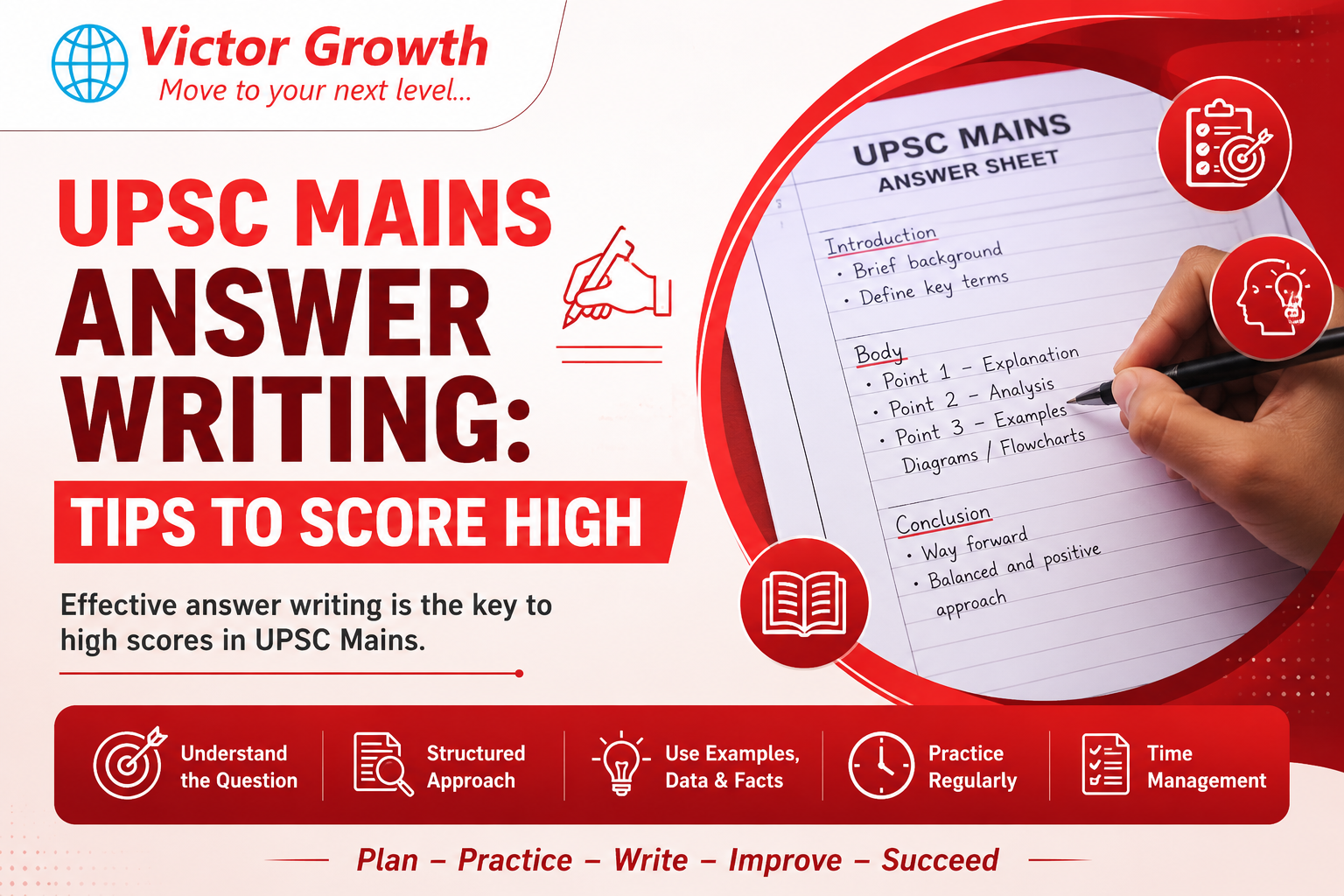
Every high-scoring answer generally follows a simple yet effective structure.
1. Introduction
The introduction should be concise and directly address the question.
It may begin with:
- Definition
- Constitutional provision
- Current affair
- Government report
- Committee recommendation
- Data or statistics
- Historical context
- Relevant quote
The introduction should usually be completed within 30–40 words.
Example:
Question: Discuss the importance of local governance in India.
Introduction:
“Local governance forms the third tier of India’s democratic framework as envisaged under the 73rd and 74th Constitutional Amendments, ensuring decentralized decision-making and participatory development.”
2. Body
The body should answer every component of the question.
Use:
- Headings
- Sub-headings
- Bullet points
- Flowcharts
- Diagrams
- Tables
- Examples
Maintain logical sequencing.
Example:
Causes
↓
Challenges
↓
Impact
↓
Government Initiatives
↓
Way Forward
This improves readability significantly.
3. Conclusion
Never end abruptly.
Provide:
- Positive outlook
- Constitutional values
- SDGs
- Government vision
- Practical recommendations
Example:
“Strengthening grassroots institutions through greater financial autonomy, transparency, and citizen participation will deepen Indian democracy and accelerate inclusive development.”
The Importance of Understanding the Demand of the Question
Many aspirants lose marks because they answer what they know instead of what UPSC asks.
Consider the question:
“Analyse the causes of urban flooding in India.”
Do not write:
- Definition
- Effects
- Government schemes
- Disaster management in general
Instead, focus specifically on:
- Causes
- Analysis
- Examples
- Solutions
Always underline keywords before beginning your answer.
Use the Introduction-Body-Conclusion (IBC) Approach
The IBC structure provides clarity to both the examiner and the candidate.
Introduction
10%
Body
80%
Conclusion
10%
Maintaining this balance ensures completeness without unnecessary elaboration.
How to Make Answers Attractive
Presentation matters.
Simple techniques can improve your score.
Use Headings
Instead of writing long paragraphs, divide the answer into sections.
Example:
- Causes
- Challenges
- Impacts
- Government Initiatives
- Way Forward
Use Bullet Points
Bullets improve readability.
Examiners evaluate hundreds of answer sheets.
Well-structured answers stand out immediately.
Draw Flowcharts
Flowcharts save time and improve presentation.
Example:
Industrialization
↓
Urban Expansion
↓
Wetland Encroachment
↓
Poor Drainage
↓
Urban Flooding
Draw Maps
Maps are especially useful in:
- Geography
- International Relations
- Disaster Management
- Internal Security
Even a rough outline map can fetch additional marks.
Use Diagrams
Simple diagrams improve conceptual clarity.
Examples:
- Water Cycle
- Food Chain
- Carbon Cycle
- Disaster Management Framework
Tables
Instead of lengthy comparisons:
| Democracy | Authoritarianism |
|---|---|
| Participation | Centralized Power |
| Accountability | Limited Accountability |
| Transparency | Restricted |
Tables improve presentation.
Add Value to Every Answer
Top-ranking candidates enrich answers using:
- Constitutional Articles
- Supreme Court Judgments
- Committee Reports
- NITI Aayog Reports
- SDGs
- Government Schemes
- Case Studies
- Examples
- International Best Practices
Example:
Question on education.
Mention:
- National Education Policy 2020
- SDG 4
- Article 21A
- RTE Act
Immediately the answer becomes richer.
The Importance of Data and Statistics
Relevant facts increase credibility.
Examples:
- Census Data
- NFHS
- NITI Aayog
- RBI Reports
- Economic Survey
- World Bank
- IMF
- UNDP
Use only authentic and updated figures.
Time Management During the Examination
The biggest challenge is completing all questions.
Suggested time:
10 Marks Question
≈ 7 minutes
15 Marks Question
≈ 11 minutes
Never spend excessive time on one answer.
Completing every question often yields more marks than writing a few perfect answers.
Daily Answer Writing Practice Strategy
Consistency is more important than volume.
Beginner (First Month)
- 2 Answers Daily
Intermediate
- 5 Answers Daily
Advanced
- One Full-Length Test Every Week
Review every answer carefully and identify areas for improvement.
Learn from Previous Year Questions (PYQs)
UPSC frequently repeats themes in different forms.
Study at least 10 years of Mains Previous Year Questions.
Observe:
- Frequently asked topics
- Directive words
- Answer structure
- Depth of analysis
Practising PYQs helps you understand the examiner’s expectations.
Improve Content Through Current Affairs
Static knowledge alone is insufficient.
Integrate:
- Budget
- Economic Survey
- Supreme Court judgments
- Government initiatives
- International developments
- Parliamentary reports
This makes your answers contemporary and relevant.
Use Keywords Effectively
Examiners scan for relevant concepts.
Highlight important terms by underlining them.
Examples:
- Inclusive Growth
- Sustainable Development
- Cooperative Federalism
- Gender Equality
- Climate Resilience
- Digital Governance
- Circular Economy
Avoid excessive highlighting; use it judiciously.
Common Mistakes to Avoid
Many aspirants lose marks due to avoidable errors.
Common mistakes include:
- Writing lengthy introductions
- Ignoring the directive word
- Not concluding the answer
- Poor handwriting or untidy presentation
- Writing irrelevant content
- Lack of examples
- Not using headings or bullet points
- Spending too much time on one question
- Ignoring current affairs
- Not practising answer writing regularly
How to Evaluate Your Own Answers
After writing an answer, ask yourself:
- Did I address every part of the question?
- Is the structure clear?
- Have I included examples?
- Did I provide balanced arguments?
- Is the conclusion optimistic and solution-oriented?
- Have I written within the word limit?
- Could the examiner quickly identify the key points?
Self-evaluation is one of the fastest ways to improve.
The Role of Test Series in UPSC Mains Preparation
A structured Mains Test Series helps aspirants:
- Develop writing speed
- Improve answer quality
- Receive expert evaluation
- Identify knowledge gaps
- Learn time management
- Build confidence
Constructive feedback from experienced mentors enables continuous improvement.
Why Mentorship Makes a Difference
UPSC Mains preparation requires more than information—it requires direction.
An experienced mentor can help you:
- Understand examiner expectations
- Improve answer structure
- Enrich content with value additions
- Correct recurring mistakes
- Stay motivated through regular feedback
- Track progress systematically
Personalized mentorship often shortens the learning curve and helps aspirants write mature, high-scoring answers.
Why Victor Growth is Among the Best IAS Coaching in Kerala
For aspirants aiming to excel in the UPSC Mains Examination, Victor Growth offers a comprehensive answer-writing ecosystem that combines expert guidance with consistent practice.
Key Features
- Over 20 years of UPSC mentoring experience
- Dedicated Mains Answer Writing Programme
- Daily answer-writing practice
- Personalized evaluation and feedback
- Model answers prepared by experienced faculty
- Regular GS and Essay test series
- Current affairs integration with static syllabus
- One-to-one mentorship and performance tracking
- Offline, Online Live, and Recorded learning options
- Comprehensive study materials and revision support
This structured approach helps aspirants build the analytical thinking, presentation skills, and confidence required to perform well in the UPSC Mains Examination.
Final Thoughts
Scoring high in the UPSC Mains Examination is not about writing more—it is about writing better. A well-structured answer that directly addresses the question, incorporates relevant facts, uses clear presentation techniques, and ends with a balanced conclusion is far more effective than a lengthy but unfocused response.
Answer writing is a skill developed through regular practice, self-assessment, and expert feedback. By following a disciplined strategy and seeking quality mentorship, aspirants can significantly improve their Mains scores and move closer to securing a place in the Civil Services.
If you are searching for the Best IAS Coaching in Kerala, choose an institute that emphasizes structured answer writing, comprehensive mentorship, regular test series, and personalized guidance to help you maximize your UPSC Mains performance.
Frequently Asked Questions (FAQs)
1. Why is answer writing important for UPSC Mains?
Answer writing is the core of the UPSC Mains Examination. It tests your analytical ability, conceptual clarity, presentation skills, and time management, all of which directly influence your final score.
2. When should I start practising answer writing?
You should begin answer writing after developing a basic understanding of the syllabus and standard books. Ideally, start within the first two to three months of preparation and continue consistently.
3. How many answers should I write daily?
Beginners can start with 2 answers per day and gradually increase to 5–10 answers daily. As the examination approaches, full-length mock tests should become a regular part of preparation.
4. What is the ideal structure of a UPSC Mains answer?
A high-scoring answer should follow the Introduction–Body–Conclusion (IBC) format. The body should use headings, bullet points, examples, diagrams, or flowcharts wherever appropriate.
5. Do diagrams and flowcharts improve marks?
Yes. Relevant diagrams, maps, tables, and flowcharts improve readability, present complex ideas effectively, and often leave a positive impression on the examiner.
6. How can I enrich my UPSC Mains answers?
Use constitutional provisions, committee recommendations, Supreme Court judgments, government schemes, Economic Survey findings, SDGs, current affairs, and authentic data to make your answers more comprehensive.
7. Are previous year questions important for Mains preparation?
Absolutely. Solving previous year questions helps you understand recurring themes, directive words, answer depth, and the overall expectations of the UPSC examiner.
8. Why is Victor Growth considered among the Best IAS Coaching in Kerala for UPSC Mains?
Victor Growth provides structured answer-writing practice, expert evaluation, personalized mentorship, comprehensive study materials, integrated current affairs coverage, and regular Mains test series. Its student-centric approach makes it one of the preferred choices for UPSC aspirants in Kerala.