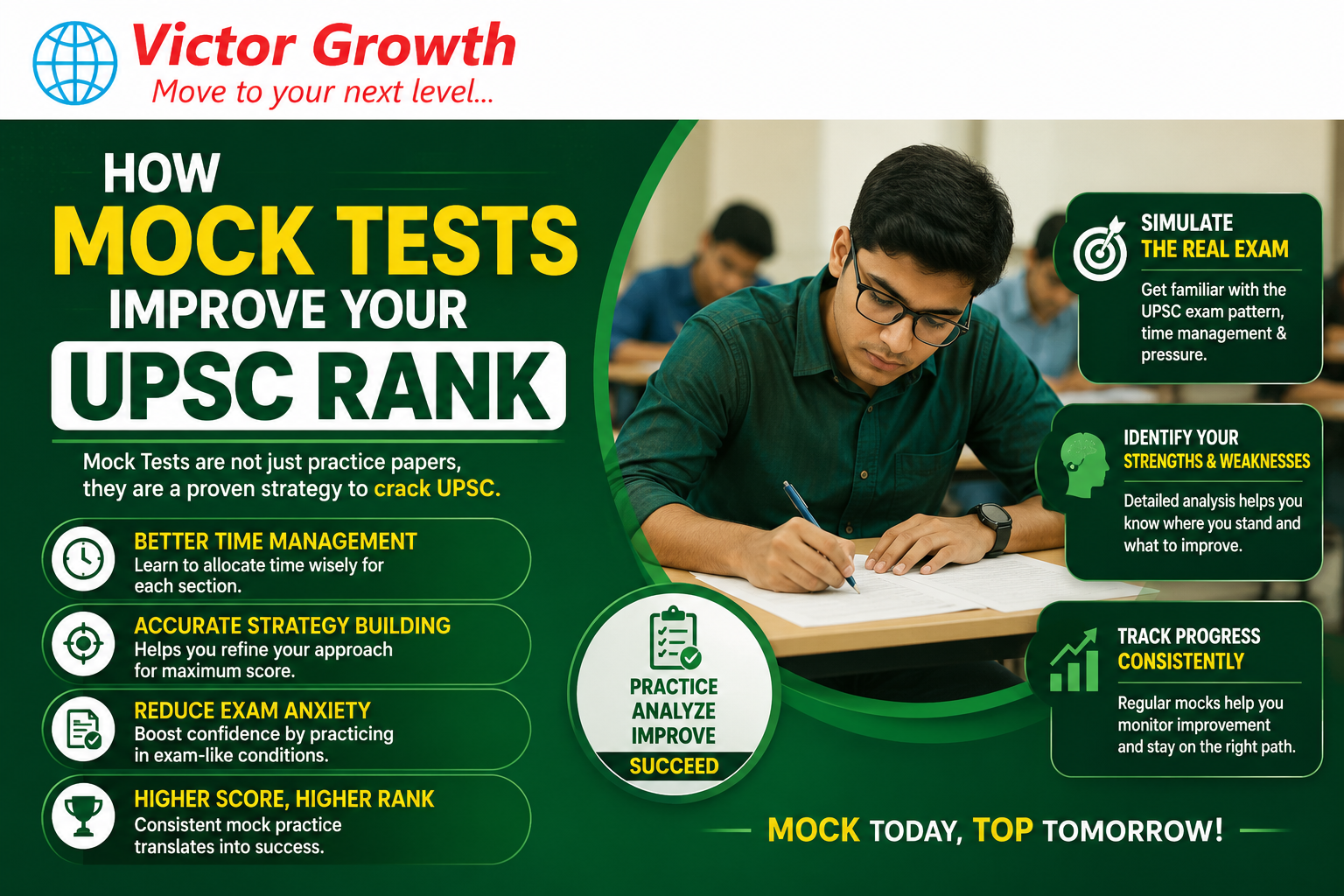
Every year, thousands of UPSC aspirants spend months reading standard books, making notes, and following current affairs. Yet, many fail to clear the Civil Services Examination—not because they lack knowledge, but because they are unable to apply what they have learned under exam conditions.
One of the biggest differences between an average aspirant and a top ranker is regular mock test practice. Mock tests are much more than practice papers; they are powerful learning tools that help candidates assess their preparation, improve decision-making, and build confidence.
Whether you are preparing for UPSC Prelims, UPSC Mains, or the Interview, mock tests play a critical role in enhancing your performance. They reveal your strengths, expose your weaknesses, and help you refine your exam strategy well before the actual examination.
At Victor Growth, recognized as one of the Best IAS Coaching in Kerala, mock tests are integrated into every stage of UPSC preparation to ensure students develop not only subject knowledge but also examination temperament.
Why Mock Tests Are Essential for UPSC Preparation
The UPSC Civil Services Examination is not merely a test of knowledge—it evaluates your ability to recall information quickly, analyze complex issues, manage time effectively, and remain composed under pressure.
Reading books alone cannot develop these skills.
Mock tests simulate the real examination environment and help aspirants experience:
- Time constraints
- Pressure of competition
- Decision-making under stress
- Writing speed
- Accuracy
- Question selection
- Mental endurance
This practical exposure significantly enhances examination readiness.
Understanding the Three Stages of UPSC
Each stage of the examination benefits from mock tests in different ways.
UPSC Preliminary Examination
Objective-type questions require:
- Accuracy
- Speed
- Intelligent guessing
- Elimination techniques
- Risk management
Mock tests help develop all these abilities.
UPSC Mains Examination
Descriptive papers evaluate:
- Analytical thinking
- Answer structure
- Presentation
- Time management
- Content quality
Mains mock tests improve answer-writing skills through continuous practice and expert evaluation.
Personality Test (Interview)
Mock interviews help candidates:
- Improve communication
- Build confidence
- Develop balanced opinions
- Handle stress
- Refine body language
They also familiarize aspirants with the interview environment.
Benefits of Mock Tests for UPSC Prelims
1. Familiarity with the Exam Pattern
Many first-time aspirants struggle simply because they are unfamiliar with the examination format.
Regular mock tests help candidates understand:
- Question distribution
- Difficulty level
- Time allocation
- Negative marking
- Answer selection strategy
By the time the actual examination arrives, the pattern feels familiar rather than intimidating.
2. Improves Time Management
UPSC Prelims provides only 120 minutes to answer 100 questions.
Without practice, candidates often:
- Spend too much time on difficult questions
- Rush through easier ones
- Leave questions unanswered
Mock tests train candidates to allocate time efficiently and maintain a steady pace throughout the examination.
3. Enhances Accuracy
Scoring high is not about attempting every question.
It is about making accurate decisions.
Mock tests help candidates:
- Reduce careless mistakes
- Improve precision
- Increase confidence in elimination techniques
- Avoid unnecessary negative marking
Over time, accuracy improves significantly.
4. Develops Intelligent Guessing Skills
Many UPSC questions cannot be answered with absolute certainty.
Experienced aspirants learn to eliminate incorrect options and make educated guesses.
Mock tests provide opportunities to practise:
- Option elimination
- Logical reasoning
- Probability-based decision-making
- Risk assessment
These skills can improve overall scores.
5. Identifies Weak Areas
Every mock test acts as a diagnostic tool.
It reveals:
- Weak subjects
- Frequently repeated mistakes
- Conceptual gaps
- Time-consuming topics
- Areas requiring revision
Knowing where you struggle allows for targeted improvement instead of random studying.
Benefits of Mock Tests for UPSC Mains
1. Improves Answer Writing
Answer writing is a skill developed through consistent practice.
Regular Mains tests help aspirants:
- Write concise introductions
- Organize answers logically
- Use headings and subheadings
- Incorporate diagrams and flowcharts
- Write effective conclusions
This structured approach improves overall presentation.
2. Increases Writing Speed
UPSC Mains requires candidates to write nearly 4,000–5,000 words over multiple papers.
Initially, many aspirants cannot complete the paper.
Regular mock tests improve:
- Handwriting endurance
- Speed
- Time allocation
- Content organization
Completing every question often leads to higher marks.
3. Builds Analytical Thinking
UPSC rarely asks direct factual questions.
Instead, it expects candidates to:
- Analyse
- Evaluate
- Compare
- Critically examine
- Justify
Writing mock tests regularly develops these higher-order thinking skills.
4. Improves Presentation
Good presentation makes answers examiner-friendly.
Mock test evaluations help aspirants learn to use:
- Bullet points
- Flowcharts
- Maps
- Tables
- Diagrams
- Underlined keywords
A visually organized answer is easier to assess and often creates a stronger impression.
Performance Analysis: The Most Important Step
Writing mock tests alone is not enough.
The real improvement happens during analysis.
After every test, review:
- Incorrect answers
- Guesswork that failed
- Time spent per section
- Conceptual mistakes
- Repeated errors
- Topics needing revision
Maintain an error notebook to avoid repeating mistakes.
How Mock Tests Improve Revision
Revision becomes more effective when guided by test performance.
Instead of revising everything repeatedly, aspirants can focus on:
- Frequently incorrect topics
- Weak subjects
- Low-scoring sections
This targeted revision saves time and improves retention.
Builds Examination Temperament
Many well-prepared candidates underperform because of stress.
Mock tests reduce anxiety by creating familiarity with:
- Exam pressure
- Time limits
- Question difficulty
- Decision-making
By the actual examination, candidates feel more confident and composed.
Improves Confidence
Confidence comes from preparation and practice.
Every successful mock test reinforces:
- Conceptual clarity
- Time management
- Problem-solving ability
Consistent improvement in mock scores also boosts motivation and reduces self-doubt.
Learning Through Mistakes
Every incorrect answer is an opportunity to improve.
Mock tests help candidates understand:
- Why they made mistakes
- How to avoid them
- Which concepts require deeper understanding
This iterative learning process is one of the most effective ways to prepare for UPSC.
Importance of Previous Year Questions
Previous Year Questions (PYQs) should complement mock tests.
PYQs help aspirants understand:
- UPSC’s evolving pattern
- Frequently tested themes
- Conceptual depth
- Question framing
Combining PYQs with mock tests creates a comprehensive preparation strategy.
Ideal Mock Test Schedule
First Phase (Foundation)
- Topic-wise tests
- One test every week
Second Phase
- Two full-length Prelims tests per week
- One Mains answer-writing test per week
Final Three Months
- Three to four Prelims mock tests weekly
- Two Mains full-length tests weekly
- Daily answer-writing practice
Consistency is more important than the number of tests.
Common Mistakes Aspirants Make with Mock Tests
Avoid these common errors:
- Writing tests without analysis
- Ignoring low scores
- Frequently changing test series
- Memorizing answers instead of understanding concepts
- Comparing scores with others excessively
- Skipping revision after tests
- Taking tests irregularly
- Focusing only on strengths
The objective is continuous improvement, not perfection.
Digital Mock Tests vs Offline Mock Tests
Both formats offer unique advantages.
Online Mock Tests
- Flexible
- Instant analysis
- Performance tracking
- Suitable for working professionals
Offline Mock Tests
- Real examination environment
- Better writing practice
- Improved concentration
- Classroom discussions
Many aspirants benefit from combining both formats.
How Mentorship Enhances Mock Test Performance
Expert mentors help candidates:
- Interpret test scores
- Identify recurring mistakes
- Improve answer quality
- Refine exam strategy
- Prioritize revision
Constructive feedback transforms mock tests into powerful learning experiences.
Why Victor Growth is Among the Best IAS Coaching in Kerala
Victor Growth integrates mock tests into every stage of UPSC preparation, ensuring aspirants continuously evaluate and improve their performance.
Key Features
- Over 20 years of UPSC mentoring experience
- Comprehensive Prelims and Mains Test Series
- Topic-wise and Full-Length Mock Tests
- Detailed performance analysis
- Personalized mentor feedback
- Dedicated answer-writing evaluation
- Current affairs integrated into test papers
- Offline, Online Live, and Recorded learning modes
- Comprehensive study materials
- Individual progress tracking and mentoring
This structured testing ecosystem enables students to identify weaknesses early, strengthen concepts, and approach the UPSC examination with confidence.
Final Thoughts
Mock tests are one of the most valuable components of UPSC preparation. They not only assess your knowledge but also sharpen your decision-making, improve time management, strengthen answer-writing skills, and build the confidence needed to perform under examination pressure.
The key is not simply to write more tests but to learn from every test through careful analysis and targeted revision. Aspirants who consistently evaluate their performance and refine their strategy are better equipped to improve their scores and secure higher ranks.
If you are looking for the Best IAS Coaching in Kerala, choose an institute that offers a well-designed test series, expert feedback, personalized mentorship, and continuous performance evaluation to help you maximize your UPSC rank.
Frequently Asked Questions (FAQs)
1. Why are mock tests important for UPSC preparation?
Mock tests simulate the actual examination, helping aspirants improve time management, accuracy, confidence, and exam strategy while identifying areas that require further improvement.
2. How many mock tests should I take before the UPSC Prelims?
Aspirants should aim to complete 40–60 full-length Prelims mock tests, along with topic-wise tests and previous year question practice.
3. When should I start writing UPSC Mains mock tests?
Begin answer-writing practice once you have covered the basics of the syllabus. Regular Mains tests should continue throughout your preparation rather than being postponed until after the Preliminary Examination.
4. Are online mock tests as effective as offline tests?
Yes. Online tests provide flexibility and instant performance analysis, while offline tests better simulate the actual examination environment. A combination of both can be beneficial.
5. Should I analyse every mock test?
Absolutely. Test analysis is as important as taking the test itself. Reviewing mistakes, identifying weak areas, and planning targeted revision are essential for continuous improvement.
6. Do previous year questions replace mock tests?
No. Previous year questions help understand the UPSC pattern, while mock tests simulate real exam conditions and improve application skills. Both should be used together.
7. Can mock tests improve my UPSC rank?
Yes. Regular mock tests enhance accuracy, speed, confidence, answer-writing quality, and exam temperament, all of which contribute to better performance and a higher rank.
8. Why is Victor Growth considered among the Best IAS Coaching in Kerala for UPSC test preparation?
Victor Growth offers comprehensive Prelims and Mains test series, expert evaluation, personalized mentorship, detailed performance analysis, integrated current affairs, and structured revision support, making it a preferred destination for serious UPSC aspirants in Kerala.