Cracking the UPSC Civil Services Examination on the first attempt is a dream shared by thousands of aspirants across India. Every year, several candidates achieve this remarkable feat, proving that success is not determined by the number of attempts but by the quality of preparation.
The UPSC examination is undoubtedly one of the toughest competitive exams in the country. However, with a well-planned strategy, disciplined execution, consistent revision, and expert guidance, clearing the examination in the first attempt is a realistic goal.
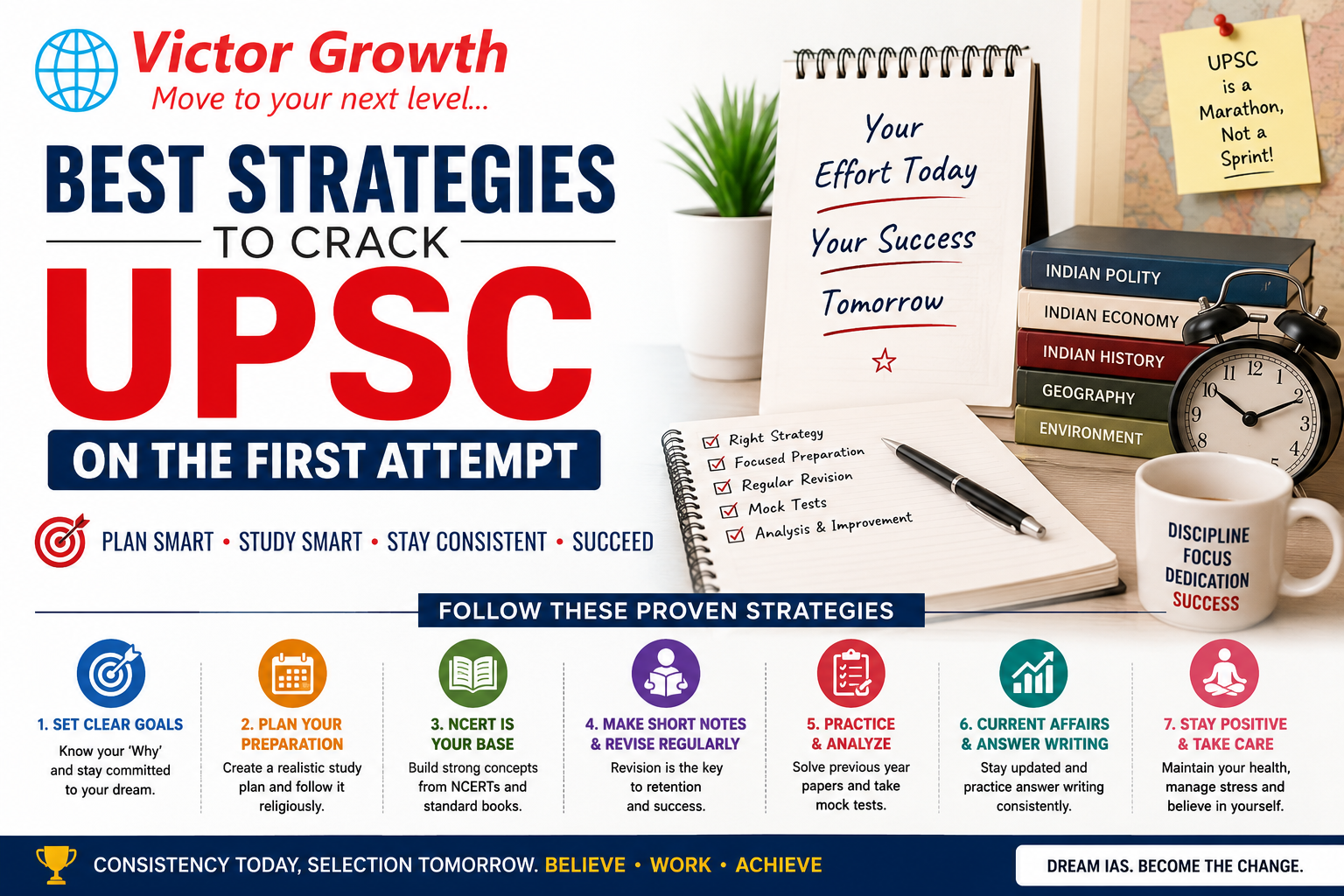
Many first-attempt successful candidates share common habits: they follow limited study resources, revise consistently, practice answer writing, solve mock tests regularly, and maintain focus throughout their preparation.
At Victor Growth, recognized as one of the Best IAS Coaching in Kerala, aspirants are guided through a structured preparation system that emphasizes conceptual clarity, smart planning, and continuous evaluation to maximize their chances of success in the very first attempt.
Is It Possible to Crack UPSC in the First Attempt?
Yes.
Every year, a significant number of candidates secure top ranks in their very first attempt.
What distinguishes these candidates is not extraordinary intelligence but:
- Consistency
- Smart planning
- Effective time management
- Conceptual clarity
- Continuous revision
- Regular practice
- Positive mindset
Success depends on following the right strategy from the beginning.
Understand the UPSC Examination Thoroughly
Before beginning preparation, understand the complete examination process.
Stage 1: Preliminary Examination
- Objective type
- General Studies Paper I
- CSAT (Qualifying)
Purpose:
Selection for the Mains Examination.
Stage 2: Mains Examination
Descriptive papers assessing:
- Knowledge
- Analysis
- Writing ability
- Decision-making
- Ethics
Marks obtained in Mains contribute directly to the final rank.
Stage 3: Personality Test
Evaluates:
- Communication
- Leadership
- Administrative aptitude
- Awareness
- Judgment
- Personality
Understanding the expectations of each stage helps you prepare in an integrated manner.
Know the UPSC Syllabus Completely
The syllabus should become your preparation roadmap.
Print the official syllabus and keep it on your study table.
Before studying any topic, ask yourself:
“Is this part of the UPSC syllabus?”
This simple habit prevents unnecessary reading and saves valuable time.
Build a Strong Foundation with NCERT Books
Every successful UPSC preparation begins with NCERT textbooks.
Recommended subjects:
- History
- Geography
- Economics
- Political Science
- Science
Benefits:
- Strong conceptual clarity
- Simple explanations
- Reliable information
- Easier understanding of advanced books
Skipping NCERTs often creates conceptual gaps.
Follow Standard Reference Books
Avoid collecting too many resources.
Recommended books include:
Indian Polity
M. Laxmikanth
Modern History
Spectrum – A Brief History of Modern India
Geography
G.C. Leong
Economy
Ramesh Singh (Selective Reading)
Environment
Shankar IAS Environment
Art & Culture
Nitin Singhania
Revise these books multiple times rather than constantly switching resources.
Prepare a Realistic Study Plan
Consistency is more important than studying extremely long hours.
Sample Daily Plan
Morning
- Core Subject
Afternoon
- Optional Subject
Evening
- Current Affairs
Night
- Revision
- MCQs
- Answer Writing
Maintain flexibility while ensuring daily progress.
Prioritize Revision
Many aspirants continue reading new material without revising earlier topics.
A practical revision cycle:
- Same day revision
- One-week revision
- One-month revision
- Final revision before examination
Repeated revision strengthens retention and boosts confidence.
Integrate Current Affairs with Static Subjects
Current affairs should not be studied in isolation.
Example:
Reading about climate change?
Revise:
- Environment
- Geography
- International Relations
- Government initiatives
Integrated preparation improves understanding and answer quality.
Practice Previous Year Questions (PYQs)
Previous Year Questions help aspirants understand:
- UPSC trends
- Frequently tested topics
- Question framing
- Difficulty level
Solve at least 10 years of Prelims and Mains PYQs.
Analyse not only the answers but also the thought process behind each question.
Master Answer Writing Early
Many aspirants postpone answer-writing practice until after the Preliminary Examination.
This is a common mistake.
Begin writing:
- Two answers daily
- One essay every two weeks initially
- Increase frequency gradually
Focus on:
- Introduction
- Structured body
- Balanced conclusion
- Use of diagrams
- Flowcharts
- Examples
Answer writing is a skill developed over time.
Take Regular Mock Tests
Mock tests simulate real examination conditions.
Benefits include:
- Time management
- Accuracy improvement
- Confidence building
- Weak area identification
- Revision guidance
Suggested targets:
Prelims
40–60 Full-Length Tests
Mains
Weekly answer-writing tests
Always analyse your performance after each test.
Develop Strong Time Management Skills
Time is your most valuable resource.
Create:
- Daily targets
- Weekly goals
- Monthly milestones
Balance:
- Static subjects
- Current affairs
- Revision
- Mock tests
- Answer writing
- Exercise
- Rest
Consistency over months matters more than occasional intense study sessions.
Avoid Resource Overload
One of the biggest reasons for poor preparation is following too many resources.
Limit yourself to:
- NCERTs
- Standard books
- One newspaper
- Monthly current affairs
- PYQs
- Test series
Master these resources thoroughly.
Build Analytical Thinking
UPSC values analysis over memorization.
Whenever you study a topic, ask:
- Why?
- How?
- What are the challenges?
- What are the solutions?
- What are the implications?
Developing this habit improves both Mains answers and Interview performance.
Improve Note-Making Skills
Prepare concise notes containing:
- Key facts
- Flowcharts
- Government schemes
- Constitutional Articles
- Case studies
- Diagrams
- Statistics
Short notes make revision faster during the final months.
Stay Healthy Throughout Preparation
A healthy body improves learning efficiency.
Maintain:
- 7–8 hours of sleep
- Regular exercise
- Balanced diet
- Adequate hydration
Physical well-being supports concentration and reduces burnout.
Stay Motivated and Consistent
Motivation naturally fluctuates during long-term preparation.
Instead of depending on motivation alone:
- Build habits
- Follow your timetable
- Track progress
- Celebrate small achievements
- Learn from setbacks
Discipline is more reliable than temporary enthusiasm.
Common Mistakes to Avoid
Avoid these common errors:
- Ignoring the official syllabus
- Reading too many books
- Neglecting revision
- Delaying answer writing
- Ignoring CSAT
- Skipping mock tests
- Studying without a plan
- Comparing yourself with others
- Following unreliable online sources
- Sacrificing sleep regularly
Avoiding these mistakes significantly improves preparation quality.
The Importance of Mentorship
Guidance from experienced mentors helps aspirants:
- Create realistic study plans
- Choose appropriate resources
- Improve answer writing
- Analyse mock tests
- Stay motivated
- Avoid common mistakes
Personalized mentorship often shortens the learning curve and increases efficiency.
Why Victor Growth is Considered One of the Best IAS Coaching in Kerala
Victor Growth has developed a comprehensive preparation ecosystem designed to help aspirants maximize their chances of success in their very first UPSC attempt.
Key Features
- Over 20 years of UPSC mentoring experience
- Structured Foundation, Prelims, and Mains programs
- Carefully curated study materials
- Daily current affairs discussions
- Regular Prelims and Mains test series
- Dedicated answer-writing practice with expert evaluation
- Personalized mentorship and progress tracking
- Offline, Online Live, and Recorded learning options
- Comprehensive revision strategy
- Continuous doubt-clearing and academic support
By combining quality teaching with disciplined preparation and individualized guidance, Victor Growth helps aspirants prepare confidently for every stage of the UPSC examination.
First Attempt Success Roadmap
Months 1–3
- Complete NCERTs
- Build conceptual clarity
- Begin current affairs
- Prepare short notes
Months 4–6
- Complete standard books
- Start answer writing
- Solve topic-wise MCQs
- Revise regularly
Months 7–9
- Full-length mock tests
- Previous Year Questions
- Optional subject revision
- Improve weak areas
Last 3 Months
- Intensive revision
- Full-length Prelims tests
- Daily answer writing
- Current affairs revision
- Confidence building
A structured roadmap helps ensure balanced preparation without last-minute stress.
Final Thoughts
Cracking the UPSC Civil Services Examination on the first attempt is an ambitious yet achievable goal. Success is not determined by extraordinary talent but by disciplined preparation, strategic planning, consistent revision, and continuous improvement.
Focus on mastering the syllabus rather than accumulating resources. Revise regularly, practise answer writing, analyse mock tests, maintain good health, and seek expert guidance whenever required.
Remember, every successful first-attempt candidate was once a beginner. With dedication, patience, and the right strategy, you can transform your aspiration into achievement.
If you are searching for the Best IAS Coaching in Kerala, choose an institute that offers structured guidance, experienced mentorship, comprehensive study materials, regular test series, and personalized support to help you confidently pursue success in your very first UPSC attempt.
Frequently Asked Questions (FAQs)
1. Can I crack UPSC on my first attempt?
Yes. Every year, many candidates clear the UPSC Civil Services Examination in their first attempt through disciplined preparation, consistent revision, mock tests, and effective guidance.
2. How many hours should I study daily for a first-attempt success?
Most successful aspirants study 6–10 focused hours daily, depending on their background and preparation stage. Quality of study is more important than the number of hours.
3. Which books are essential for first-time UPSC aspirants?
Begin with NCERTs, followed by standard books such as M. Laxmikanth (Polity), Spectrum (Modern History), G.C. Leong (Geography), Shankar IAS (Environment), Ramesh Singh (Economy), and Nitin Singhania (Art & Culture).
4. When should I start answer-writing practice?
Start answer-writing practice after completing the basics of the syllabus. Early and regular practice helps improve analytical thinking, presentation, and writing speed.
5. How important are mock tests?
Mock tests are essential for improving time management, accuracy, confidence, revision, and exam temperament. They also help identify strengths and weaknesses.
6. Should I prepare Current Affairs separately?
Current affairs should be integrated with static subjects. Reading one quality newspaper daily and revising monthly compilations is generally sufficient.
7. Is coaching necessary to crack UPSC on the first attempt?
Coaching is not mandatory, but structured guidance, personalized mentorship, quality study materials, answer-writing evaluation, and regular test series can make preparation more efficient and focused.
8. Why is Victor Growth considered among the Best IAS Coaching in Kerala?
Victor Growth offers structured Foundation, Prelims, and Mains programs, experienced faculty, personalized mentorship, curated study materials, current affairs support, answer-writing practice, comprehensive test series, and continuous academic guidance—creating a systematic preparation environment for first-attempt UPSC aspirants.