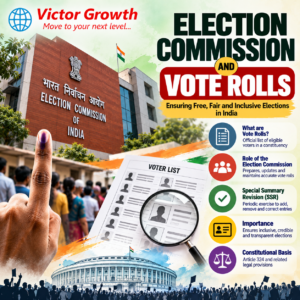
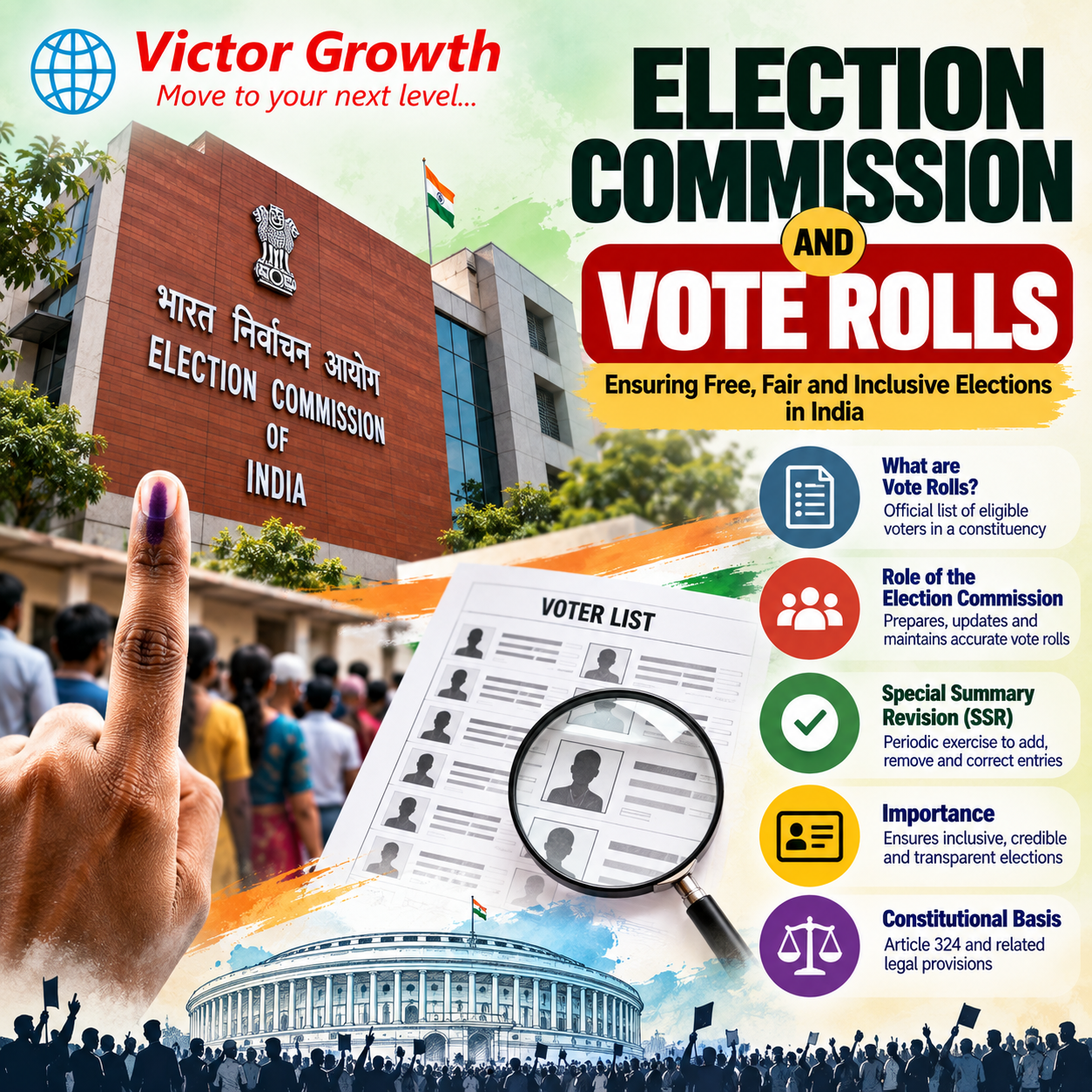
The Election Commission of India (ECI) has been undertaking extensive Special Intensive Revision (SIR) of electoral rolls in 2026. The exercise has renewed attention on the importance of accurate, inclusive and updated voter lists in ensuring free and fair elections.
The ECI considers the preparation, maintenance and purification of electoral rolls a core responsibility linked to Article 324 of the Constitution, the Representation of the People Act, 1950, and the Registration of Electors Rules, 1960.
What is an Electoral Roll?
An electoral roll is the official list of eligible voters registered in a particular constituency.
A person generally needs to:
Be an Indian citizen
Have attained 18 years of age
Be ordinarily resident in the relevant constituency
Not be legally disqualified from registration
The ECI currently recognises four qualifying dates — 1 January, 1 April, 1 July and 1 October — for determining eligibility based on age.
An eligible citizen can apply for registration through Form 6.
Constitutional and Legal Framework
Article 324
Article 324 provides for the establishment of the Election Commission of India and vests it with the superintendence, direction and control of elections and related electoral processes.
Representation of the People Act, 1950
The Act provides the statutory framework for:
Preparation of electoral rolls
Allocation of seats and constituencies
Qualifications for registration
Inclusion, correction and deletion of electoral-roll entries
Section 21 deals with the preparation and revision of electoral rolls.
Registration of Electors Rules, 1960
These rules provide the procedural framework for electoral-roll preparation and revision.
Types of Electoral Roll Revision
1. Summary Revision
In a Summary Revision, the existing electoral roll is published in draft form. Citizens and stakeholders are given an opportunity to submit claims and objections, after which the final roll is published.
2. Intensive Revision
An Intensive Revision involves a more detailed, house-to-house verification process, generally through enumerators or Booth Level Officers (BLOs).
3. Special Revision
The ECI can order a Special Revision when circumstances warrant a more intensive examination of the electoral roll.
4. Continuous Updation
Electoral rolls are also updated continuously to incorporate eligible new voters and make corrections or deletions, subject to the applicable legal and election-period restrictions.
Special Intensive Revision (SIR)
Special Intensive Revision is a detailed exercise aimed at verifying electoral-roll entries and identifying cases requiring inclusion, correction or deletion.
The process can involve:
Door-to-door enumeration
Verification of elector details
Identification of shifted or deceased electors
Detection of duplicate entries
Inclusion of eligible citizens
Claims and objections
Publication of draft and final electoral rolls
The key objective is to ensure that eligible citizens are included while inaccurate or ineligible entries are addressed through due process.
Forms You Should Know
| Form | Purpose |
|---|---|
| Form 6 | New voter registration |
| Form 6A | Registration of overseas/NRI elector |
| Form 7 | Objection to inclusion / deletion |
| Form 8 | Correction, shifting of residence and other updation of existing electoral-roll entries |
The ECI provides these services through its voter-services platforms.
Why Are Accurate Electoral Rolls Important?
1. Free and Fair Elections
An accurate voter list is fundamental to ensuring that eligible citizens can exercise their right to vote.
2. Preventing Electoral Irregularities
Regular revision can help identify:
Duplicate registrations
Deceased electors
Permanently shifted electors
Incorrect entries
3. Electoral Inclusion
Revision should also ensure that newly eligible voters, migrants and other eligible citizens are not excluded.
4. Public Confidence
Transparent procedures for addition, deletion and correction strengthen trust in the electoral process. The ECI emphasises opportunities for claims, objections and verification as part of this framework.
Challenges
Electoral-roll revision must balance two equally important objectives:
Electoral integrity + universal inclusion
Potential challenges include:
Incorrect deletion of eligible voters
Difficulties faced by migrants and vulnerable groups
Documentation and verification issues
Errors in digitisation
Lack of awareness
Ensuring transparency and due process
Therefore, verification mechanisms, public disclosure, claims and objections and effective grievance redressal are crucial.
UPSC Relevance
Prelims
Remember:
Article 324: Election Commission of India
RPA 1950: Electoral-roll framework
Form 6: New voter
Form 6A: Overseas elector
Form 7: Objection/deletion
Form 8: Correction/updation
BLO: Booth Level Officer
SIR: Special Intensive Revision
Mains
GS Paper II:
Election Commission
Electoral reforms
Representation and democracy
Free and fair elections
Constitutional and statutory institutions
Essay:
Electoral integrity, democratic participation and inclusive democracy.
Possible UPSC Mains Question
“Accurate and inclusive electoral rolls are the foundation of free and fair elections. Discuss the role of the Election Commission of India in maintaining electoral rolls and the challenges involved.”
Conclusion
The Election Commission and electoral rolls are central to India’s democratic system. Electoral-roll revision is necessary to maintain accuracy and prevent irregularities, but it must simultaneously protect the inclusion of every eligible voter.
For UPSC aspirants, the issue should be studied through the interconnected themes of Article 324, electoral reforms, Representation of the People Act, ECI independence, democratic participation and the principle of free and fair elections.