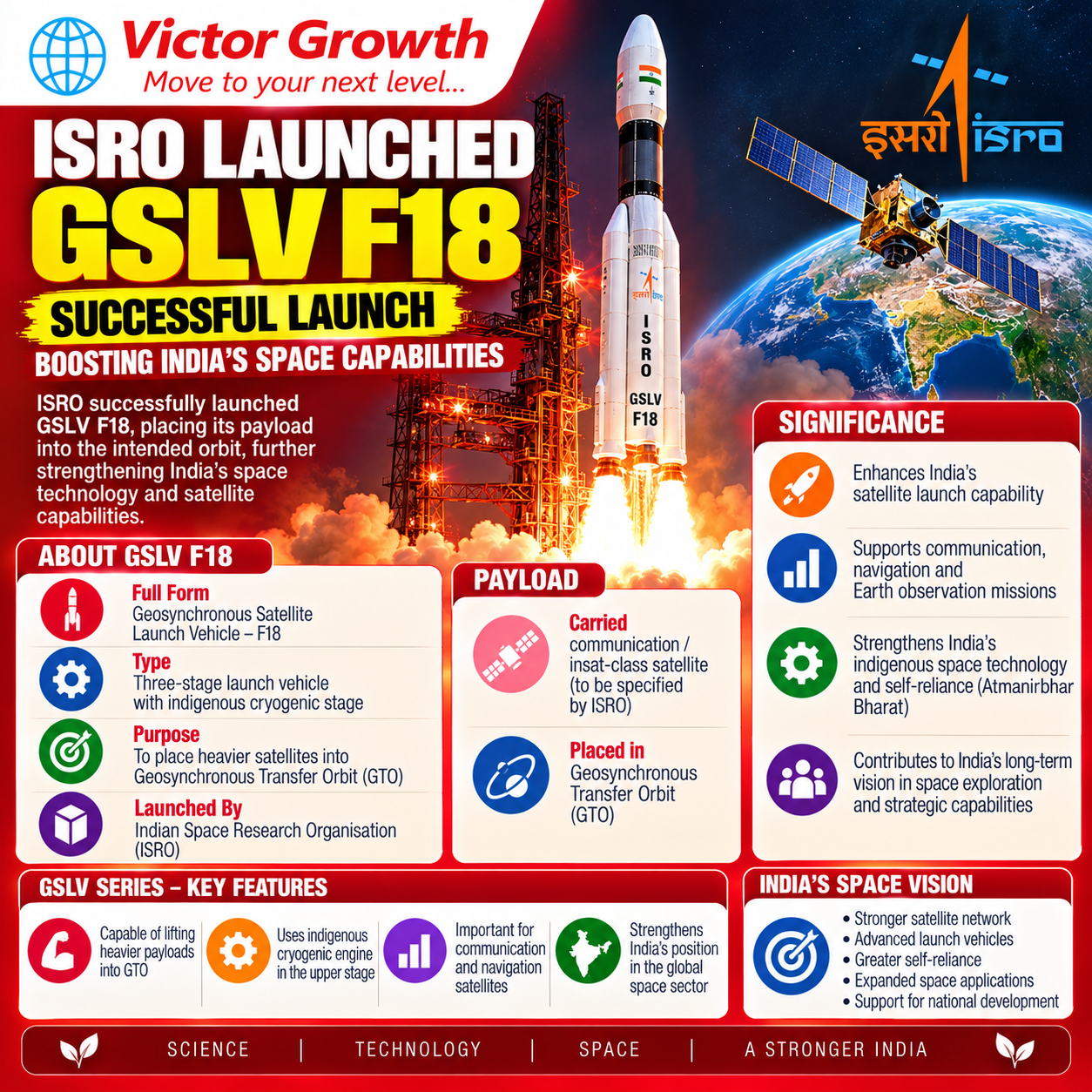
The Indian Space Research Organisation (ISRO) successfully launched GSLV-F18 carrying the NVS-03 satellite on 30 October 2026 from the Satish Dhawan Space Centre, Sriharikota, Andhra Pradesh.
The satellite was injected into Geosynchronous Transfer Orbit (GTO). The mission marks the 20th flight of the Geosynchronous Satellite Launch Vehicle (GSLV) and is an important step towards strengthening India’s indigenous navigation system, NavIC.
Key Details of the GSLV-F18 Mission
Launch vehicle: GSLV-F18
Payload: NVS-03 navigation satellite
Launch date: 30 October 2026
Launch site: Satish Dhawan Space Centre, Sriharikota
Target orbit: Geosynchronous Transfer Orbit (GTO)
Satellite weight: Approximately 2,232 kg
Mission objective: Strengthening India’s NavIC navigation constellation.
What Is NVS-03?
NVS-03 is the third satellite in India’s second-generation Navigation with Indian Constellation (NavIC) series.
Its major features include:
Indigenous atomic clock: Carries an Indian-developed atomic clock, which supports precise timekeeping essential for satellite navigation.
Additional L1 signal: Introduces the L1 frequency alongside the existing L5 and S-band signals, improving compatibility with navigation receivers.
Improved navigation services: Designed to strengthen the continuity and reliability of India’s regional navigation services.
Regional coverage: NavIC is designed to provide coverage over India and approximately 1,500 km beyond its geographical boundary.
What Is NavIC?
NavIC (Navigation with Indian Constellation) is India’s independent regional satellite navigation system, developed by ISRO. It was formerly known as the Indian Regional Navigation Satellite System (IRNSS).
Its main applications include:
Civilian navigation and location-based services.
Maritime and aviation navigation.
Disaster management and emergency response.
Vehicle tracking and fleet management.
Precision timing and strategic applications.
NavIC reduces India’s dependence on foreign navigation systems for critical services.
GSLV: Important Features
The Geosynchronous Satellite Launch Vehicle (GSLV) is a three-stage launch vehicle developed by ISRO.
First stage: Solid propellant core with liquid strap-on boosters.
Second stage: Liquid propellant.
Third stage: Cryogenic upper stage.
The cryogenic stage uses liquid hydrogen and liquid oxygen as propellants. It enables the vehicle to carry heavier payloads into higher-energy orbits.
GSLV is particularly important for launching communication and navigation satellites into geosynchronous transfer orbits.
Why Is the Mission Important for India?
Strategic autonomy: Strengthens India’s independent navigation capabilities.
National security: Supports strategic applications that require reliable positioning and timing.
Economic benefits: Helps transportation, logistics, fisheries, agriculture and location-based services.
Technological advancement: Demonstrates progress in cryogenic propulsion, satellite navigation and atomic clock technology.
Atmanirbhar Bharat: Reduces dependence on foreign navigation infrastructure.
NavIC vs Other Major Navigation Systems
| Navigation system | Country/Region |
|---|---|
| GPS | United States |
| GLONASS | Russia |
| Galileo | European Union |
| BeiDou | China |
| NavIC | India |
| QZSS | Japan |
UPSC Examination Relevance
Prelims: GSLV, cryogenic engine, NVS-03, NavIC, GTO, atomic clocks and satellite navigation systems.
Mains – GS Paper III: Space technology, indigenous technology, strategic autonomy and applications of science and technology in national development.
Possible UPSC Mains Question:
“Examine the significance of India’s NavIC system in strengthening strategic autonomy, technological self-reliance and national security.”
Conclusion
The successful GSLV-F18/NVS-03 mission represents an important milestone in India’s space programme. By strengthening NavIC and developing indigenous capabilities in navigation technology, India is moving towards greater strategic and technological independence.