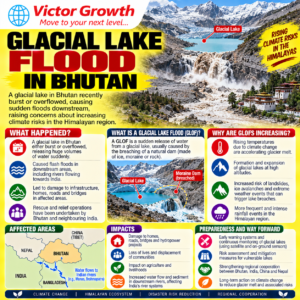
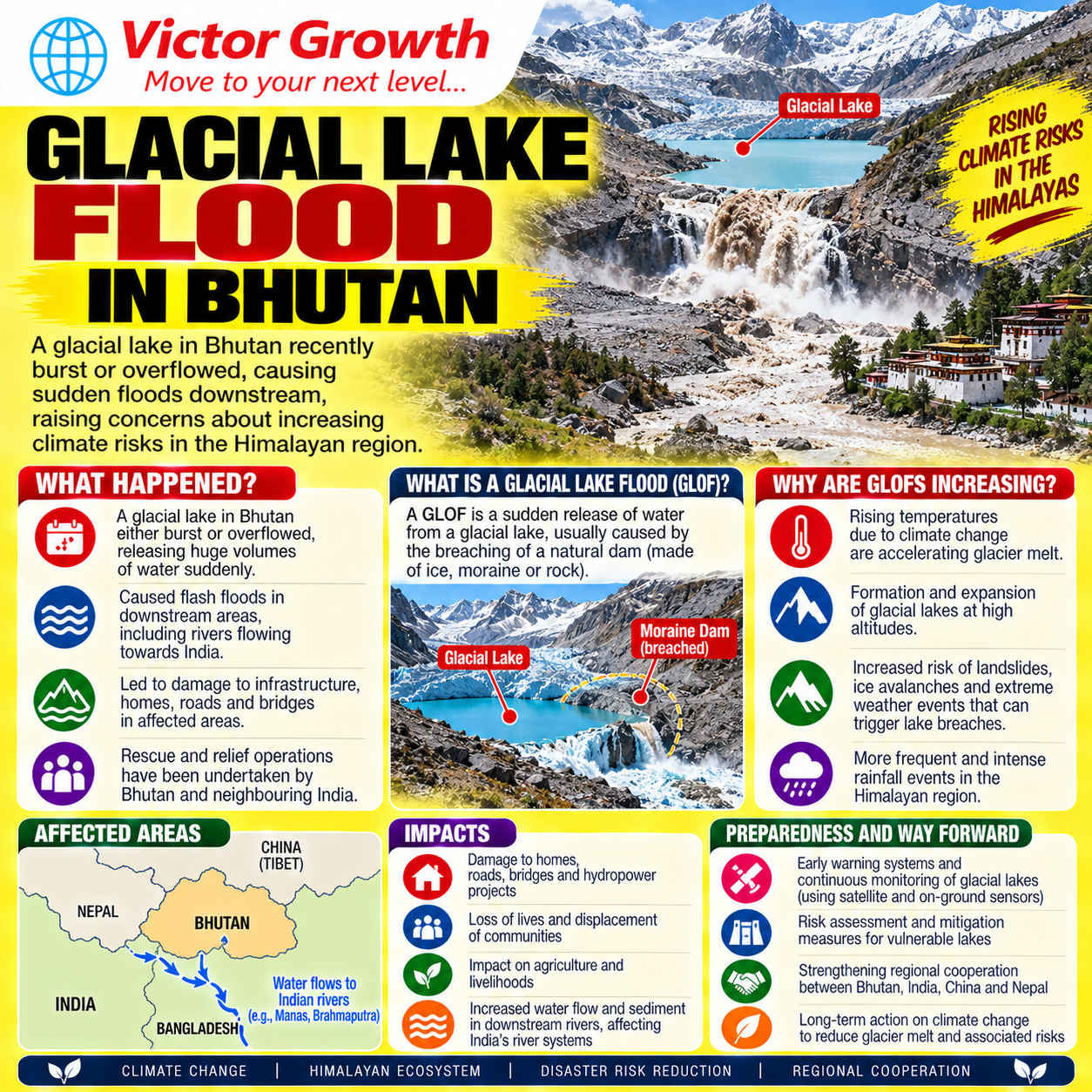
A major Glacial Lake Outburst Flood (GLOF) occurred at Sintaphu Lake (also called Shintaphu Lake) in Bhutan’s Gasa district on 29 October 2026.
The sudden release of water travelled through the Mo Chhu river system towards the Sankosh river, triggering flood alerts in parts of West Bengal and Assam. Thousands of people were moved to safer locations as a precaution. The incident has highlighted the growing threat of glacial hazards in the Hindu Kush Himalaya region. <Cite refs={[“turn178883news7″,”turn178883search0”]}/>
What Is a Glacial Lake Outburst Flood (GLOF)?
A GLOF is the sudden release of a large volume of water from a glacial lake. Such lakes commonly form when glaciers retreat and meltwater accumulates behind natural barriers.
These barriers may consist of:
Moraine dams: Accumulations of rocks, soil and debris left behind by glaciers.
Ice dams: Barriers formed by glacial ice.
When these barriers fail, enormous quantities of water, mud, rocks and debris can rush downstream, causing devastating floods.
Causes of GLOFs
Climate change: Rising temperatures accelerate glacier melting and increase the formation and expansion of glacial lakes.
Moraine instability: Natural dams made of loose sediments may collapse under pressure.
Avalanches: Ice, snow or rock avalanches entering a lake can generate waves that overtop its natural barrier.
Heavy rainfall: Intense rainfall can increase lake water levels and destabilise surrounding slopes.
Earthquakes: Seismic activity may trigger landslides or damage natural lake barriers.
Bhutan GLOF 2026: Major Developments
The outburst occurred at Sintaphu Lake in Bhutan’s Gasa district.
Around 7.4 million cubic metres of water were reported to have been released.
Floodwaters damaged roads, bridges and infrastructure in Bhutan.
The Gasa Tshachu natural hot spring complex was reportedly washed away.
India’s Central Water Commission issued a flood advisory for vulnerable areas of West Bengal and Assam.
Around 12,000 people were evacuated from vulnerable areas in West Bengal as a precaution.
A temporary artificial lake formed downstream, creating concerns about possible secondary flood hazards. <Cite refs={[“turn178883news7″,”turn178883search1″,”turn178883search3”]}/>
Why Is the Himalayan Region Vulnerable?
The Hindu Kush Himalaya (HKH) is often called the Third Pole because it contains extensive glaciers outside the polar regions.
The region is vulnerable because of:
Rapid glacier retreat and changing precipitation patterns.
Increasing numbers and sizes of glacial lakes.
Steep mountain slopes and unstable geological conditions.
Settlements, roads and hydropower projects located in river valleys.
Limited access to remote mountain communities during emergencies.
Implications for India
1. Transboundary disaster risk: Floods originating in Bhutan can affect downstream Indian states through shared river systems.
2. Infrastructure damage: Roads, bridges, hydropower facilities and settlements located near rivers are vulnerable.
3. Agriculture and livelihoods: Flooding can damage crops, livestock, fisheries and local economic activities.
4. Hydropower security: Bhutan and India depend significantly on hydropower cooperation. GLOFs can threaten dams and power infrastructure.
5. Disaster management challenges: Effective forecasting and communication require cooperation between countries sharing Himalayan river basins.
Measures to Reduce GLOF Risks
Early-warning systems: Install lake-level sensors, river gauges, automated weather stations and warning sirens.
Hazard mapping: Identify potentially dangerous glacial lakes through satellite imagery and field surveys.
Controlled lake drainage: Reduce water levels in high-risk lakes through scientifically designed engineering interventions.
Regional cooperation: Strengthen real-time hydrological data sharing between Bhutan, India and other Himalayan countries.
Climate adaptation: Protect vulnerable communities through resilient infrastructure, evacuation plans and community awareness.
UPSC Examination Relevance
Prelims: GLOF, moraine dams, glaciers, Hindu Kush Himalaya, Third Pole, Sankosh River and Mo Chhu River.
Mains – GS Paper I: Himalayan geomorphology, glaciers, climate change and natural hazards.
Mains – GS Paper II: India–Bhutan relations and transboundary river cooperation.
Mains – GS Paper III: Disaster management, climate adaptation, hydropower security and early-warning systems.
Possible UPSC Mains Question:
“Glacial Lake Outburst Floods are emerging as a major climate-induced disaster in the Himalayan region. Discuss their causes, impacts and the need for transboundary disaster management cooperation, with reference to the recent Bhutan event.”
Conclusion
The Bhutan GLOF demonstrates that Himalayan disasters do not respect political boundaries. India and Bhutan must strengthen scientific monitoring, early-warning systems and cross-border coordination to protect vulnerable communities and critical infrastructure. Climate-resilient development is essential for long-term Himalayan security.