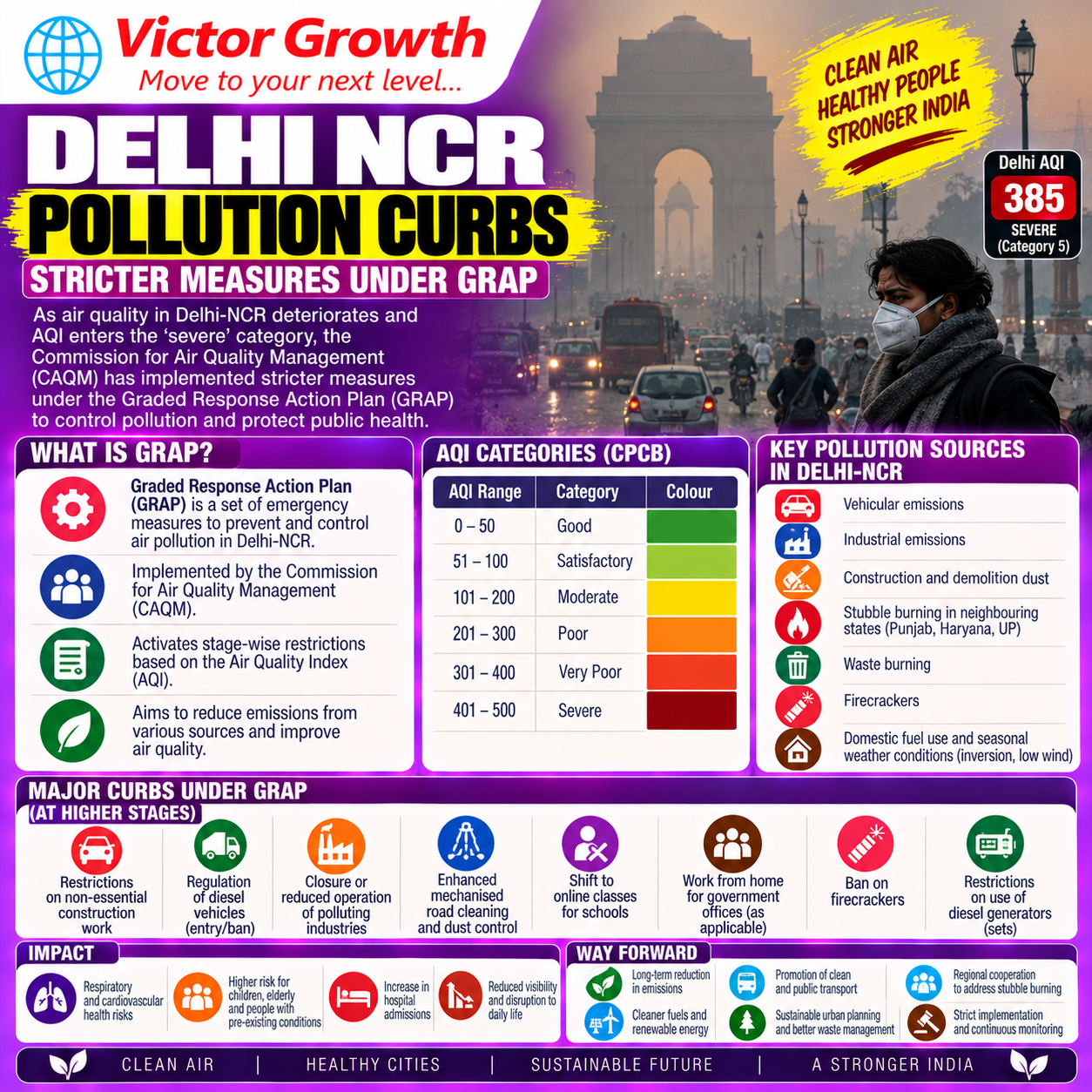
Delhi-NCR has witnessed a deterioration in air quality with the Air Quality Index (AQI) reaching 244 (Poor category) on 21 October 2026. In response, the Commission for Air Quality Management (CAQM) invoked Stage I of the Graded Response Action Plan (GRAP) across the National Capital Region.
The revised GRAP framework and additional winter pollution-control measures aim to reduce vehicular emissions, construction dust and other major sources of air pollution. <Cite refs={[“turn702064search0″,”turn702064search2”]}/>
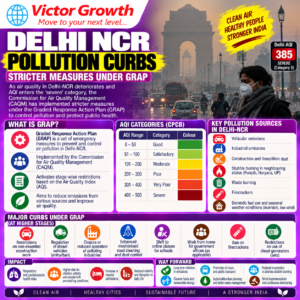
What Is GRAP?
The Graded Response Action Plan (GRAP) is an emergency framework designed to prevent further deterioration of air quality in Delhi-NCR.
It was introduced following directions of the Supreme Court and is implemented by the CAQM in coordination with state governments and other agencies.
GRAP contains four stages, activated according to the severity of Delhi’s AQI.
Four Stages of GRAP
| Stage | AQI category | Major measures |
|---|---|---|
| Stage I | Poor (201–300) | Dust control, road cleaning, restrictions on waste burning and certain polluting activities |
| Stage II | Very Poor (301–400) | Enhanced public transport, parking charges, restrictions on diesel generator use |
| Stage III | Severe (401–450) | Restrictions on construction activities and certain older vehicles; hybrid classes for eligible schools |
| Stage IV | Severe+ (Above 450) | Stricter vehicle and truck-entry restrictions and additional emergency measures |
Note: Measures are cumulative and subject to the applicable CAQM schedule and subsequent directions.
Major Pollution Curbs in Delhi-NCR (2026)
1. Stage I GRAP restrictions
Following the October 2026 order, authorities have been directed to:
Control dust from construction and demolition activities.
Ensure proper covering and transportation of construction materials.
Intensify mechanised road sweeping and water sprinkling.
Prevent open burning of municipal and other waste.
Restrict diesel generator use as prescribed.
Prohibit coal and firewood as fuel in commercial tandoors at hotels, restaurants and open eateries.
2. Additional measures from November 1
Delhi’s winter pollution-control plan also includes:
No PUCC, No Fuel: Vehicles without a valid Pollution Under Control Certificate will not be supplied fuel.
Restrictions on older vehicles: Certain non-BS-VI vehicles registered outside Delhi will be restricted from entering the capital during the notified period.
Higher parking charges: Parking charges at authorised facilities are scheduled to increase to discourage private vehicle use.
These are separate government measures and should not be confused with the immediate Stage I GRAP order. <Cite refs={[“turn702064news4″,”turn702064news12”]}/>
Major Causes of Air Pollution in Delhi-NCR
Vehicular emissions: Cars, trucks and other vehicles release particulate matter and nitrogen oxides.
Construction dust: Construction, demolition and road dust contribute significantly to particulate pollution.
Stubble burning: Seasonal agricultural residue burning in neighbouring states can worsen pollution episodes.
Industrial emissions: Industries and thermal power plants release pollutants.
Waste burning: Open burning of municipal waste and biomass adds toxic pollutants.
Meteorological conditions: Low wind speed, temperature inversion and a shallow atmospheric boundary layer trap pollutants close to the ground.
What Is AQI?
The Air Quality Index (AQI) communicates the quality of air through a numerical scale based on concentrations of major pollutants.
India’s AQI considers eight pollutants:
PM10
PM2.5
Nitrogen dioxide (NO₂)
Sulphur dioxide (SO₂)
Carbon monoxide (CO)
Ozone (O₃)
Ammonia (NH₃)
Lead (Pb)
| AQI | Category |
|---|---|
| 0–50 | Good |
| 51–100 | Satisfactory |
| 101–200 | Moderate |
| 201–300 | Poor |
| 301–400 | Very Poor |
| 401–500 | Severe |
Institutions Responsible for Air Pollution Control
CAQM: Coordinates air-quality management across Delhi-NCR and adjoining areas.
CPCB: Monitors air quality and provides technical and regulatory support.
State Pollution Control Boards: Enforce pollution-control regulations within their jurisdictions.
IMD and IITM: Provide meteorological and air-quality forecasts.
Environment Ministry: Frames national environmental policies and regulations.
Way Forward
Promote electric vehicles and strengthen public transport.
Reduce dependence on fossil fuels and improve industrial emission controls.
Adopt sustainable agricultural practices to prevent stubble burning.
Strengthen dust management at construction sites and roads.
Improve waste segregation, collection and scientific disposal.
Expand urban green spaces and protect natural ecosystems.
Develop coordinated, year-round pollution-control strategies instead of relying only on emergency restrictions.
UPSC Examination Relevance
Prelims: GRAP, CAQM, AQI, CPCB, PM2.5, PM10, temperature inversion and National Clean Air Programme (NCAP).
Mains – GS Paper III: Environmental pollution, urbanisation, climate and environmental governance, disaster management and sustainable development.
Possible UPSC Mains Question:
“Delhi-NCR’s air pollution is a year-round problem that becomes more severe during winter. Examine its major causes and evaluate the effectiveness of GRAP in controlling air pollution.”
Conclusion
Delhi-NCR’s pollution crisis requires more than temporary restrictions during winter. GRAP provides an emergency response mechanism, but long-term improvement depends on coordinated action across transport, agriculture, industry, construction and waste management. Clean air must be treated as an essential component of public health and sustainable urban development.