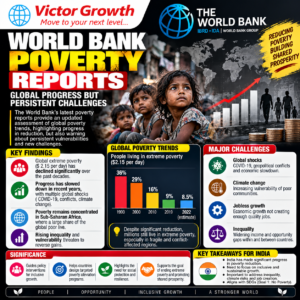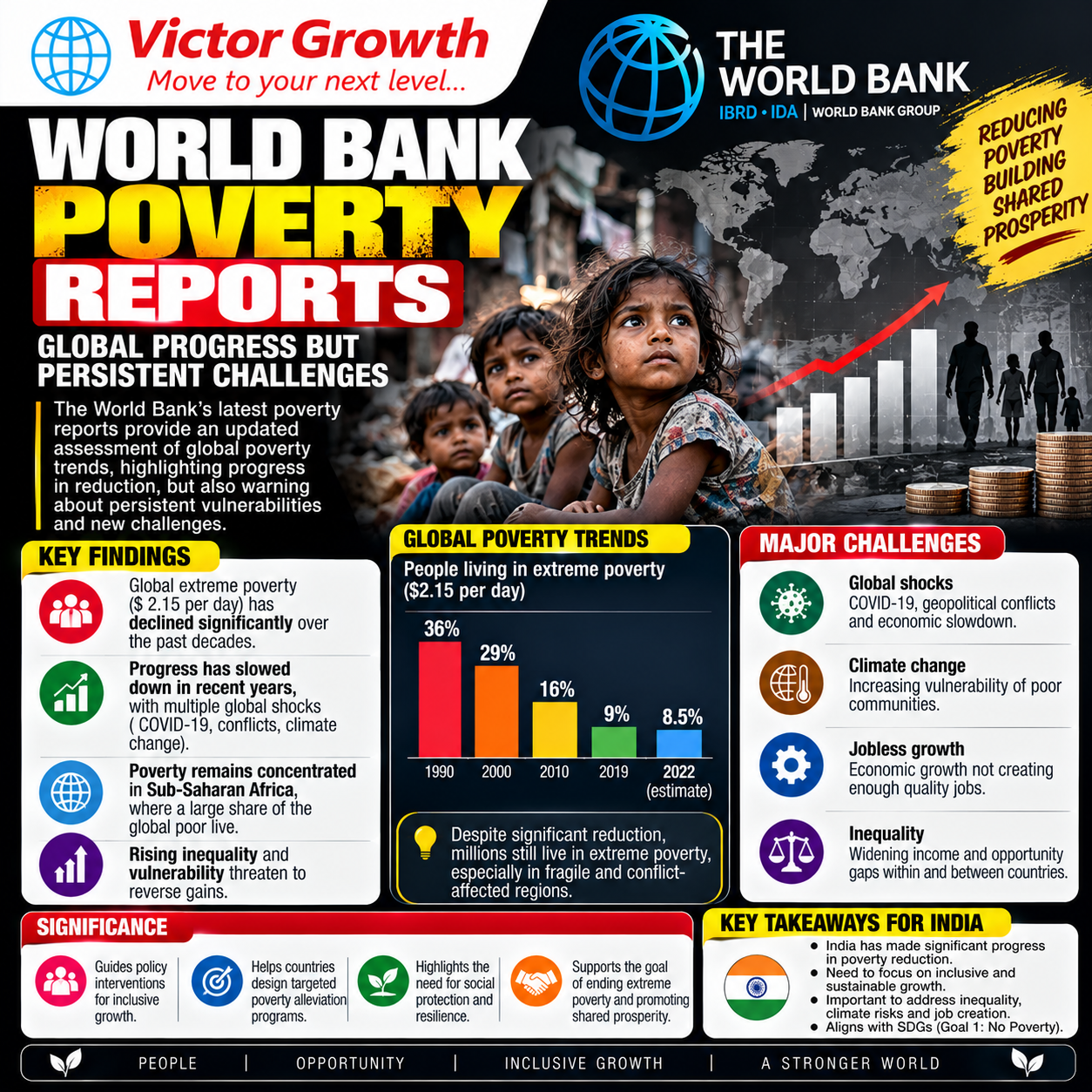
The World Bank released its September 2026 global poverty update, highlighting the continuing challenge of extreme poverty despite decades of economic progress. The report provides updated estimates through 2024 and projections for 2025 and 2026.
It highlights the uneven pace of poverty reduction across regions and the growing importance of addressing inequality, conflict and economic vulnerability.
Key Findings of the World Bank Report
Global extreme poverty: Around 824 million people, or 10.1% of the global population, lived in extreme poverty in 2024.
2026 projection: The global extreme poverty rate is projected to decline marginally to 9.8%.
Regional disparity: Sub-Saharan Africa continues to account for a major share of the world’s extreme poor.
Conflict-affected regions: Poverty remains high in areas affected by conflict, displacement and economic instability.
Slow progress: Global poverty reduction has slowed considerably compared with earlier decades.
What Is the International Poverty Line?
The World Bank revised its international poverty lines in June 2025 following the adoption of new Purchasing Power Parity (PPP) benchmarks.
| Poverty category | Poverty line per person per day |
|---|---|
| Extreme poverty | US$3.00 |
| Lower-middle-income countries | US$4.20 |
| Upper-middle-income countries | US$8.30 |
These values are expressed in 2021 PPP international dollars, not direct currency conversion at market exchange rates.
The international poverty line is used to compare extreme poverty across countries. National poverty lines remain more appropriate for measuring poverty within individual countries.
India’s Position in the World Bank Poverty Estimates
The World Bank’s updated estimates indicate a substantial decline in India’s extreme poverty.
The extreme poverty rate, using the revised US$3.00 threshold, is estimated to have declined from 16.2% in 2011–12 to 2.3% in 2022–23.
Improved household consumption data and updated survey methodology contributed to the revised estimates.
The decline reflects improvements in consumption, access to basic services and social protection.
However, poverty remains a multidimensional challenge. Income insecurity, malnutrition, unemployment, inequality and regional disparities continue to require attention.
Why Does Poverty Persist?
Unemployment and informal work: Low wages and insecure employment increase household vulnerability.
Educational inequality: Poor access to quality education limits economic opportunities.
Healthcare costs: Out-of-pocket medical expenditure can push vulnerable families into poverty.
Regional inequality: Rural, tribal and conflict-affected regions often experience higher deprivation.
Climate change: Droughts, floods and extreme weather affect agricultural livelihoods and food security.
Conflict and displacement: Wars and political instability destroy livelihoods and infrastructure.
Government Initiatives to Reduce Poverty in India
MGNREGA: Provides a legal guarantee of wage employment in rural areas.
National Food Security Act: Strengthens access to subsidised food grains.
PMAY: Promotes affordable housing.
Ayushman Bharat: Improves access to healthcare for eligible beneficiaries.
DAY-NRLM: Supports rural livelihoods and women’s self-help groups.
PM-KISAN: Provides income support to eligible farmer families.
Way Forward
India needs to move beyond income-based poverty reduction towards inclusive and sustainable development. Priorities include generating productive employment, improving learning outcomes, strengthening public healthcare, expanding social security and addressing regional inequalities.
Better household surveys and transparent poverty measurement are equally important for effective policymaking.
UPSC Examination Relevance
Prelims: World Bank, international poverty line, PPP, extreme poverty, Poverty and Inequality Platform (PIP) and Sustainable Development Goal 1.
Mains – GS Paper II: Welfare schemes, social justice, vulnerable sections and inclusive governance.
Mains – GS Paper III: Inclusive growth, employment, inequality and poverty reduction.
Possible UPSC Mains Question:
“Despite significant progress in poverty reduction, global poverty remains unevenly distributed. Discuss the major findings of the World Bank’s latest poverty estimates and suggest measures to address poverty in India.”
Conclusion
The World Bank’s latest poverty update highlights both progress and persistent challenges in the global fight against poverty. For India, sustained investment in education, healthcare, employment and social protection is essential to achieve inclusive growth and fulfil the objectives of Sustainable Development Goal 1: No Poverty.