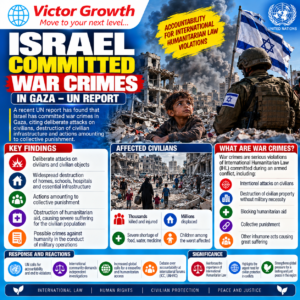
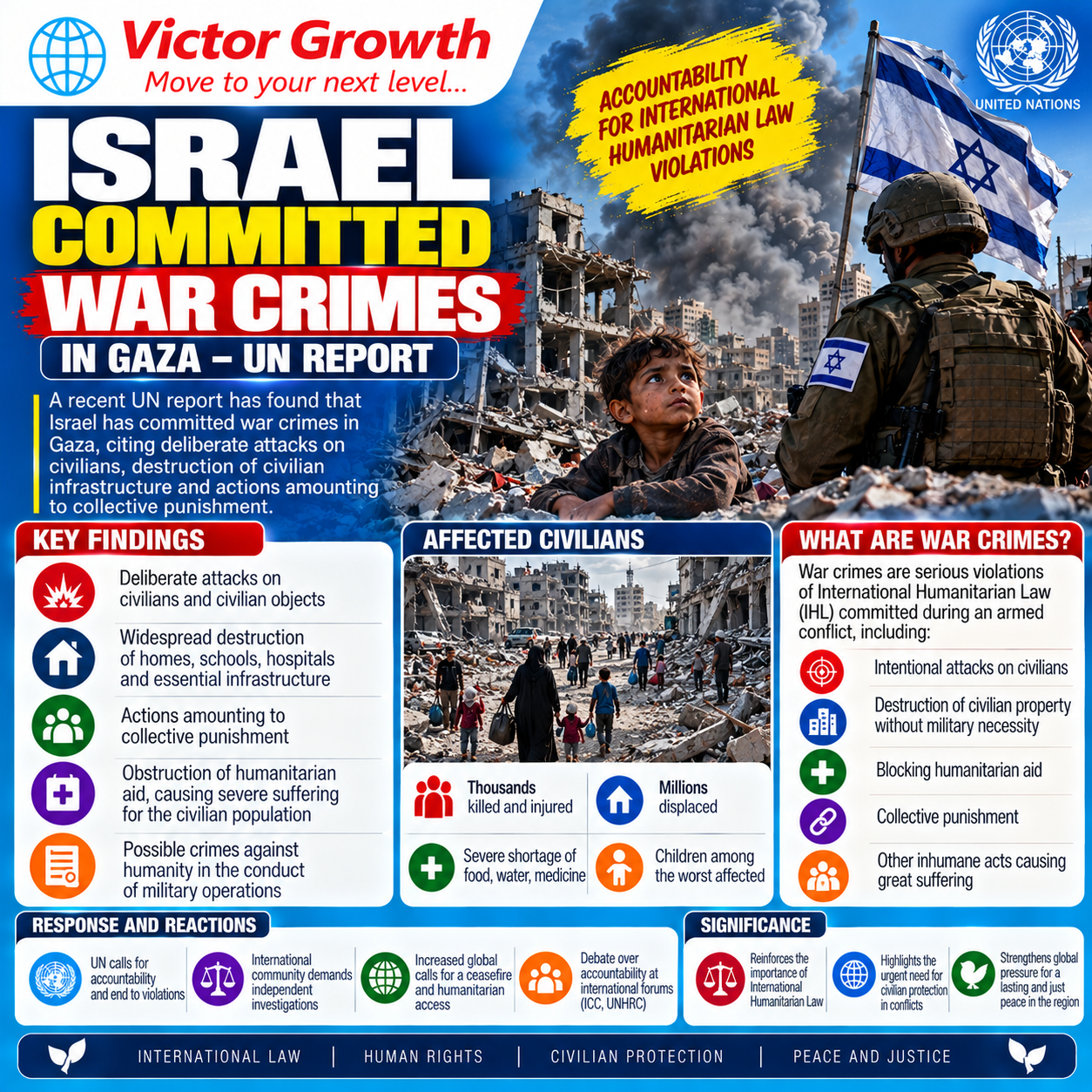
On 26 October 2026, the United Nations Independent International Commission of Inquiry released a report finding that Israeli authorities and forces had committed war crimes and crimes against humanity in the Occupied Palestinian Territory.
The report examined violations in Gaza and the West Bank since October 2023. It also concluded that genocidal acts continued in Gaza despite the ceasefire arrangement. Israel has rejected the findings. <Cite refs={[“turn808151search0″,”turn808151news8”]}/>
Major Findings of the UN Report
The Commission highlighted the following concerns:
Civilian casualties: Continued killings and injuries among Palestinian civilians, including women and children.
Destruction of infrastructure: Attacks affecting residential buildings and essential civilian infrastructure.
West Bank violence: Military operations and settler violence contributing to civilian deaths and displacement.
Torture and sexual violence: The Commission documented cases of torture, rape and other forms of sexual violence.
Forced displacement: Military operations and territorial expansion have displaced large numbers of Palestinians.
Lack of accountability: The report expressed concern over the absence of effective investigations and remedies for victims.
The Commission concluded that certain actions amounted to war crimes and crimes against humanity, including wilful killing, torture, persecution and extermination. <Cite refs={[“turn808151search1″,”turn808151search0”]}/>
What Are War Crimes?
War crimes are serious violations of international humanitarian law committed during armed conflicts.
The Geneva Conventions of 1949 and their Additional Protocols establish important protections for civilians, prisoners of war, wounded persons and other protected groups.
Examples include:
Deliberately targeting civilians.
Torture or inhuman treatment of protected persons.
Taking hostages.
Intentionally attacking civilian hospitals and essential infrastructure without lawful justification.
Indiscriminate attacks that fail to distinguish between civilians and combatants.
War Crimes vs Crimes Against Humanity vs Genocide
| Category | Meaning |
|---|---|
| War crimes | Serious violations of international humanitarian law during armed conflict |
| Crimes against humanity | Widespread or systematic attacks directed against civilian populations |
| Genocide | Acts committed with the specific intent to destroy, wholly or partly, a protected national, ethnic, racial or religious group |
These are distinct legal categories, although the same conduct may fall under more than one category.
Role of International Institutions
1. International Criminal Court (ICC)
The ICC prosecutes individuals accused of genocide, war crimes, crimes against humanity and the crime of aggression. It is a permanent international criminal court established under the Rome Statute.
2. International Court of Justice (ICJ)
The ICJ settles legal disputes between states and gives advisory opinions. South Africa instituted proceedings against Israel under the Genocide Convention. The case remains under consideration; the ICJ has not issued a final judgment on the merits. <Cite refs={[“turn808151search2”]}/>
3. United Nations Human Rights Council
Its Independent International Commission of Inquiry investigates alleged violations of international human rights law and international humanitarian law and reports its findings.
Why Is This Issue Important for India?
Strategic relations: India maintains important relations with Israel in defence, technology and agriculture, as well as with Arab countries.
Energy security: Instability in West Asia can affect oil supplies and global energy prices.
Indian diaspora: Millions of Indians live and work in the Gulf region.
International law: India supports peaceful resolution of conflicts and respect for international law.
Diplomatic balance: India must maintain its strategic interests while supporting civilian protection and a peaceful resolution of the Palestinian question.
Way Forward
Ensure compliance with international humanitarian law by all parties to the conflict.
Protect civilians and guarantee humanitarian access to affected populations.
Support independent investigations into alleged violations.
Strengthen international accountability mechanisms.
Pursue a negotiated political settlement based on the two-state solution.
UPSC Examination Relevance
Prelims: Geneva Conventions, ICC, ICJ, Rome Statute, UN Human Rights Council, Genocide Convention and international humanitarian law.
Mains – GS Paper II: International institutions, India’s foreign policy, UN reforms and international relations.
Mains – GS Paper III: Internal and external security, humanitarian crises and their geopolitical implications.
Possible UPSC Mains Question:
“Examine the role of international institutions in ensuring accountability for violations of international humanitarian law. Discuss the challenges in enforcing international law in the Israel–Palestine conflict.”
Conclusion
The latest UN findings highlight the importance of civilian protection, accountability and respect for international humanitarian law. The Israel–Palestine conflict also demonstrates the limitations of international institutions when geopolitical divisions obstruct effective enforcement. A sustainable political settlement remains essential for lasting peace in West Asia.