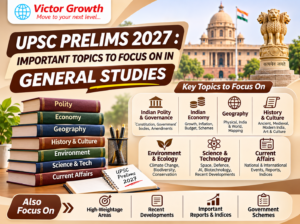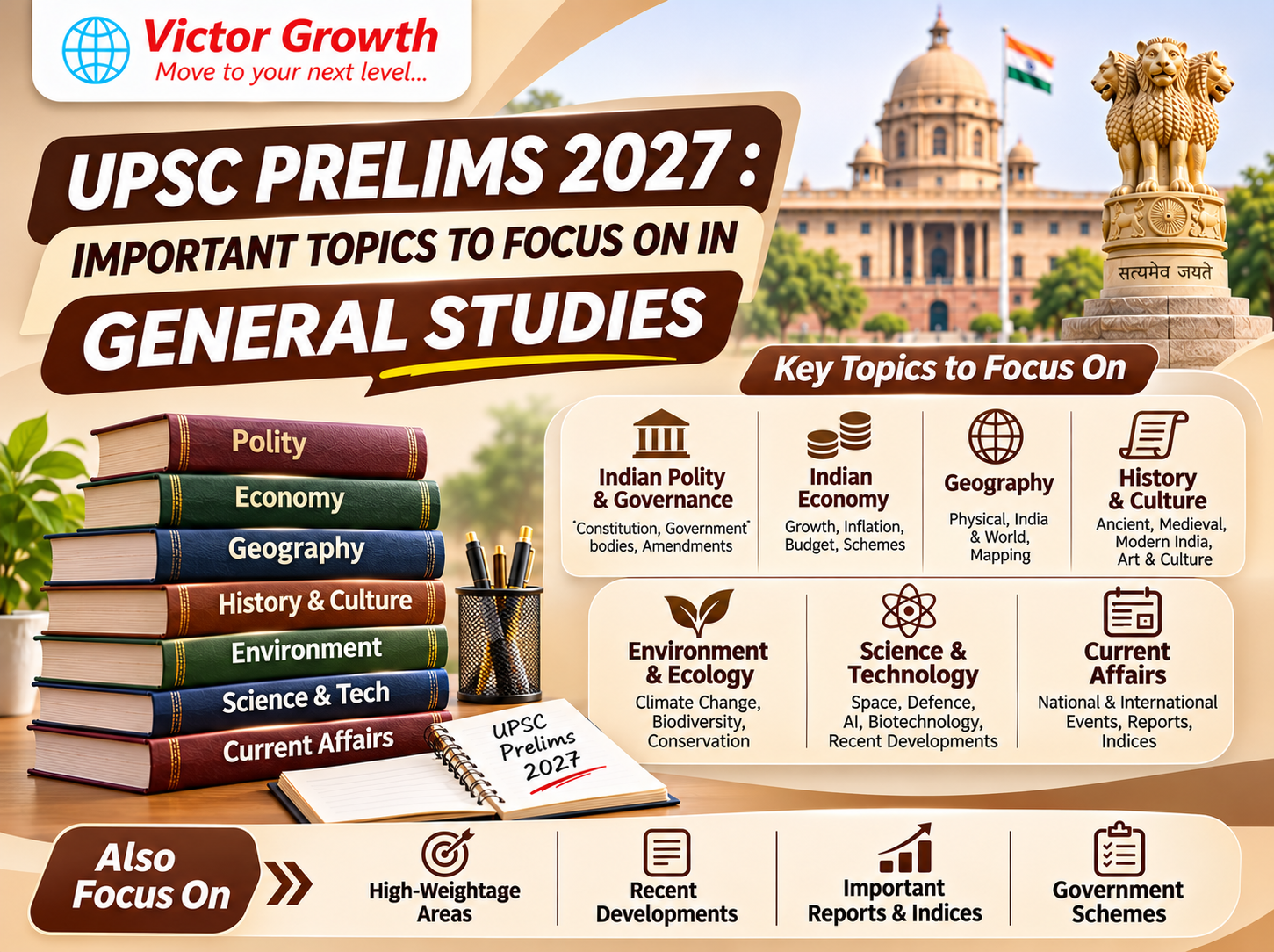
Preparing for UPSC Prelims 2027 requires a clear understanding of the General Studies (GS) syllabus and the ability to identify important topics across different subjects. With a wide syllabus covering History, Geography, Indian Polity, Economy, Environment, Science and Technology, and Current Affairs, aspirants need a focused preparation strategy.
Rather than studying every topic without direction, candidates should prioritise fundamental concepts, frequently tested areas, and current developments connected to the syllabus. This guide highlights the important General Studies topics to focus on for UPSC Prelims 2027.
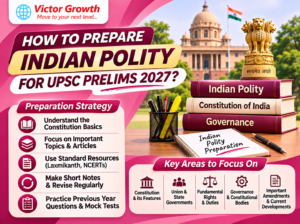
1. Indian Polity and Constitution
Indian Polity is an important area of General Studies Paper I. Candidates should understand constitutional provisions, government institutions, and the functioning of India’s political system.
Important topics:
Preamble and salient features of the Constitution.
Fundamental Rights, Fundamental Duties, and Directive Principles.
President, Vice-President, Prime Minister, and Council of Ministers.
Parliament and State Legislatures.
Supreme Court and High Courts.
Constitutional and statutory bodies.
Emergency provisions.
Panchayati Raj and local governance.
Important constitutional amendments.
Preparation Tip: Focus on constitutional concepts, important articles, landmark judgments, and recent developments related to governance.
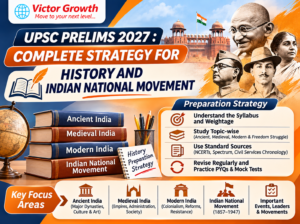
2. Indian History and National Movement
History requires an understanding of important events, personalities, movements, and their contributions to India’s development.
Important topics:
Indus Valley Civilisation and Vedic Period.
Mauryan and Gupta Empires.
Delhi Sultanate and Mughal Empire.
Bhakti and Sufi movements.
Social and religious reform movements.
Revolt of 1857.
Indian National Congress and freedom struggle.
Non-Cooperation, Civil Disobedience, and Quit India movements.
Important freedom fighters and revolutionary organisations.
Preparation Tip: Give particular attention to Modern Indian History and the Indian National Movement. Use timelines to remember important events.
3. Indian and World Geography
Geography covers physical features, natural resources, climate, population, and economic activities.
Important topics:
Earth’s structure, landforms, and plate tectonics.
Atmospheric circulation, monsoons, and climate.
Indian rivers, mountains, and physiographic divisions.
Soil types and natural vegetation.
Agriculture and irrigation.
Minerals and energy resources.
Population distribution and urbanisation.
Important locations, straits, seas, and international boundaries.
Preparation Tip: Practise map-based questions regularly. Pay special attention to Indian geography and locations frequently mentioned in current affairs.
4. Indian Economy
Candidates should understand basic economic concepts and connect them with recent government policies and economic developments.
Important topics:
GDP, national income, and economic growth.
Inflation and unemployment.
Banking system and Reserve Bank of India.
Monetary and fiscal policies.
Union Budget and taxation.
Government expenditure and public debt.
Poverty and inclusive growth.
Agriculture and rural development.
Government welfare schemes.
Sustainable development.
Preparation Tip: Build a strong foundation in economic terminology before studying advanced topics. Follow important announcements related to the Union Budget and RBI.
5. Environment and Ecology
Environmental issues are important for understanding biodiversity, conservation, and global environmental challenges.
Important topics:
Ecosystems and food chains.
Biodiversity and conservation.
National parks, wildlife sanctuaries, and biosphere reserves.
Endangered and endemic species.
Climate change and global warming.
Environmental pollution.
International environmental conventions.
Renewable energy and sustainable development.
Preparation Tip: Connect static environmental concepts with current affairs, especially new conservation initiatives, species-related news, and international agreements.
6. Science and Technology
This section focuses on scientific developments and their practical applications.
Important topics:
Space missions and satellite technology.
Biotechnology and genetic engineering.
Artificial Intelligence and robotics.
Information and communication technology.
Defence technology and missile developments.
Nuclear technology.
Health and medical advancements.
Nanotechnology and emerging technologies.
Preparation Tip: Focus on basic scientific principles and applications. Avoid spending excessive time on highly technical details.
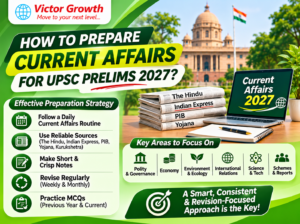
7. Current Affairs and Government Schemes
Current affairs connect different General Studies subjects with recent developments. Aspirants should follow important national and international events throughout their preparation.
Important topics:
Central government schemes and policies.
Constitutional and judicial developments.
International organisations and summits.
India’s foreign relations.
Important reports, indices, and rankings.
Awards and important appointments.
Defence and space developments.
Environmental initiatives and economic announcements.
Preparation Tip: Read one reliable newspaper daily, prepare short notes, and revise monthly current affairs compilations.
8. CSAT Preparation: Do Not Ignore Paper II
Although CSAT is qualifying, candidates must secure at least 33% marks to qualify in the Preliminary Examination.
Focus on:
Reading comprehension.
Logical reasoning.
Analytical ability.
Basic numeracy.
Data interpretation.
Problem-solving and decision-making.
Practise previous-year questions regularly, especially if mathematics or reasoning is challenging.
9. How to Prioritise General Studies Preparation
A subject-wise timetable helps aspirants cover important topics without losing focus.
| Subject | Preparation priority |
|---|---|
| Indian Polity | Constitution and governance |
| History | Modern India and freedom struggle |
| Geography | Indian geography and physical geography |
| Economy | Banking, inflation, Budget and basic concepts |
| Environment | Ecology, biodiversity and climate change |
| Science and Technology | Space, biotechnology and recent developments |
| Current Affairs | Government schemes and national developments |
Remember that these are useful focus areas, not guaranteed predictions of questions. Do not skip other syllabus topics based on expected weightage.
10. Choosing the Best UPSC Coaching in Kerala
The right academic guidance can help aspirants organise their General Studies preparation and understand difficult concepts.
When searching for the best UPSC coaching in Kerala, consider:
Experienced faculty with strong subject knowledge.
Complete syllabus coverage through structured classes.
Updated study materials and current affairs support.
Regular MCQ practice and mock examinations.
Performance analysis and doubt-clearing sessions.
Systematic revision and individual academic guidance.
Choose a coaching programme that encourages conceptual understanding, independent study, and consistent practice.
Frequently Asked Questions (FAQs)
1. Which subjects are most important for UPSC Prelims 2027 General Studies?
Indian Polity, History, Geography, Economy, Environment, Science and Technology, and Current Affairs are all important areas of General Studies Paper I.
2. Which topics should beginners focus on first?
Beginners can start with Indian Polity, Modern Indian History, basic Geography, and fundamental Economics. Gradually cover the remaining subjects according to the syllabus.
3. Is current affairs important for UPSC Prelims 2027?
Yes. Current affairs help candidates understand recent developments and connect them with static subjects. Regular newspaper reading and revision are useful.
4. How can I improve my General Studies score?
Study standard resources, revise regularly, solve previous-year questions, practise MCQs, and analyse mistakes through mock tests.
5. Is CSAT difficult for beginners?
The difficulty varies from candidate to candidate. Regular practice in comprehension, reasoning, basic mathematics, and data interpretation can improve performance.
6. How can I find the best UPSC coaching in Kerala?
Compare faculty experience, teaching methods, syllabus coverage, study materials, current affairs guidance, mock tests, and student support before choosing an institute.
Conclusion
UPSC Prelims 2027 General Studies preparation requires a balanced approach across all subjects. Focus on fundamental concepts, important syllabus areas, current developments, and regular question practice. Avoid relying entirely on predicted topics and make sure you revise the complete syllabus systematically. With consistent preparation, suitable study materials, and the right guidance, aspirants can strengthen their performance in the Civil Services Preliminary Examination.