Preparing for UPSC Prelims 2027 requires studying a vast syllabus covering History, Geography, Indian Polity, Economy, Environment, Science and Technology, and Current Affairs. Revising all these subjects repeatedly can be challenging. This is where effective short notes become valuable.
Short notes help aspirants organise important information, revise quickly, remember key concepts, and improve their performance in mock tests. Instead of writing lengthy explanations, candidates should focus on preparing concise, syllabus-oriented notes that are easy to understand and revise.
1. Why Are Short Notes Important for UPSC Prelims 2027?
Making short notes is an important part of an effective UPSC preparation strategy.
Quick Revision: Short notes help cover important topics within a limited time.
Better Retention: Writing key points in your own words improves understanding and memory.
Organised Learning: Notes help arrange information subject-wise and topic-wise.
Easy Current Affairs Revision: Important schemes, reports, and government initiatives can be updated regularly.
Improved Exam Confidence: Well-prepared notes make last-minute revision easier.
Time Management: Instead of reading entire textbooks again, candidates can revise essential concepts quickly.
2. Select Important Topics Before Making Notes
Do not prepare notes for every sentence in a textbook or newspaper. First, understand the UPSC syllabus and identify important topics.
Focus on these major subjects:
History: Important dynasties, freedom movements, historical events, and personalities.
Geography: Climate, rivers, mountains, soils, natural resources, and physical features.
Indian Polity: Constitutional articles, fundamental rights, Parliament, judiciary, and constitutional bodies.
Indian Economy: GDP, inflation, monetary policy, banking, taxation, and government schemes.
Environment: Biodiversity, national parks, wildlife sanctuaries, climate change, and environmental conventions.
Science and Technology: Space missions, biotechnology, artificial intelligence, and defence technology.
Current Affairs: Government schemes, important reports, international organisations, and national developments.
Always connect your notes with the official UPSC syllabus and previous-year questions.
3. Use a Simple Structure for Preparing Short Notes
Your notes should be brief, clear, and easy to revise. Follow a consistent structure for every topic.
For example, while preparing notes on the Reserve Bank of India (RBI), include:
Establishment and headquarters
Main functions
Monetary policy
Repo rate and CRR
Role in controlling inflation
Important recent developments
Similarly, for government schemes, record the ministry, objectives, beneficiaries, important features, and recent updates.
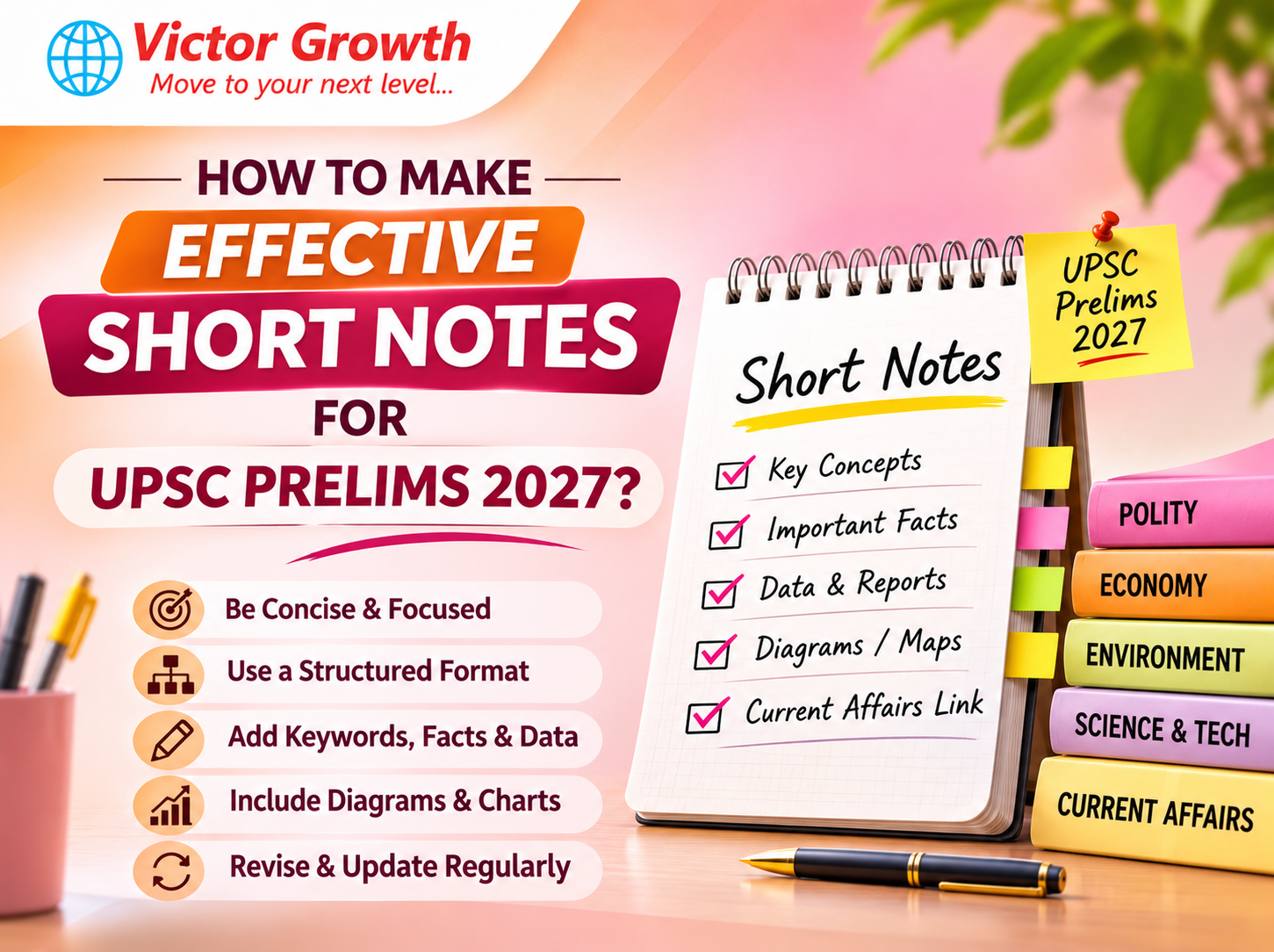
Avoid writing lengthy paragraphs. Use headings, bullet points, tables, and flowcharts wherever appropriate.
4. Prepare Subject-Wise Short Notes
History
Prepare timelines, important events, movements, personalities, and their contributions. Use tables to compare different historical periods and movements.
Geography
Use maps, diagrams, and flowcharts. Mark important rivers, mountain ranges, national parks, and geographical locations.
Indian Polity
Create separate notes for constitutional articles, amendments, schedules, constitutional bodies, and important provisions. Comparison tables can make similar concepts easier to remember.
Indian Economy
Prepare short definitions and comparisons of economic concepts such as GDP, inflation, fiscal deficit, monetary policy, and Balance of Payments.
Environment
Make separate lists of national parks, wildlife sanctuaries, endangered species, environmental conventions, and conservation programmes.
Science and Technology
Record the meaning, applications, and significance of important technologies. Avoid unnecessary technical explanations.
5. How to Make Effective Current Affairs Notes
Current affairs are an important part of UPSC Prelims preparation. However, collecting too much information can make revision difficult.
Follow these methods:
Read one or two reliable newspapers regularly.
Identify news items related to the UPSC syllabus.
Record only important facts and concepts.
Connect current developments with static subjects.
Update notes when new information becomes relevant.
Revise monthly current affairs notes.
For example, while studying a recent space mission, note its objective, launching organisation, technology involved, and importance for India.
6. Choose Between Digital Notes and Handwritten Notes
Both methods are useful. Select the one that helps you revise comfortably.
Handwritten notes | Digital notes |
|---|---|
Helps with active learning | Easy to edit and update |
Useful for diagrams and flowcharts | Easy to organise by subject |
No device required | Can be accessed across devices |
Suitable for personal revision | Convenient for storing large amounts of information |
You can also use a combination of both. For example, prepare handwritten notes for static subjects and digital notes for regularly changing current affairs.
7. Common Mistakes to Avoid While Making Short Notes
Many aspirants spend more time preparing notes than actually studying and revising. Avoid these mistakes:
Copying entire textbook paragraphs.
Making notes without referring to the UPSC syllabus.
Collecting information from too many sources.
Writing unnecessary details and facts.
Preparing notes without revising them.
Making notes so brief that their meaning becomes unclear.
Rewriting the same notes repeatedly instead of practising questions.
Remember, the purpose of short notes is to simplify revision, not to create another set of lengthy textbooks.
8. Follow a Practical Short Notes Preparation Strategy
Use this simple routine throughout your UPSC preparation:
Activity | Suggested time |
|---|---|
Reading the topic | 45 minutes |
Identifying important points | 15 minutes |
Preparing short notes | 20 minutes |
Revising previous notes | 15 minutes |
Practising MCQs | 15 minutes |
Adjust the timings according to your daily study schedule. Most importantly, revise your notes weekly and use mock tests to identify topics that need improvement.
9. Get Proper Guidance for UPSC Preparation
Preparing effective notes becomes easier when aspirants understand what is important from the examination perspective. Proper guidance can help candidates prioritise topics, connect current affairs with static subjects, and avoid unnecessary study materials.
Students searching for the best NDA coaching in Kerala should compare faculty experience, study materials, test series, and individual academic support. However, NDA and UPSC Civil Services have different syllabuses and preparation requirements. UPSC aspirants should choose a programme specifically designed for Civil Services preparation.
Frequently Asked Questions (FAQs)
1. Are short notes necessary for UPSC Prelims 2027?
Yes. Short notes make revision easier and help aspirants remember important concepts, facts, and current affairs.
2. When should I start making short notes for UPSC?
Start making notes from the beginning of your preparation. Prepare them after understanding each topic rather than copying information during the first reading.
3. Should I make handwritten or digital notes?
Both are useful. Choose the method that suits your learning style and allows you to revise and update information easily.
4. How many pages should UPSC short notes contain?
There is no fixed page limit. Keep notes concise and include only examination-relevant information.
5. Should I make separate notes for current affairs?
Yes. Maintain subject-wise or monthly current affairs notes and connect important developments with static concepts.
6. How often should I revise short notes?
Revise them weekly and increase revision frequency as the examination approaches. Regular MCQ practice will also help identify areas that need further revision.
Conclusion
Effective short notes can make UPSC Prelims 2027 preparation more organised and manageable. Focus on syllabus-based information, use simple language, prepare subject-wise notes, and connect current affairs with static concepts. Avoid unnecessary details and revise regularly. Remember, the quality of your notes matters more than their length. A consistent approach to note-making, revision, and mock test practice can help you prepare with greater confidence.