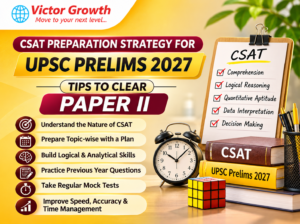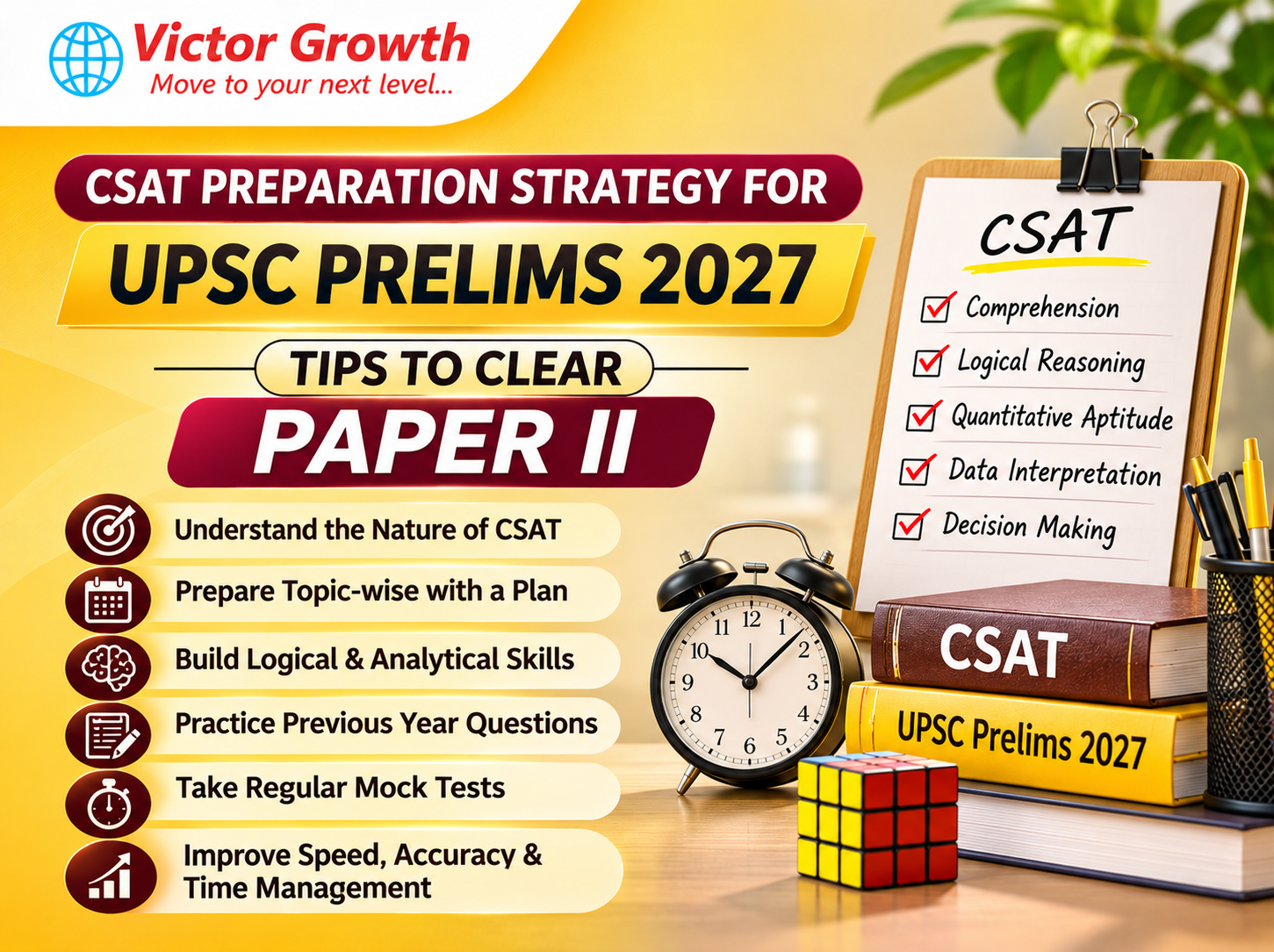
The Civil Services Aptitude Test (CSAT), also known as General Studies Paper II, is an important part of the UPSC Civil Services Preliminary Examination. Although it is a qualifying paper, candidates must clear the minimum required cutoff to qualify for the next stage of the examination.
Many aspirants underestimate CSAT because it is qualifying in nature. However, difficulty with mathematics, logical reasoning, or reading comprehension can make it challenging. A proper preparation strategy, regular practice, and effective time management are essential to clear CSAT Paper II in UPSC Prelims 2027.
1. Understand the UPSC CSAT Exam Pattern 2027
Before starting preparation, candidates should understand the examination pattern.
Particulars | Details |
|---|---|
Paper | General Studies Paper II (CSAT) |
Total questions | 80 |
Maximum marks | 200 |
Duration | 2 hours |
Qualifying marks | 33% (66 marks) |
Question type | Objective multiple-choice questions |
Negative marking | One-third of the marks assigned to a question for each incorrect answer |
CSAT is qualifying in nature. Candidates must score at least 33% to qualify, but they should aim for a comfortable margin rather than preparing only to reach the minimum marks.
2. Understand the Important Topics in the CSAT Syllabus
The UPSC CSAT syllabus covers aptitude, reasoning, comprehension, and basic numerical ability.
Reading Comprehension
Understanding passages
Identifying the main idea
Drawing logical conclusions
Understanding the author’s viewpoint
Answering inference-based questions
Logical Reasoning and Analytical Ability
Logical arrangements
Statements and conclusions
Coding and decoding
Blood relations
Direction sense
Syllogisms
Analytical reasoning
Basic Numeracy
Number systems
Percentage
Ratio and proportion
Profit and loss
Average
Simple and compound interest
Time and work
Time, speed and distance
Data Interpretation
Tables
Bar graphs
Pie charts
Line graphs
Data comparison and analysis
3. Develop a Strong Foundation in Mathematics
Mathematics is one of the challenging areas for many CSAT aspirants, particularly those who have not studied it regularly.
Start with basic concepts and gradually move towards application-based questions.
Follow these preparation tips:
Revise multiplication tables, squares, cubes, and basic calculations.
Understand percentages, ratios, averages, and fractions.
Practise basic arithmetic questions daily.
Learn simple calculation techniques.
Solve previous-year questions topic-wise.
Focus on accuracy before increasing speed.
Do not try to learn complicated shortcuts without understanding the basic concepts.
4. Improve Reading Comprehension Skills
Reading comprehension can be an important scoring area in CSAT. Regular practice helps improve reading speed and understanding.
To improve comprehension:
Read English newspaper editorials regularly.
Practise passages from previous-year CSAT papers.
Identify the central idea of each passage.
Understand the difference between facts and assumptions.
Avoid selecting answers based on personal opinions.
Practise answering questions within a time limit.
Read the passage carefully and choose answers based on the information provided rather than outside knowledge.
5. Practise Logical Reasoning and Analytical Ability
Logical reasoning tests your ability to understand information and solve problems systematically.
Important areas include:
Blood relations
Coding and decoding
Direction sense
Seating arrangements
Series and patterns
Statements and conclusions
Logical puzzles
Practise a few questions daily. Initially, focus on understanding the method of solving each question. Gradually improve your speed through regular timed practice.
6. Refer to the Right Study Materials
Choosing limited and useful study materials helps avoid confusion.
Resource | Purpose |
|---|---|
NCERT Mathematics (Classes 6–10) | Build basic mathematical concepts |
Previous-year CSAT papers | Understand question patterns |
CSAT practice books | Topic-wise aptitude and reasoning practice |
Mock test series | Improve speed and accuracy |
Newspaper editorials | Improve reading comprehension |
Previous-year question papers should be a priority. They help aspirants understand the level and style of questions asked in the actual examination.
7. Follow a Daily CSAT Preparation Timetable
Consistent practice is more effective than studying CSAT only a few weeks before the examination.
A simple daily timetable:
Time | Activity |
|---|---|
30 minutes | Basic mathematics |
20 minutes | Logical reasoning |
20 minutes | Reading comprehension |
20 minutes | Previous-year questions |
10 minutes | Review mistakes |
Adjust the schedule according to your preparation level. Candidates who are weak in mathematics should dedicate additional time to numerical ability.
8. Importance of Mock Tests and Previous-Year Questions
Mock tests are essential for understanding your preparation level.
Solve previous-year CSAT papers regularly.
Attempt topic-wise tests after completing each chapter.
Practise full-length mock tests under the actual two-hour time limit.
Analyse incorrect answers and identify weak areas.
Avoid spending too much time on a single difficult question.
Develop a strategy to attempt questions accurately.
Remember that negative marking can reduce your score. Avoid random guessing and make informed attempts.
9. Common Mistakes to Avoid in CSAT Preparation
Many aspirants fail to clear CSAT because they underestimate the paper.
Avoid these mistakes:
Treating CSAT as an easy qualifying paper.
Starting preparation only at the last moment.
Ignoring mathematics and reasoning.
Practising questions without analysing mistakes.
Focusing only on shortcuts instead of basic concepts.
Not attempting full-length mock tests.
Ignoring time management.
Start preparation early and regularly evaluate your performance.
10. Choose the Right Coaching and Guidance
Proper guidance can help aspirants understand difficult CSAT concepts and improve their problem-solving skills. Regular practice sessions, individual attention, and mock test analysis can make preparation more effective.
Students searching for the best NDA coaching in Kerala should compare faculty experience, teaching methods, study materials, and test facilities. However, NDA and UPSC Civil Services are different examinations. UPSC aspirants should choose a coaching programme that specifically covers CSAT and the Civil Services syllabus.
Frequently Asked Questions (FAQs)
1. Is CSAT compulsory for UPSC Prelims 2027?
Yes. CSAT is Paper II of the UPSC Preliminary Examination. Candidates must qualify in this paper to be considered for the Mains examination.
2. What is the qualifying mark for UPSC CSAT?
Candidates must score at least 33% of the total 200 marks, which is 66 marks.
3. Is CSAT difficult for non-mathematics students?
It may initially be challenging, but regular practice of basic mathematics, reasoning, and comprehension can help candidates improve.
4. How much time should I spend on CSAT daily?
Around 1–2 hours daily is a useful starting point. Candidates who struggle with mathematics may need additional practice.
5. Are previous-year questions enough for CSAT preparation?
Previous-year questions are essential, but candidates should also practise topic-wise questions and full-length mock tests.
6. Can I ignore CSAT if I am strong in General Studies?
No. Even if you score very well in General Studies Paper I, you must qualify in CSAT Paper II to clear the UPSC Prelims.
7. How can I improve my CSAT score?
Build strong fundamentals, practise regularly, improve reading comprehension, solve previous-year questions, and analyse mock test performance.
Conclusion
Clearing CSAT Paper II in UPSC Prelims 2027 requires consistent practice, strong fundamentals, and effective time management. Focus on mathematics, logical reasoning, reading comprehension, and data interpretation. Do not underestimate this qualifying paper or postpone its preparation. With a structured study plan, regular mock tests, and proper guidance, aspirants can improve their confidence and clear the CSAT qualifying requirement.